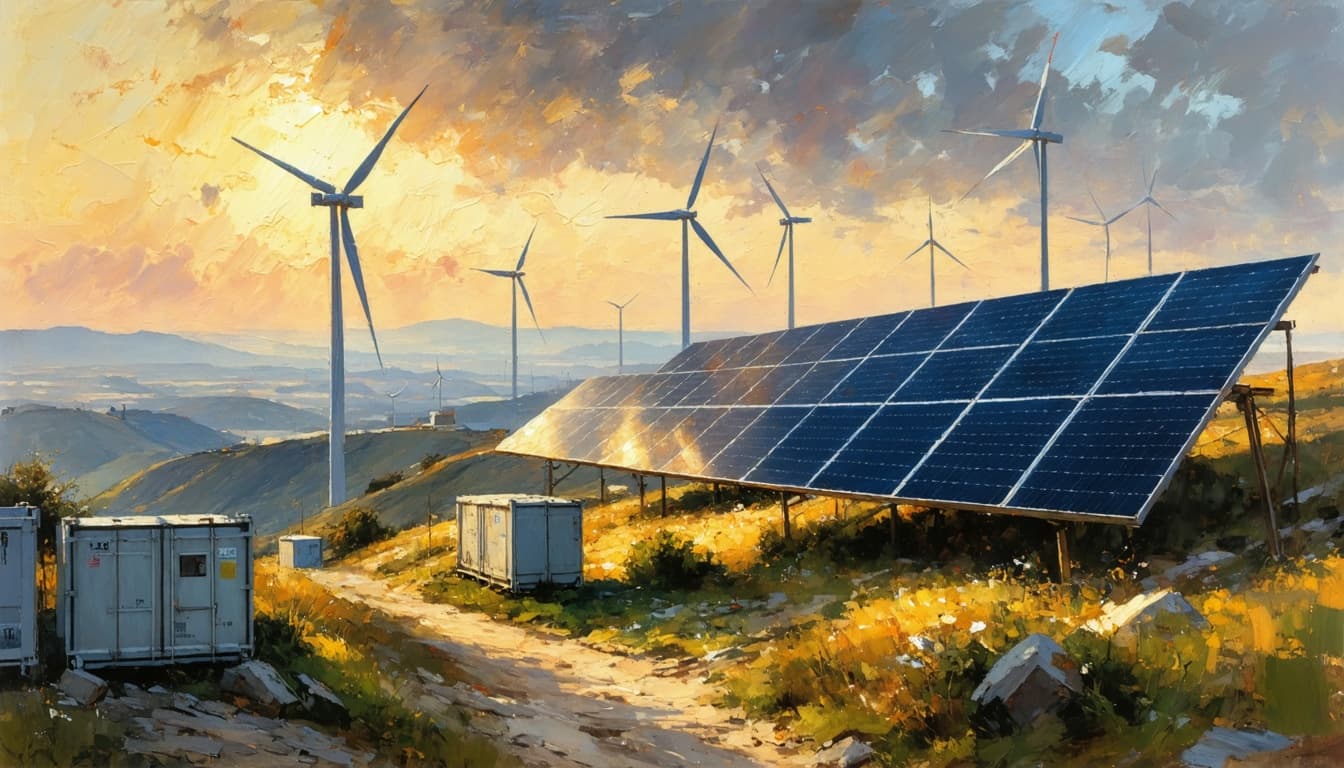
The e-reverse auction for SECI’s 1 GW Firm and Dispatchable Renewable Energy Round-the-Clock (FDRE-RTC) tender began at Rs. 5.16/unit and concluded with a final tariff range of Rs. 5.25-5.26/unit. This narrow price discovery—just 1.7-1.9% above the floor price—signals intense competitive pressure among bidders. The limited movement suggests developers were operating near their cost thresholds, likely constrained by the complex technical requirements of FDRE-RTC projects, including mandatory energy storage system integration and stringent dispatch fulfillment obligations.
The auction attracted 16 participating companies, but only seven developers secured capacity. This high elimination rate reflects strict evaluation criteria beyond just tariff, including technical capability, financial strength, and experience with integrated renewable-plus-storage projects. The competitive elimination of nine bidders indicates SECI prioritized specialized FDRE-RTC expertise over general renewable experience, setting a high bar for project delivery in this evolving segment.
Why Tariffs Rose from the Previous 630 MW Tender
This escalation stems from several factors. The current tender imposes more stringent technical requirements, including higher Dispatch Fulfilment Ratios (DFR)—90% during peak hours and 90% annually, compared to 80% monthly in the earlier tranche. Enhanced storage integration requirements and the complexity of the Round-the-Clock Thermal Mimic (RTC-TM) model also contribute to higher costs.
Storage costs have declined dramatically—from Rs. 10.18/kWh in 2022-23 to around Rs. 2.1/kWh recently—but FDRE-RTC projects require larger, more sophisticated battery systems.
The RTC-TM model’s requirement for 100% renewable dispatchability, combined with advanced energy management systems and grid integration, justifies the premium over earlier tenders.
The FDRE-RTC model fundamentally transforms developer cost structures by requiring sophisticated energy management systems and potentially large-scale Battery Energy Storage Systems. Unlike standard solar or wind tenders, FDRE-RTC mandates higher capital expenditure and complex operational requirements to meet strict dispatchability criteria. For developers like Juniper Green Energy and Hero Solar Energy, storage costs represent a significant portion of the total tariff, with BESS integration adding roughly Rs. 2.8-3.0/kWh to base generation costs.
Developers who secured capacity at the lower Rs. 5.25/unit tariff—Kengeri Prime Solar Power, Resolven Four Energy, and Hero Solar Energy—likely implemented several cost-optimization strategies. These include hybrid wind-solar configurations leveraging complementary generation patterns (solar daytime, wind nighttime) to achieve 30-40% capacity utilization factors versus standalone solar’s 19-22%. Shared infrastructure costs through co-located systems, economies of scale in procurement, and standardized containerized BESS solutions reducing installation costs by 15% through factory integration testing also contributed to competitive bids.
Technology Choices Behind the Tariff Differential
The minimal Rs. 0.01/kWh differential between Rs. 5.25/unit and Rs. 5.26/unit winning bids reflects subtle but significant cost structure differences. Juniper Green Energy and Hexa Climate Solutions, who bid at the higher tariff, likely justified their premium through enhanced storage capacity providing greater dispatch flexibility and reliability margins, advanced technology choices such as premium battery chemistries or sophisticated management systems, and superior balance-of-system components including higher-quality inverters and grid integration equipment.
Storage system cost components reveal where these differentials emerge. Battery packs (cells and modules) account for 32-38% of storage CAPEX, with LFP cell prices at $95-110/kWh. Power conversion systems represent 12-15% of costs, while thermal management and safety systems add 10-13%. Balance-of-system components including civil works, cabling, and integration constitute 18-22%, with grid interconnection and transformers at 8-12%. Engineering, permitting, and soft costs make up the remaining 10-15%. The narrow tariff range suggests all winning developers operated near similar cost optimization levels, with small premiums reflecting strategic choices rather than fundamental cost disadvantages.
Juniper Green Energy’s 300 MW Win: Scale and Expertise
This allocation reflects SECI’s confidence in Juniper’s ability to deliver complex, storage-backed renewable projects at scale. Juniper was the second-largest bidder in terms of total capacity awarded in Wind-Solar Hybrid and FDRE tenders between April 2021 and December 2024, demonstrating proven FDRE expertise. The company’s extensive portfolio includes approximately 10,247 MWp total capacity with 4,563 MWh of battery energy storage across 50 projects as of June 2026.
Juniper’s competitive advantages include comprehensive in-house capabilities spanning engineering, procurement, construction, and operations & maintenance teams. Their diverse technology portfolio encompasses wind, solar, wind-solar hybrid, and FDRE projects with battery energy storage systems. Strong financial backing through Juniper Renewable Holdings Pte. Ltd., with 75.01% owned by AT Holdings Pte. Ltd., provides the balance sheet strength needed for complex FDRE-RTC projects. The company successfully utilized the bucket-filling method to secure 230 MW out of its quoted 300 MW at Rs. 5.26/unit, demonstrating sophisticated bidding strategy and scale advantages.
Hero Solar Energy’s Capacity Evolution and Tariff Increase
Hero Solar Energy’s capacity award increased from 100 MW in the previous FDRE tender at Rs. 4.98/unit to 120 MW in the current tender at Rs. 5.25/unit—a 20% capacity expansion with a 5.4% tariff increase. This evolution reflects enhanced technical capabilities for complex FDRE-RTC projects and stronger competitive positioning in the evolving market. Despite the higher tariff, Hero secured more capacity, demonstrating improved technical capabilities and confidence in project execution at the elevated price level.
The tariff escalation is attributed to more stringent DFR requirements in the current tender, advanced storage integration necessitating larger or more sophisticated systems, and different competitive dynamics with a distinct bidder mix. The RTC-TM model’s complexity is more technically demanding than previous FDRE specifications, requiring developers to integrate energy storage that can deliver firm power across specific time blocks while maintaining high reliability standards.
Purvah Green Power’s Strategic Entry and Competitive Pressure
Purvah Green Power Private Limited (CESC subsidiary) received a relatively smaller 70 MW allocation at Rs. 5.25/unit, reflecting a cautious entry strategy into the complex FDRE-RTC segment. The company has a diversified renewable portfolio, including recent wind project awards and hybrid project experience. The focused approach with smaller capacity allocation suggests risk management and using this tender as a stepping stone for larger future FDRE-RTC projects. CESC’s strong financial position and distribution experience, combined with vertical integration potential and regulatory advantages, support this strategic market positioning.
The participation of unsuccessful bidders significantly influenced competitive dynamics.
Their presence created substantial competitive pressure, pushing tariffs toward the lower end of the competitive range while maintaining high technical standards. The exclusion of these industry giants suggests SECI prioritized specialized FDRE-RTC expertise over general renewable experience, with stringent evaluation criteria focusing on complex storage integration and round-the-clock dispatch capabilities.
Market Maturity and Strategic Evolution
The evolution from SECI’s 630 MW FDRE tender to the 1 GW FDRE-RTC tender represents a fundamental transformation in renewable energy procurement strategy and market maturity. The 59% capacity increase demonstrates enhanced market confidence in firm renewable energy. This is the fifth tranche of RTC-TM tenders, indicating an established procurement framework rather than an experimental approach. The emergence of a specialized developer ecosystem with FDRE-focused specialists like Juniper Green Energy, clear differentiation between successful and unsuccessful bidders based on complex project execution capabilities, and enhanced understanding of storage-integrated project economics all point to market maturation.
The four-month timeline between tender issuance in March and award in August significantly influenced market dynamics. The extended timeline allowed adequate preparation time for thorough technical and financial due diligence, resulting in 16 serious bidders with 7 winners indicating high-quality participation rather than volume. It enabled strategic bidding with risk-return optimization, thorough cost-benefit analysis of complex FDRE-RTC requirements, time to evaluate optimal storage solutions and renewable mix, and enhanced due diligence on project financing and risk mitigation.
RTC-TM Model: Accelerating Renewable Energy Adoption
SECI’s RTC-TM model plays a transformative role in accelerating renewable energy adoption by providing firm power comparable to conventional generation. The model enables grid stability contributions through thermal plant replacement capabilities—an 80% DFR is sufficient to replace new thermal power plants with a solar, wind, and battery storage mix. It offers dispatchability assurance with 25-year fixed tariffs providing price certainty unlike thermal power’s variable components, and unique capability to follow buyer-specified demand curves unlike conventional tenders.
The RTC-TM model overcomes intermittency challenges through mandatory storage integration, facilitates higher renewable penetration without grid stability concerns by providing firm and dispatchable power, and attracts institutional investment through long-term PPAs with guaranteed delivery profiles. It creates technology ecosystem development by explicitly linking renewable capacity to storage, accelerating the domestic battery energy storage ecosystem, stimulates innovation in system integration for hybrid renewable systems, and evolves financing models to evaluate the combined value of generation and storage, rewarding projects that deliver guaranteed power over those that merely generate it.
The comparative advantages over conventional generation are compelling. FDRE-RTC offers fixed tariffs for 25 years versus thermal power’s fixed plus variable components, zero environmental impact versus significant pollution, 18-24 month deployment timelines versus 5-7 years for thermal plants, no fuel cost risk versus high volatility exposure, and minimal social costs versus Rs. 8.54/kWh additional for thermal power when including pollution and climate damages.