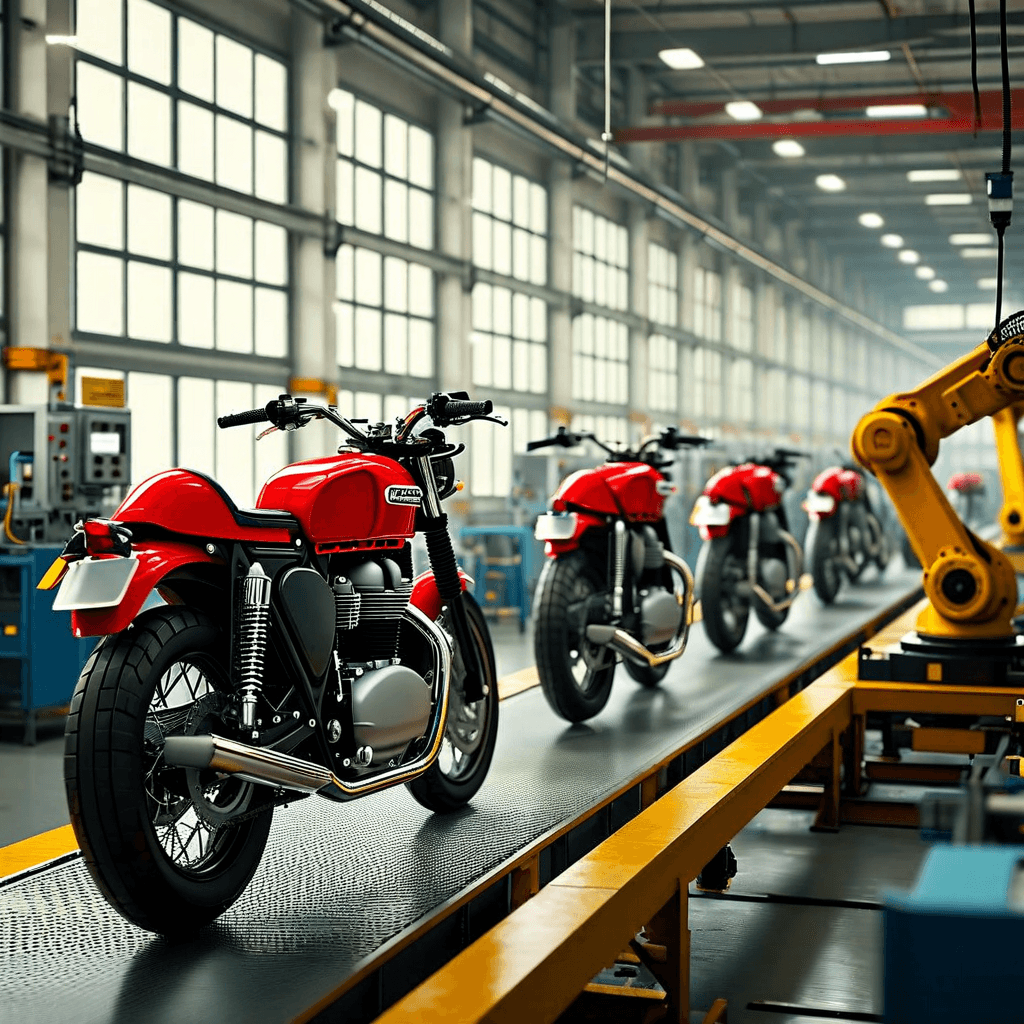
Royal Enfield is operating at near-full capacity with 14.6 lakh motorcycles annually, driven by robust domestic demand and international expansion. In FY26, the company crossed 1.2 million sales—a 23% year-over-year increase—with domestic volumes up 23% and exports growing 23% as well. The 350cc segment has been particularly explosive, posting 50% growth during festive periods following GST reductions. This demand surge has plants running 24/7, with management even exploring weekend operations to keep up. Website search metrics remain exceptionally strong, indicating sustained consumer interest across urban, rural, and semi-urban markets. This demand profile justifies the massive Rs 2,500 crore greenfield investment in Andhra Pradesh, which will add 9 lakh units of capacity when fully operational by 2032. InvestorPresentations
Strategic Comparison: Andhra vs. Cheyyar
The Cheyyar project adds 5.4 lakh units efficiently, costing approximately Rs 17,740 per unit of capacity, with completion targeted by FY28. It addresses immediate demand constraints through faster implementation at an existing facility. The Andhra investment, at roughly Rs 27,778 per unit, is costlier but serves a different strategic purpose: geographic diversification.
The Tada facility near Tirupati provides long-term capacity security and access to a different labor pool and infrastructure network. Both investments will be funded through internal accruals, reflecting Royal Enfield's strong cash generation—FY25 operating cash flow reached Rs 3,979 crore. InvestorPresentations
Capacity vs. Product Development Trade-offs
Royal Enfield is balancing capacity expansion with product development, particularly for the upcoming 750cc platform. The company spends approximately 2-3% of capex on R&D, with "very deep investments" in EV development and product testing.
The Rs 2,500 crore Andhra facility will support the launch of Himalayan 750, Continental GT 750, and Interceptor 750 models expected between 2026-2027. These 750cc twins, producing 50-55 bhp, will enter price points around Rs 3.8-4.5 lakh, expanding Royal Enfield's presence in higher-displacement premium segments. The modular capacity strategy allows the company to shift production between platforms based on market signals, avoiding over-investment in any single engine category. InvestorPresentations
Fixed Cost Impact and Breakeven Analysis
The Rs 2,500 crore investment will significantly alter Royal Enfield's cost structure. Assuming a 10-year depreciation life, the facility adds approximately Rs 250 crore in annual depreciation. Including opportunity costs and fixed overheads, total incremental fixed costs could reach Rs 500-600 crore annually. At current EBITDA margins around 25%, the plant needs to generate Rs 2,000-2,500 crore of revenue to achieve acceptable returns . This translates to 2-2.5 lakh units of annual volume at average realizations of Rs 2 lakh per unit. The breakeven utilization rate is approximately 50-60% of capacity. However, achieving the 25% weighted average cost of capital (WACC) hurdle rate requires 70%+ utilization, or roughly 6.3 lakh units annually. The phased implementation—Phase 1 by 2029, Phase 2 by 2032—allows demand validation before full commitment, reducing execution risk. InvestorPresentations
Risk Mitigation Through Geographic Diversification
Diversifying beyond Tamil Nadu mitigates several operational risks. All current manufacturing is concentrated in one state, vulnerable to cyclones, floods, labor disputes, and regional policy changes. The Andhra facility provides geographic redundancy, enabling production shifts if one location faces disruptions. Supply chain resilience improves through the dedicated vendor park, creating a secondary supplier hub and reducing dependence on Tamil Nadu's concentrated ecosystem. Logistics costs should decrease 15-25% for domestic markets, particularly for eastern, central, and northern regions, as transit distances shorten. Export markets benefit from access to multiple ports—Krishnapatnam in Andhra Pradesh plus Chennai—reducing dependency on a single gateway and potentially cutting export lead times from 45-60 days to 30-45 days for key markets. InvestorPresentations
Government Support and Operating Environment
The Andhra Pradesh government is actively facilitating this expansion. The State Investment Promotion Board, chaired by Chief Minister N Chandrababu Naidu, approved the project, allocating 267-276 acres across Vanelluru and Rallakuppam villages. The state offers early-investor incentives, employment support for 5,000 jobs, and infrastructure development including road connectivity to ports. Andhra Pradesh pioneered the Industrial Single Window Clearance Act, enabling faster regulatory approvals compared to Tamil Nadu's mature but complex environment. While Tamil Nadu offers an established automotive ecosystem with mature suppliers, Andhra provides competitive advantages in land costs, labor rates, and potential tax incentives. The effective tax rate could be 2-3 percentage points lower in Andhra due to state-specific benefits, improving net margins.
Platform Scaling and Competitive Positioning
The expanded capacity enables Royal Enfield to scale production across its platform portfolio. The 350cc J-platform, driving 88.9% market share in the mid-size segment, gets immediate relief from capacity constraints.
The new 750cc platform, launching with Himalayan 750, Continental GT 750, and Interceptor 750 models, requires dedicated production lines without disrupting existing volumes.
This brand strength, combined with 95%+ market share in the 500cc+ segment, provides significant pricing power. The capacity expansion supports maintaining premium pricing while reducing waiting periods that currently stretch 1-6 months across models. InvestorPresentations
ROIC Projections and Margin Enhancement
The Andhra facility is projected to deliver 22-25% ROIC, meeting or exceeding Royal Enfield's 25% WACC hurdle rate in base case scenarios. At 70% utilization (6.3 lakh units), the plant could generate Rs 2,500 crore revenue and Rs 625 crore EBITDA annually. The addition of 5.4 lakh units from Cheyyar and 9 lakh units from Andhra will drive revenue growth over the next 3-5 years, with FY27 potentially reaching Rs 34,000-36,000 crore as the 20 lakh unit capacity comes online. Operating leverage should expand margins 200-550 basis points over five years as fixed costs absorb across larger volumes. The Andhra facility offers margin advantages of 200-300 basis points compared to Tamil Nadu plants through labor cost savings (10-15%), power cost benefits (5-10%), logistics optimization (10-15%), and potential tax incentives. Modern automation and IoT-based manufacturing from inception provide additional efficiency gains of 5-8%. InvestorPresentations
Strategic Alignment and Investment Viability
Royal Enfield's dual expansion strategy represents a sophisticated approach to balancing immediate needs with long-term positioning. The Rs 958 crore Cheyyar investment addresses current demand efficiently, while the Rs 2,500 crore Andhra investment builds geographic diversification and capacity security for the next decade. The company's exceptional capital efficiency—achieving 60-70% capacity increases with lean capex—demonstrates disciplined deployment. With record ROE of 29.14%, net cash balance sheet, and minimal financial risk, Royal Enfield can fund these expansions while maintaining a 34.90% dividend payout ratio. The investment creates sustainable competitive advantages through modern infrastructure, reduced operational risk, and enhanced market leadership in the 250cc-750cc segment where Royal Enfield commands 88.9% market share in India. InvestorPresentations