In October 2025, Ola Electric's service turnaround time stretched to 14 days. By March 2026, it had plummeted to just one day—an 88% improvement. But the damage was done. This service nightmare became the single largest constraint on demand and brand trust throughout FY26, directly contributing to a 43.5% decline in scooter deliveries from 3,07,846 units in FY25 to 1,73,794 units in FY26.
The causal mechanism was brutal. Ola's direct-to-consumer model meant every negative service experience hit the brand directly—no dealer network to buffer the blow. With over 10,000 CCPA complaints triggering formal investigations, mass protests in Goa, and social media flooded with unresolved issues, potential customers simply deferred purchases. The Net Promoter Score tells the story: customers without service delays scored 64, while those with delays dropped to 41. That 23-point gap represents massive negative word-of-mouth that crushed conversion rates. InvestorPresentations +1
Market share collapsed from 30% to 6% as TVS Motor, Bajaj Auto, and Ather Energy captured displaced customers. By August 2025, TVS led with 24.8% share, Ather overtook Ola at 17.9%, and even Bajaj slipped to fifth at 11.3%. The service backlog created a self-reinforcing negative cycle: delays led to complaints, complaints damaged trust, trust reduced sales, lower sales meant less service revenue, which further constrained service capacity.
The Quality Transformation
Amid this chaos, something remarkable happened.
On a per-vehicle basis, this dropped from ₹18,033 to ₹3,395, an 81% improvement that validates genuine product quality advances.
The operational improvements driving this were systematic. Gen 3 products delivered 70% lower warranty costs than Gen 2 through better design, enhanced diagnostics, and superior repair capability. The company shifted from replacement-led to repair-led economics, dramatically reducing parts costs. Service turnaround time improved 88%, same-day closures reached 87%, and parts pendency fell 69%. A 250-member taskforce deployed across cities to clear backlogs, while third-party garage partnerships expanded service capacity. InvestorPresentations +3
This quality reset wasn't cheap—it required a deliberate strategic decision to slow sales and prioritize operational stability. But it created the foundation for sustainable recovery.
The Financial Reset
Q4 FY26 marked Ola Electric's first operating cash-flow positive quarter with ₹91 crore consolidated CFO. The auto business alone generated ₹213 crore CFO and ₹173 crore free cash flow. This achievement came through ruthless cost discipline: operating expenses nearly halved from ₹844 crore in Q4 FY25 to ₹428 crore in Q4 FY26.
The cost reduction came from four strategic pillars. Network rationalisation eliminated duplicate infrastructure. Sales and service costs tightened through the shift to repair-led economics. Fixed overheads fell through facility consolidation. Stronger operating governance, including AI-driven execution with 2 lakh daily calls, improved efficiency. InvestorPresentations
Revenue declined 50.1% from ₹4,514 crore to ₹2,253 crore—but this was primarily an intentional strategic reset rather than competitive pressure alone.
The evidence? A V-shaped recovery began in April with registrations rising 20% month-on-month while the broader E2W industry declined 22%.
The most stunning metric: gross margins exploded from 13.7% in Q4 FY25 to 38.5% in Q4 FY26. This 24.8 percentage point improvement came from vertical integration, Gen 3 maturity, pricing architecture optimization, and downstream control. The trade-off was clear—Q4 FY26 had the lowest volume but highest margins. At the new cost structure, EBITDA breakeven requires just 20,000-25,000 units monthly, down from 40,000+ previously. InvestorPresentations +2
The Battery Technology Breakthrough
The real story isn't the scooter reset—it's the battery breakthrough.
The advantages are staggering: 33% lower capital expenditure, 40-60% reduced energy consumption, and 70% smaller manufacturing footprint versus conventional methods. InvestorPresentations +1
This technology underpins the Gigafactory expansion strategy. Current operational capacity stands at 2.5 GWh, with 6 GWh installation largely complete and commercialization expected by quarter-end. The path to 20 GWh follows an incremental brownfield expansion approach—the core platform is already built. This positions Ola to capture a portion of India's projected $30 billion battery market by 2035 (420 GWh demand). InvestorPresentations +4
The transition to in-house batteries accelerates this advantage. Currently 15% of orders use Ola's own 4680 Bharat Cells, with full portfolio transition targeted by September 2026. The integration delivers tangible benefits: scooter battery capacity jumps from 4 kWh to 5.2 kWh (30% higher range), while motorcycle capacity doubles from 4.5 kWh to 9.1 kWh. Vertical integration provides cost savings, margin improvements, and supply chain security that third-party sourcing cannot match. InvestorPresentations +2
The Corporate Restructuring
Ola is executing a sophisticated separation strategy. The company plans to raise ₹2,000 crore at the cell subsidiary level, enabling independent valuation of Ola Cell Technologies distinct from the loss-making scooter operations. The cell business generated ₹20 crore revenue with ₹191 crore operating EBITDA loss in FY26, while the auto business delivered ₹213 crore CFO in Q4 FY26. InvestorPresentations +2
This structural separation serves multiple purposes. It establishes market valuation for the battery unit as a key infrastructure asset. It de-risks the parent company balance sheet while attracting infrastructure-focused capital to high-value battery IP. It allows investors to assess technology leadership separately from competitive EV market dynamics.
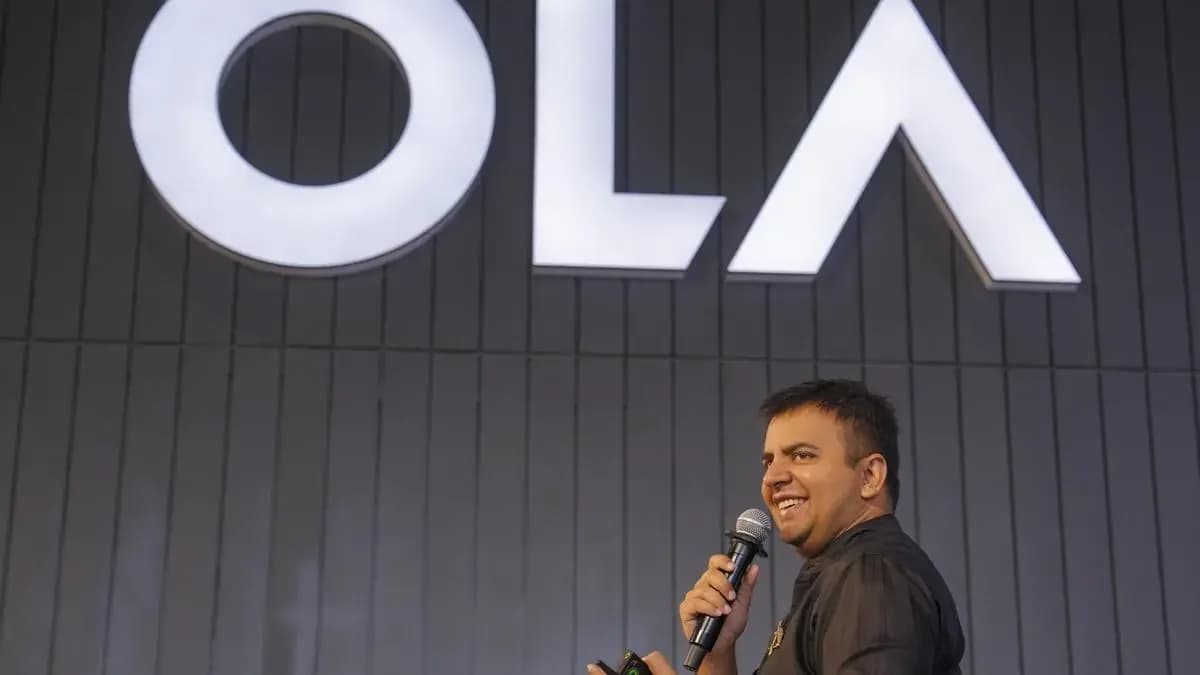
Bhavish Aggarwal's shareholder communication reflects this strategic pivot. He's positioning Ola not as an electric scooter company, but as an integrated energy technology player across "the two most important pillars of India's energy future: electric mobility and batteries". The narrative emphasizes that "the heavy build phase is behind us—the next phase is disciplined scale". InvestorPresentations
The Diversification Strategy
The launch of Shakti distributed energy storage and Mahashakti utility-scale storage systems creates multiple revenue engines beyond competitive scooters. Shakti, launched in January 2026, has already generated 50,000+ customer leads across telecom, petrol pumps, retail, and commercial backup. Mahashakti, targeting CY 2027 launch, will address renewable integration, peak load management, and grid balancing. InvestorPresentations +3
The business model now centers on "one cell platform, three demand engines": electric vehicles (captive and external sales), grid energy storage, and small energy storage. This diversification reduces dependence on the scooter market while leveraging the same manufacturing platform across segments. InvestorPresentations +1
The motorcycle business is emerging as a second growth engine. Ola holds 50% market share in electric motorcycles, with bikes contributing 15% of April gross orders. The Roadster series delivers 500+ km certified range, addressing India's largest two-wheeler category where EV penetration remains low.
The Path Forward
Ola's FY26 reset was painful but necessary. Service failures forced a reckoning that exposed fundamental operational weaknesses. Yet the company used this crisis to execute a comprehensive transformation—improving product quality, slashing costs, achieving cash flow positivity, and building a battery technology platform that could redefine its future.
The strategic pivot from scooter maker to energy technology player addresses investor concerns about sustained cash burn by highlighting the $30 billion battery opportunity versus the saturated scooter market. The cell subsidiary capital raise will unlock independent valuation for the battery business, while energy storage products create multiple growth engines.
Rebuilding national market share to 15-20% over six months is ambitious but achievable given the V-shaped recovery beginning in April. The vertically integrated battery platform creates barriers to entry for competitors lacking in-house cell manufacturing capabilities, potentially reshaping long-term market share dynamics.
The heavy build phase is indeed behind. The next phase—disciplined scale across mobility and energy storage—has begun. If Ola executes this strategy successfully, FY26's service crisis will be remembered not as the beginning of the end, but as the painful reset that enabled a remarkable transformation.