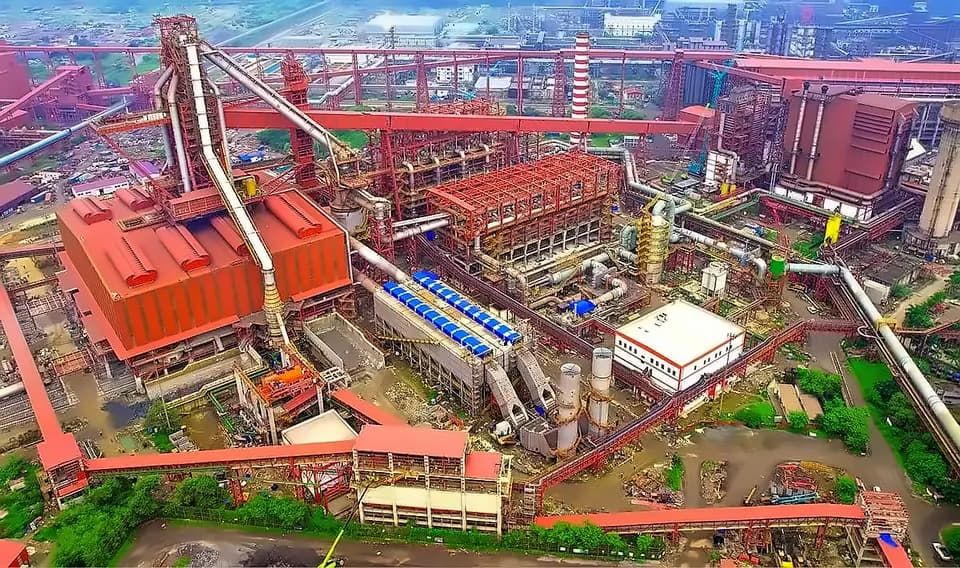
JSW Steel didn't just beat expectations in Q1 FY2027—it crushed them. Consolidated net profit surged from ₹2,209 crore to ₹4,696 crore, a 112% year-on-year jump that demands explanation. The story begins with EBITDA, which climbed to ₹9,383 crore from ₹7,576 crore, providing the foundation for profit growth. But the real magic happened below the operating line. InvestorPresentations +1
Finance costs dropped 17% to ₹1,712 crore, driven by lower debt levels and favorable interest rates. This wasn't accidental—it was the payoff from the completed JSW JFE JV transaction, which slashed net debt by approximately ₹37,000 crore. Add in tax efficiency gains from JVML, which operates under a concessional tax regime, and you have a profit expansion that feels almost mathematical in its precision. InvestorPresentations +2
Margin Expansion: The Real Story
The EBITDA margin expansion from 17.56% to 19.81%—a 241 basis point improvement—tells a deeper story about operational leverage. Revenue grew 19% year-on-year on a proforma basis, but costs didn't keep pace. Why? Because JSW Steel focused on what matters: higher-value products. InvestorPresentations
Value-added and special products (VASP) grew 8% year-on-year and now comprise 61% of total sales. This isn't just about selling more steel—it's about selling better steel. Record sales to the automotive sector (+18%) and renewable energy (+24%) demonstrate this premium mix success. Capacity utilization at Indian operations hit 94% (excluding Vijayanagar BF-3 shutdown), compared to 88% in Q1 FY26, driving better fixed cost absorption. InvestorPresentations +1
The Other Income Factor
Other income nearly doubled to ₹724 crore from ₹350 crore, contributing meaningfully to overall profitability. This wasn't luck—it was strategy. The deleveraging program and strong cash generation led to higher investment balances and improved returns. With cash and cash equivalents at ₹21,630 crore, JSW Steel had substantial scope for investment income generation. InvestorPresentations
Revenue vs. EBITDA: The Operating Leverage Story
Here's where things get interesting. Revenue grew 9.8% to ₹47,364 crore, but EBITDA grew 24%. This 14.2 percentage point divergence is textbook operating leverage—fixed costs getting spread across higher volumes and better realizations. Consolidated steel sales increased 4% to 6.25 million tonnes, with Indian operations leading the charge. Flat steel sales grew 9% year-on-year as production focused on flats due to better demand and pricing dynamics. InvestorPresentations +2
Production: The 15% Story
Crude steel production reached 6.59 million tonnes, up 3% year-on-year. But this number understates reality. Excluding the Blast Furnace-3 shutdown impact, production would have grown 15% year-on-year. The BF-3 shutdown significantly impacted year-on-year comparisons—Vijayanagar's crude steel production was 1.12 million tonnes in Q1 FY27 compared to just 0.75 million tonnes in Q1 FY26. The 15% adjusted growth reflects the true underlying operational performance. InvestorPresentations +2
The Deleveraging Masterclass
The primary driver? The BPSL (Bhushan Power & Steel) transaction, which enabled structural deleveraging of approximately ₹37,000 crore. About ₹30,000 crore was completed by March-end, with the second tranche of equity investment in JFE expected to drive further deleveraging of ₹7,900 crore by end-June. Transcripts +2
The financial metrics tell the story: Net debt-to-EBITDA improved from 1.81x to 1.46x, and net debt-to-equity improved from 0.51x to 0.42x. Weighted average interest cost improved to 6.51%, representing approximately 60 basis points year-on-year improvement. This isn't just about lower debt—it's about cheaper debt. InvestorPresentations +5
The Growth vs. Deleveraging Balance
JSW Steel is managing a delicate trade-off. The company has approved growth plan capex of ₹1,26,000 crore over the next 4-5 years, with expected spend of ₹22,000-24,000 crore in FY27. Annual capex run rate is expected to increase from ₹20,000 to ₹35,000 crore per year as multiple projects accelerate. Transcripts +2
How do they fund this without blowing up leverage? Internal cash generation. Incremental capacity of 8 million tonnes from JVML, BF-3 upgradation, and Dolvi Phase 3 will generate an estimated ₹9,000-12,000 crore of additional EBITDA. Management has indicated they can "stretch to ₹30,000-35,000 crore of capex spend" while maintaining financial comfort, given strong cash generation from expanded operations. Transcripts +3
The JSW One IPO Strategy
JSW Steel approved participation as a Promoter Selling Shareholder in the proposed IPO of JSW One Platforms Limited, offering for sale equity shares aggregating up to ₹811 crore. This is strategic asset recycling—monetizing a successful digital venture while retaining control. Others
JSW One has demonstrated exceptional growth, with Gross Merchandise Value reaching ₹18,596 crore in FY 2025-26, up 48% year-on-year. The platform achieved profitability in Q4 FY26 for the first time. The IPO proceeds represent significant cash inflow relative to JSW One's current contribution to JSW Steel's financials—JSW One's contribution to consolidated net profit for FY 2025-26 was ₹90 crore (0.35% of consolidated net profit after tax). Others +2
Post-IPO, JSW Steel will maintain controlling interest (likely around 50-55%), preserving strategic synergies while unlocking value. This aligns with JSW Steel's broader digital B2B commerce strategy—building digital capabilities and then strategically monetizing investments to fund core business expansion. Others
Market Interpretation: What Investors Saw
But what exactly did investors see? They saw operating efficiency first and foremost—the 94% capacity utilization, the 241 basis point margin expansion, the digital transformation initiatives that eliminated millions of manual transactions. InvestorPresentations +3
They saw leverage improvement—the dramatic reduction in net debt-to-EBITDA from 1.81x to 1.46x, the 17% decline in finance costs, the revised leverage targets showing management confidence. They saw strategic initiatives working—VASP growing to 61% of sales, record sales to automotive and renewable energy sectors, international operations turning profitable. InvestorPresentations +6
The most significant aspect? Operating efficiency. The margin expansion and capacity utilization demonstrated that JSW Steel could execute operationally while maintaining financial discipline. The leverage improvement provided confidence in the balance sheet's ability to support growth. The strategic initiatives, while important for long-term value creation, played a supporting role in the immediate market reaction.
The Bottom Line
JSW Steel's Q1 FY2027 performance wasn't just about beating numbers—it was about demonstrating a business model that works. Higher realizations, robust volumes, improved operating efficiencies, and disciplined capital allocation combined to create a quarter that feels almost too good to be true. But the data suggests it's very real, and the market seems to agree.