Between March 2020 and July 2024, GPT Infraprojects Limited delivered a staggering 6,836% return, rocketing from ₹2.94 to an all-time high of ₹204. Even after a 44% correction to the current ₹113, the stock has still gained 3,760% from its pandemic lows. But this isn't just another small-cap momentum story. The company's fundamentals have transformed dramatically over six years—revenue grew 109% from ₹615 crore in FY21 to ₹1,289.9 crore in FY26, while profit after tax surged 375% to ₹97.3 crore. The question is whether this transformation is sustainable or if the stock got ahead of itself. Others
What's Driving the Order Machine?
The sustained order inflows from Rail Vikas Nigam Limited, Eastern Railway, and North-east Frontier Railway aren't luck—they're structural. The Indian government has allocated a record ₹2.93 lakh crore for railway capital expenditure in FY27, the highest in history and a 10.5% increase over the previous year. This massive spending spree is part of broader initiatives like Gati Shakti and the National Infrastructure Pipeline, with RVNL alone submitting 286 bids totaling over ₹1.5 lakh crore and maintaining a success rate exceeding 20%. Others
GPT has positioned itself perfectly to capture this wave. The company operates across three segments: Infrastructure (bridges and roads), Railway Signaling, and Concrete Sleepers. Its infrastructure business focuses heavily on railway-led civil works, while the signaling segment—acquired through the ₹151.83 crore purchase of Alcon Builders in February 2026—handles end-to-end design, installation, and testing of signaling systems including Kavach and Electronic Interlocking. This integrated offering makes GPT a "one-stop" solution for Indian Railways, creating a competitive moat that's difficult for peers to replicate.
The ₹483 Crore Bridge: More Than Just Another Order
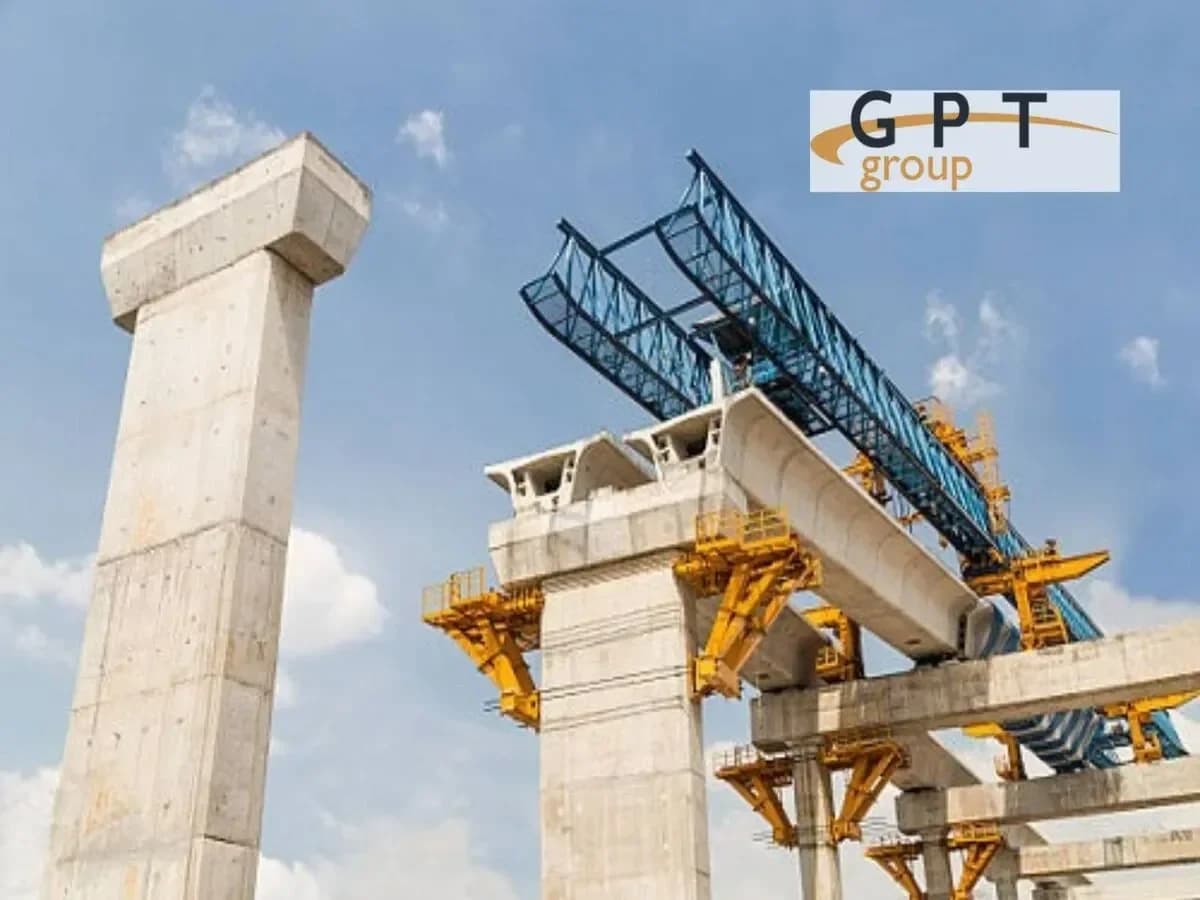
The recent ₹483.72 crore order from RVNL for constructing Bridge 544 over the Mahanadi River is significant beyond its headline value. The project involves building 32 spans of 65.84-meter open web steel girders as part of the third and fourth railway lines between Nergundi and Barang in the Khurda Road Division of East Coast Railway. With a 1,095-day execution period, this contract provides approximately ₹161 crore of annualized revenue visibility over three years, strengthening the company's outstanding order book to ₹4,992 crore.
More importantly, this project is part of a broader infrastructure expansion in the Khurda Road Division, which includes the 32.32 km Khurda-Barang third line and the 104.242 km Angul-Sukinda railway line. These aren't isolated projects—they're part of critical freight corridor development that creates a multiplier effect for follow-on orders. The technical complexity of major bridge construction over one of eastern India's widest rivers also demonstrates GPT's engineering capabilities, positioning it favorably for upcoming East Coast and Northern Railway tenders. Others
Diversification: Balancing Complexity and Margins
GPT's strategic expansion into signaling through the Alcon acquisition has fundamentally changed its risk-return profile. Civil infrastructure projects like the Mahanadi bridge are asset-intensive, require heavy working capital deployment, and typically span 3-4 years with back-end loaded revenue recognition. Management indicates EBITDA margins around 13-14% for these bridge projects, citing higher value addition through engineering and limited competition. However, they come with significant execution risks—seasonal flow restrictions during monsoon months can delay underwater substructure work by 3-4 months annually, while raw material price volatility in steel and concrete can temporarily compress margins until escalation clauses kick in. Others
In contrast, signaling projects are technology-intensive with shorter execution periods (typically 12 months) and faster revenue recognition. Recent orders include ₹85.53 crore from Eastern Railway for auto signaling and electronic interlocking at New Mugma Yard, and ₹114.82 crore from North-east Frontier Railway for electronic interlocking at 10 stations. While segment-specific margins aren't disclosed, management describes signaling as a "high-margin" vertical expected to drive overall EBITDA expansion beyond the current 13.5%. The asset-light nature of these projects also improves working capital efficiency, creating a natural hedge against the cyclicality of pure-play civil construction.
The Dedicated Freight Corridor Connection
Several of GPT's recent orders are explicitly linked to the Dedicated Freight Corridor (DFC) project, which significantly influences both timelines and payment cycles. The Eastern Railway signaling order for New Mugma Yard is part of DFC multitracking, with a tight 12-month execution timeline. DFC projects typically benefit from priority status with strong government backing and timely fund provision, reducing payment uncertainty compared to state government projects. However, they also require corridor-wide coordination between multiple contractors, creating integration dependencies that can impact milestone payments.
Historically, GPT had a ₹98.1 crore contract to supply concrete sleepers for the Eastern DFC via GMR, where revenue was tied to offtake schedules. Factories were geared to produce ₹8-9 crore monthly, but total inflow depended on GMR's offtake volumes. This pattern highlights both the opportunity and the challenge—DFC projects provide long-term visibility but require careful working capital management during execution phases. Others
From ₹2.94 to ₹204 and Back: What Happened?
The stock's epic rally from April to July 2024—gaining 155% in just three months to peak at ₹204—was driven by a perfect storm of factors. Exceptional order win momentum included a ₹487 crore order from Central Railway for the Solapur Division, a ₹470 crore MCGM flyover order, and a ₹195 crore Ivory Coast project. Q1 FY26 results showed PAT zooming 40% year-on-year with margin expansion, while the broader small-cap infrastructure sector was experiencing a re-rating rally. The stock's P/E expanded from ~15x to ~25x at the peak as investors priced in aggressive growth expectations.
The subsequent 44% correction to ₹113, despite continued order wins, reflects a convergence of factors. Valuation concerns were legitimate—at 25x P/E, the stock was expensive even for a high-growth infrastructure company. Execution challenges emerged, with Q2 FY26 reporting flat revenues due to monsoon impacts on construction. Broader small-cap sell-offs in 2025, liquidity tightening, and sector rotation away from infrastructure all contributed. Company-specific issues including 50.8% promoter pledge and increasing debtor days from 30.2 to 36.4 days also weighed on sentiment.
Current Position: Fundamentals vs. Valuation
Today, GPT trades at a more reasonable 14.6x P/E with a market cap of ₹1,435 crore. The order book stands at ₹4,992 crore, representing 3.9x FY26 revenue and providing 3-4 years of visibility. Management has guided for 27-30% revenue growth in FY27 with a ₹3,000 crore order inflow target, funded entirely through operating cash flows. The company's financial metrics remain strong—ROE of 22.1%, debt-to-equity of 0.37x, and industry-leading cash flow to EBITDA conversion of 80-125% . Others
Compared to small-cap infrastructure peers, GPT commands a premium on P/B (2.33x vs. sector average of 1.36x) but trades at a discount on P/E (14.61x vs. 20.23x). This premium is justified by superior execution capabilities, high-quality order book from clients like RVNL and Indian Railways, and strong growth visibility. The company's 'A' credit rating is rare for a small-cap infra company, reflecting superior execution, discipline, and integrity.
The Concentration Risk Question
GPT's dependence on railway sector orders—approximately 50-55% of total revenues when combining infrastructure railway work with the concrete sleeper business—creates legitimate concentration risk. Railway contracts account for 40-45% of the infrastructure order book, with the balance from NHAI, MoRTH, and road agencies. This exposure makes the company vulnerable to shifts in railway budget allocations, policy changes, and payment delays typical of government contracts. Others
However, this risk is partially mitigated by diversification within the railway sector across multiple zones (Eastern, North-east Frontier, East Coast, South Eastern), different project types (bridges, signaling, sleepers), and various contract structures (EPC, supply contracts, joint ventures). Non-railway infrastructure exposure provides additional balance, with 55-60% of the infrastructure order book coming from road and highway projects. Most importantly, railway infrastructure remains a government priority under Gati Shakti, with 95% of railway capex financed by central government budget.
The Road Ahead
The combination of massive railway capex plans, structural reforms in railway procurement, and GPT's established competitive position creates a favorable environment for sustained order inflow. The company is now eligible to bid for ₹1,600+ crore single projects, up from ~₹700 crore previously, with a large order of 1,200-1,500 crore expected soon. Management expects to close FY26 at ₹1,500 crore revenue and ₹120 crore PAT, making the current PE around 10x with a 4% dividend yield at current levels.
The key risks to monitor include execution delays on complex projects like the Mahanadi bridge, margin pressure from input cost inflation, and the potential for railway capex to face fiscal pressures. However, GPT's strategy of maintaining focus on railway infrastructure while gradually diversifying into signaling and international markets provides a balanced approach to growth and risk management.
For investors who can look through the volatility, GPT Infraprojects represents a fundamentally sound business riding one of India's most powerful structural trends—the railway infrastructure boom. The stock may never again see the vertical ascent of 2024, but the underlying business transformation suggests the long-term story remains intact.