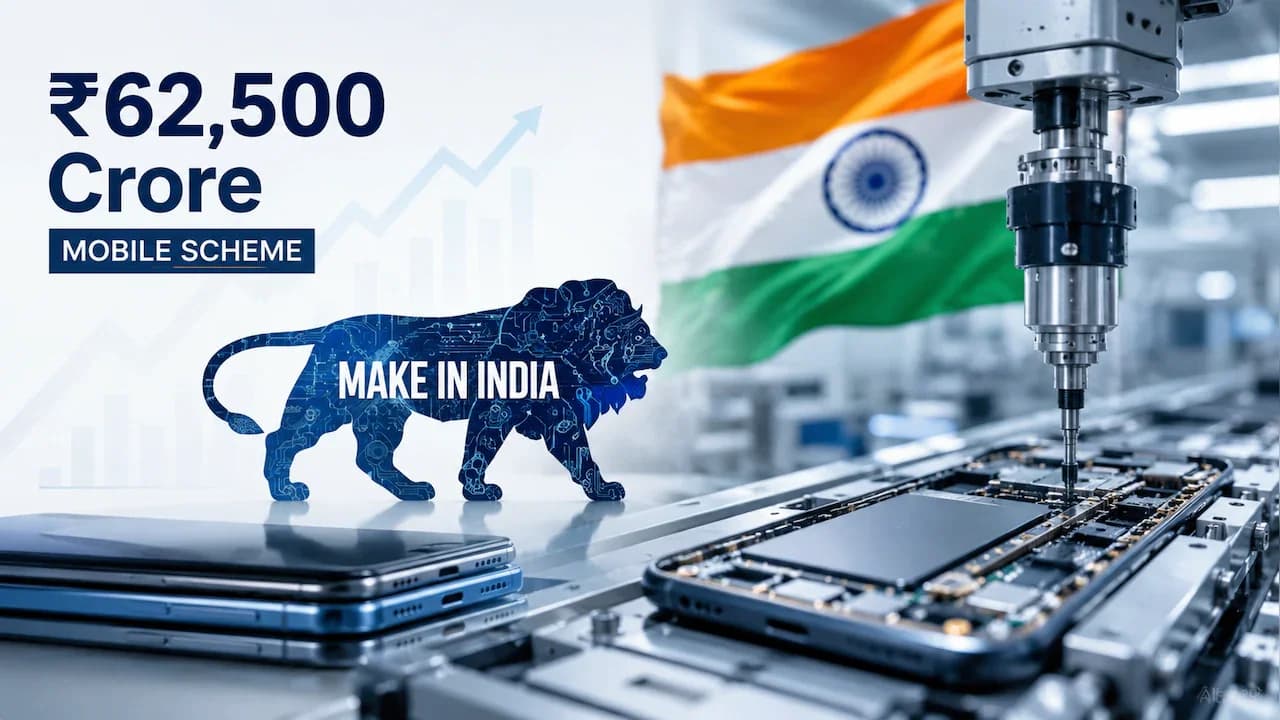
On August 24, 2026, the Government of India unveiled a massive ₹62,500 crore Production-Linked Incentive (PLI) scheme for mobile manufacturing. Logic suggested that Dixon Technologies, India's largest electronics manufacturer with a nearly $9 billion market capitalization, should have been among the clearest beneficiaries. Instead, the stock declined over 2% by midday. This counterintuitive market reaction reveals a critical misalignment between government policy design and the realities of contract manufacturing.
The Structural Misalignment: Brands vs. Manufacturers
The core issue lies in MEITY's decision to pay incentives directly to brands rather than manufacturers. Under this structure, while the total PLI incentive represents 4-5% of revenues, Dixon retains only 0.6-0.7% as its net share, with the balance (approximately 3.4-4%) being passed through to customers and brands. This pass-through mechanism means that despite bearing the full manufacturing costs and operational risks, the majority of the incentive value accrues to brand owners who may not have direct manufacturing capabilities in India. InvestorPresentations
This design creates a fundamental disconnect between Dixon's manufacturing capabilities and direct incentive receipt. As a pure-play contract manufacturer, Dixon cannot capture the full value of incentives it helps generate through production. The scheme effectively treats manufacturing as a commodity service while rewarding brand ownership and sales performance—a structure that inherently disadvantages companies focused on manufacturing excellence rather than brand building.
The Certification Competition: Multiple Manufacturers, Uncertain Allocations
The requirement for brands to provide certifications to multiple manufacturers introduces another layer of complexity. If a brand uses more than one manufacturer, it must provide the required certifications to each, with benefits potentially split between them. This multi-manufacturer certification requirement creates competitive disadvantages for Dixon.
The PLI scheme has attracted significant participation, with 32 companies approved under Large Scale Electronics Manufacturing and 27 companies under PLI 2.0 for IT Hardware. This crowded competitive landscape means that even when Dixon overperforms on production targets, its share of PLI benefits depends on brand allocation decisions rather than manufacturing excellence. The company has approximately ₹1,380 crores in pending PLI receivables across four schemes, including "overflow money" earned due to overperformance that remains unpaid—highlighting the uncertainty inherent in this allocation mechanism. InvestorPresentations
The Moving Benchmark: Escalating Thresholds and Planning Challenges
Perhaps the most significant challenge lies in the scheme's escalating sales threshold structure. Existing brands need to increase sales by at least ₹5,000 crore every year compared to FY26 levels. Specifically, FY27 sales must be at least ₹5,000 crore higher than FY26, FY28 sales must be at least ₹10,000 crore higher, and FY29 sales must be at least ₹15,000 crore higher. Since this benchmark resets every year, companies need to keep growing sales to keep earning incentives.
For Dixon, this creates cascading planning challenges. The company is building capacity for 60-65 million smartphones by FY27 and expanding mobile display capacity from 24 million to 50-55 million units over two years. However, these capacity investments must be made ahead of demand certainty, as brand achievement of escalating thresholds becomes critical for sustained order flow. The progressive threshold structure—requiring 200% growth by FY28 and 300% growth by FY29 relative to FY27 levels—creates exponential growth requirements that become increasingly difficult to achieve. InvestorPresentations
The Utilization Volatility Trap
The escalating thresholds create a causal chain that directly impacts Dixon's capacity utilization. As thresholds rise, brand performance pressure increases, leading to manufacturer allocation uncertainty, which results in capacity utilization volatility and ultimately financial performance variability.
In FY27, with a moderate ₹5,000 crore threshold, Dixon can plan capacity with reasonable certainty and maintain optimal utilization (85-90%). By FY28, the ₹10,000 crore threshold creates high allocation uncertainty, widening the utilization volatility range to 75-90%. By FY29, the ₹15,000 crore threshold creates very high allocation uncertainty, with extreme utilization volatility ranging from 65-95%. This volatility directly impacts margins, as underutilization leads to poor fixed cost absorption while overutilization creates overtime costs and quality risks.
The Market Reaction: Sell-the-News Dynamics
The August 24 stock decline represents a classic sell-the-news scenario. Dixon shares had surged 7.6% in the seven trading sessions before the announcement, driven by anticipation of favorable PLI scheme details. When the actual policy details revealed the brand-centric incentive structure and escalating thresholds, investors who had positioned for substantial benefits took profits.
BNP Paribas' skepticism played a crucial role in shaping market sentiment. The firm's report noted that the moving benchmark structure "seems like a tall ask to us, especially beyond FY27". This analyst skepticism reflected broader concerns about the feasibility of meeting compounding growth targets, especially considering the Indian smartphone market could contract by 10-15% in FY27 due to rising memory prices. The combination of pre-announcement run-up, structural disappointment, and fundamental concerns about target feasibility created the perfect storm for the decline.
Dixon's Strategic Response: Bargaining Power and Vertical Integration
Despite these structural challenges, Dixon's position as a nearly $9 billion electronics manufacturing giant provides significant bargaining power advantages. The company has strengthened its position through strategic joint ventures with binding commitments. Its partnerships with Transsion (covering brands like Infinix, iTEL, and Tecno) and the forthcoming JV with Vivo include binding volume commitments where a very large percentage of volumes must go through the JV. If customers don't meet these commitments, they compensate Dixon for CAPEX investment and certain fixed costs. InvestorPresentations
Dixon is also aggressively pursuing vertical integration as a core competitive strategy. The company has formed a 74:26 joint venture with HKC for display module manufacturing, targeting mid-to-high teens EBITDA margins. It's partnering with Q Tech, one of the five largest camera module manufacturers globally, to expand from 40 million units in FY26 to 190-200 million units annually. This backward integration strategy aims to generate significant margin expansion and provide more "tenacity" in customer relationships. InvestorPresentations
The Export Pivot: Aligning with PLI 2.0 Objectives
The new PLI scheme's focus on exports and brand creation requires Dixon to fundamentally adjust its business model. The scheme offers export incentives of 2.5-5% on export value, with the higher 5% band being "a very, very large element to support export from India". Additionally, there's a 1.5% localization incentive (0.3% each for five components: display, camera modules, battery, mechanicals, and charger) calculated on export value. InvestorPresentations
Dixon has outlined an ambitious export strategy. Current mobile exports of approximately ₹5,375 crores are expected to reach ₹7,000 crores in FY26, with long-term potential of ₹11,000-12,000 crores. The company is planning 4-5 million export units beyond domestic volumes, with geographic focus including the U.S. market through an anchor customer, African countries and Latin America through the Transsion relationship, and European markets for LED lighting products through a partnership with Signify. InvestorPresentations
The Path Forward: Transformation Imperative
Dixon's ability to navigate the new PLI framework will determine its position in India's electronics manufacturing landscape through March 2031. The company must execute a comprehensive strategic transformation that includes scaling exports from ₹5,375 crores to ₹11,000-12,000 crores, completing display and camera module manufacturing integration, transforming transactional relationships into structural partnerships, and expanding beyond pure-play contract manufacturing.
The stock's reaction on August 24 highlights the importance of policy design details over headline numbers. While the government's intent to support electronics manufacturing is clear, the mechanics of incentive delivery matter significantly for market valuation of pure-play manufacturers like Dixon. With its strong foundation, strategic partnerships, and clear vision for vertical integration and export-led growth, Dixon is well-positioned to navigate these challenges. However, the path forward requires flawless execution of component manufacturing initiatives, deepening of structural relationships with key brands, and building world-class export manufacturing capabilities.
The PLI scheme represents both a challenge and an opportunity for Dixon Technologies. The challenge lies in the structural misalignment between policy design and the company's business model. The opportunity lies in using its scale, partnerships, and vertical integration strategy to capture value despite these structural constraints. How successfully Dixon executes this transformation will determine whether it emerges as a leading export-oriented electronics manufacturer or remains constrained by the very policies designed to support India's manufacturing ecosystem.