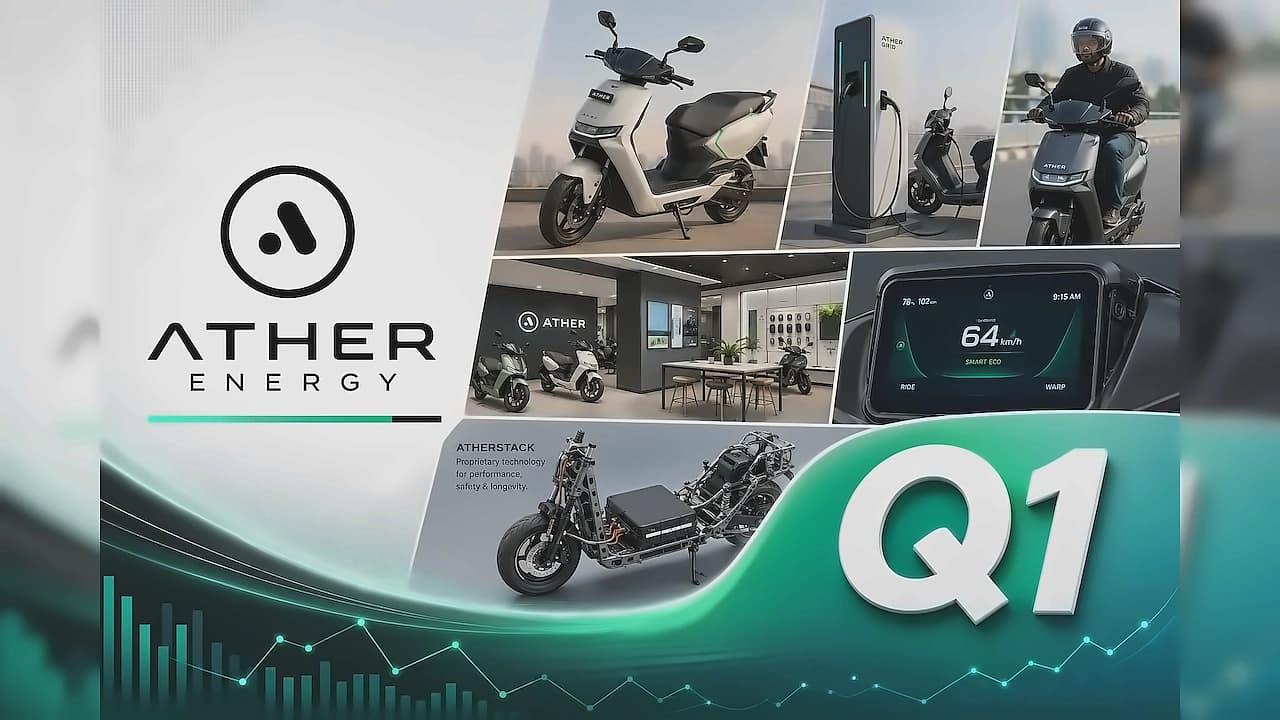
Ather Energy Limited delivered a landmark quarter in Q1 FY27, reporting its first-ever positive EBITDA of ₹9.45 crore alongside an 89% revenue surge to ₹1,217 crore. Net losses narrowed dramatically to ₹51.1 crore from ₹178.2 crore a year earlier, marking a critical inflection point for the Bengaluru-based electric two-wheeler manufacturer. InvestorPresentations
What Drove the 89% Revenue Surge?
The revenue explosion wasn't a single factor—it was a three-engine thrust. Volume growth did the heavy lifting, with vehicle deliveries jumping 80.5% year-on-year to 83,173 units. That's roughly 77% of the revenue growth right there. But Ather also squeezed more from each sale: revenue per vehicle climbed 4.6% to approximately ₹1.46 lakh, driven by calibrated price increases and a smarter product mix favoring higher-margin configurations. InvestorPresentations +1
The third engine? Non-vehicle revenue. Software subscriptions, charging services, accessories, and after-sales services now contribute 14% of total revenue, up from 13% last year. This ecosystem revenue streams in at higher margins and compounds as the fleet grows. InvestorPresentations
Historically, this acceleration is remarkable. Full-year FY26 revenue grew 63% to ₹3,672 crore. Q1 FY27's 89% growth suggests Ather is accelerating, not decelerating, as it scales.
How EBITDA Turned Positive
Achieving positive EBITDA—just 0.8%, but positive nonetheless—required more than selling more scooters. It demanded a fundamental rethinking of the cost structure. The secret sauce: roughly 75% of costs below gross margin are fundamentally fixed in nature. As volumes scale, these fixed costs spread across a much larger revenue base, creating powerful operating leverage. Transcripts
This lean P&L structure meant gross margins translated more effectively to EBITDA than industry peers. Transcripts
Manufacturing efficiency played a crucial role too. The Hosur facility progressed from single-shift to triple-shift operations, running at 90-95% capacity utilization. Monthly production climbed from 16,000 units in Q1 FY26 to 28,000 units in Q1 FY27. Multi-shift operations and high utilization rates drive down per-unit costs significantly. Transcripts +1
Structural cost reductions delivered another 2.6% margin boost through price hikes, continuous R&D-driven cost reductions, and skew management optimizing the product mix. This gain was achieved despite commodity inflation hammering margins by 5.6%—net result: adjusted gross margin held steady at 22.4%. InvestorPresentations
The "Different Orbit" Demand Environment
The data backs this up: pre-orders surged 158% year-on-year to 150,000 units, customer enquiries jumped 95% to 7.07 lakh, and industry EV penetration in scooters reached 20%. Transcripts +2
This mainstream shift enabled Ather to expand geographically. Tier 3 cities are now growing faster than Tier 2 cities. Middle India grew 141% year-on-year, Rest of India 118%, while even the mature South India market posted 76% growth. The company now operates across 500 cities, up from strong southern concentration just a year ago. Transcripts +1
Ather's competitive advantages in this environment? Technology and ecosystem. The company operates India's largest two-wheeler charging network with over 6,000 fast charging points on its open LECCS standard. AtherStack Pro software maintains a 94% attach rate despite nearly 5x volume growth, creating customer lock-in and recurring revenue. With half its workforce in R&D and 643 patents filed, Ather's software-defined differentiator—features like auto hold, skid control, crash alerts—is difficult for competitors to replicate quickly. Transcripts +2
Risks and Opportunities Ahead
The path forward isn't without obstacles. Commodity inflation remains the most immediate threat—aluminum prices jumped 60%, copper 43%, lithium hydroxide 131% between Q4 FY25 and Q1 FY27. Supply chain volatility, including rare-earth magnet shortages and battery price increases, adds further margin pressure. InvestorPresentations
Competitive intensity is escalating.
Hero Vida's aggressive pricing starting at ₹44,990 with battery-as-a-service shows the mass market will be a price war zone. The PM E-DRIVE subsidy of ₹5,000 per vehicle ends July 31, 2026, with no extension notified yet—this could dampen demand in the near term.
But opportunities abound. Management targets 10-20% long-term cost reduction through manufacturing engineering, VAVE initiatives, and the upcoming EL platform, which promises better underlying cost structures with reduced dependence on expensive commodities like aluminum. The EL platform launch on August 29, 2026, targets the mass market segment (₹1-1.25 lakh)—the largest chunk of India's EV market. Transcripts +1
Capital Allocation and Path to Profitability
Ather raised ₹2,500 crore in June 2026 through a QIP and preferential issue to fund its next growth phase. The largest allocation goes to Factory 3.0 at Chhatrapati Sambhaji Nagar, targeting commercial operations in Q3 FY27 with Phase I adding 5 lakh units of annual capacity. When fully built out, total capacity will reach 1.42 million units annually.
R&D remains a priority—₹67.47 crores of development expenditures were capitalized in FY26, up from ₹35.22 crores the previous year. The company added 283 patents in FY26, its highest ever. This investment fuels the technology moat and product innovation pipeline. AnnualReports +1
The path to net profitability looks increasingly credible.
Analysts project EBITDA margins reaching 4% by FY28 when monthly production hits ~45,000 units, with net profitability potentially following in FY29. Gross margins are targeted at 28% by FY28. InvestorPresentations
The critical question: can Ather sustain this momentum? Factory 3.0 must come online smoothly. The EL platform needs to deliver on its cost reduction promises. Commodity prices must stabilize. And Ather must defend its 16.8% market share against legacy OEMs with deeper pockets. If execution holds, Ather's first positive EBITDA quarter may mark the beginning of a sustainable profitability story rather than a one-off blip.