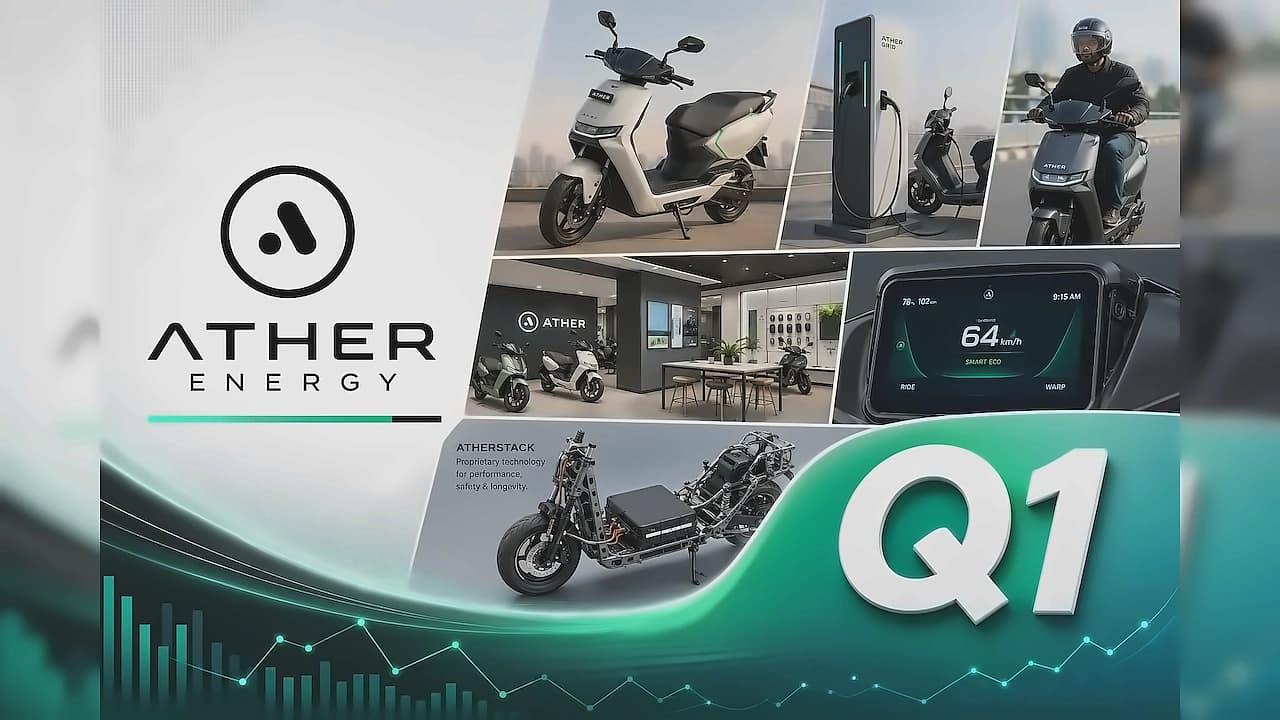
Ather Energy shares jumped 14.65% to ₹1,459.10 following the company's strong Q1 FY27 results, demonstrating continued investor confidence in the electric vehicle manufacturer's operational turnaround. The company reported consolidated net loss of ₹51.09 crore for the quarter, significantly lower than the ₹178.23 crore loss reported in the corresponding period last year. Revenue from operations surged 88.8% year-on-year to ₹1,216.92 crore, with consolidated total income increasing 87.2% to ₹1,260 crore driven by strong volume growth, calibrated pricing actions and higher contribution from non-vehicle revenue streams. Revenue from software subscriptions, charging services, accessories, spares and servicing contributed 14% of total revenue during the quarter, compared with 13% in the year-ago period. The company also reported a positive consolidated EBITDA of ₹9.45 crore, compared with an EBITDA loss of ₹105.97 crore in the same quarter last year, with EBITDA margin improving to 1% from a negative 16% despite commodity headwinds. Revenue per two-wheeler sold improved 3.4% YoY to ₹1,25,891 from ₹1,21,751 a year ago, while electric two-wheeler market share expanded to 16.8% from 14.2%.
Ather Energy has achieved a historic milestone by becoming the first pure-play new-age electric scooter maker to report an operating profit before depreciation, finance and amortization costs. The Bengaluru-based electric vehicle maker reported an EBITDA margin of 1% in Q1 FY27, marking its first positive quarter since listing, even as commodity costs rose 46% over the last five quarters and squeezed gross margins by 5.6 percentage points. This achievement came as revenue nearly doubled to ₹1,217 crore from ₹645 crore as EV sales surged owing to fuel price hikes and availability-led fears amid the West Asia war. Wholesales of 83,173 units in Q1 FY27 compared to 46,078 units in the year-ago period, representing a remarkable 80.5% growth in sales volume. Adjusted gross margin came in at ₹282 crore, up 82.3% YoY, though the adjusted gross margin percentage moderated to 22% from 23% a year ago. The company also turned adjusted EBITDA positive during the quarter, marking a significant operational turnaround, with net loss narrowing to ₹51 crore from ₹178 crore. Despite higher input costs for copper, aluminium, lithium and crude-linked materials, calibrated price increases, improved product mix, value engineering and supplier negotiations helped sustain healthy margins. Operating loss dropped drastically from ₹134 crore to ₹33 crore, demonstrating the company's improved operational efficiency.
The company's monthly production capacity increased from 24,000 units to 31,000 units in June as it fully utilized its Hosur plant's annual capacity of about 420,000 units, with production climbing steadily through the quarter — from 24,000 units in April to 28,000 units in May and 31,000 units in June. However, Executive Director and CEO Tarun Mehta revealed that the company lost out on 13,000-15,000 units of sales every month in the June quarter simply because it did not have the capacity to produce more. "We believe today that of the 30,000 units that we retail average in Q1, we could have probably sold an incremental 13,000 to 15,000 units every month. That's the unrealised retail potential for us," Mehta said. Dealer inventory declined to three days from 14 days at the end of the March quarter, indicating improved supply chain management, while pre-orders jumped 158% year-on-year to a record 1.5 lakh units despite dealers in several states stopping fresh order acceptance due to waiting times hitting two months or higher. Daily inquiries rose 95% year-on-year, with more than 7 lakh logged in the quarter, demonstrating sustained demand momentum. CLSA noted that bookings are running at around 50,000 units per month, well above the current production capacity of 35,000 units, indicating that the company is constrained by capacity rather than demand. Customer enquiries increased 95% year-on-year to 7.07 lakh, reflecting sustained customer demand that continued to outpace available production during the quarter.
To address the supply-demand gap, Ather is racing to bring its new Aurangabad plant on stream, with Phase 1 lifting annual capacity to 9.2 lakh units from 4.2 lakh units later this calendar year, with a possible Phase 2 that could take total capacity to 14.2 lakh units. The Factory 3.0 at AURIC in Chhatrapati Sambhaji Nagar remains on track, with Phase 1 having an annual production capacity of 5 lakh electric two-wheelers expected to commence production in Q3 FY27. Upon completion of both phases, the company's total installed manufacturing capacity will increase to 14.2 lakh electric two-wheelers annually. The company has raised ₹2,500 crore in total — a ₹1,300 crore QIP already closed and a ₹1,200 crore preference issue awaiting shareholder approval to fund the expansion. Manufacturing capacity is being scaled up to 60,000 units a month across Hosur and Aurangabad for the upcoming EL scooter platform launch. New store additions have been deliberately held back as Mehta noted it's not prudent to ship out more inventory to build out new stores while existing stores are only meeting 50-60% of demand. The company will unveil the first production scooter based on its all-new EL platform on 29 August 2026 at Ather Community Day, with the next-generation platform designed to improve scalability, manufacturing efficiency and support a broader product portfolio targeting a larger customer base.
The company reported record customer engagement metrics with enquiries rising 95% year-on-year to 7.07 lakh and pre-orders growing 158% year-on-year to 1.5 lakh, demonstrating strong momentum across its customer funnel. As per The Economic Times, domestic institutional investors have steadily increased their Ather Energy stake for five quarters, with DII ownership rising to 21.1% in Q2 FY27 from 20.5% in the previous quarter. Over the preceding four quarters, DIIs steadily raised their stake from 12% in June FY26 to 18%, continuing to add to their holdings and reaping returns as the stock rallied a staggering 275% over the past year. Ather's volumes rose 81% year on year in the first quarter of FY27, comfortably outpacing the electric two wheeler industry's 68% growth, with EV penetration crossing the 10% mark for the first time in June 2026. HSBC noted that the upcoming Factory 3.0, with an annual capacity of 500,000 units, is expected to remove the production bottleneck from Q3 FY27, while recent price hikes and cost reduction measures should support margins. Nomura analysts maintain Ather Energy as their top pick in the EV two-wheeler space, expecting the upcoming EL platform to expand TAM by ~2x and also lower costs meaningfully. Nomura estimates FY27F/28F/29F EBITDA margin estimates at -5.7%/+3.8%/+7.2% and has raised the target price to ₹1,714, implying ~35% upside from current levels, while maintaining a 'Buy' rating on the stock.
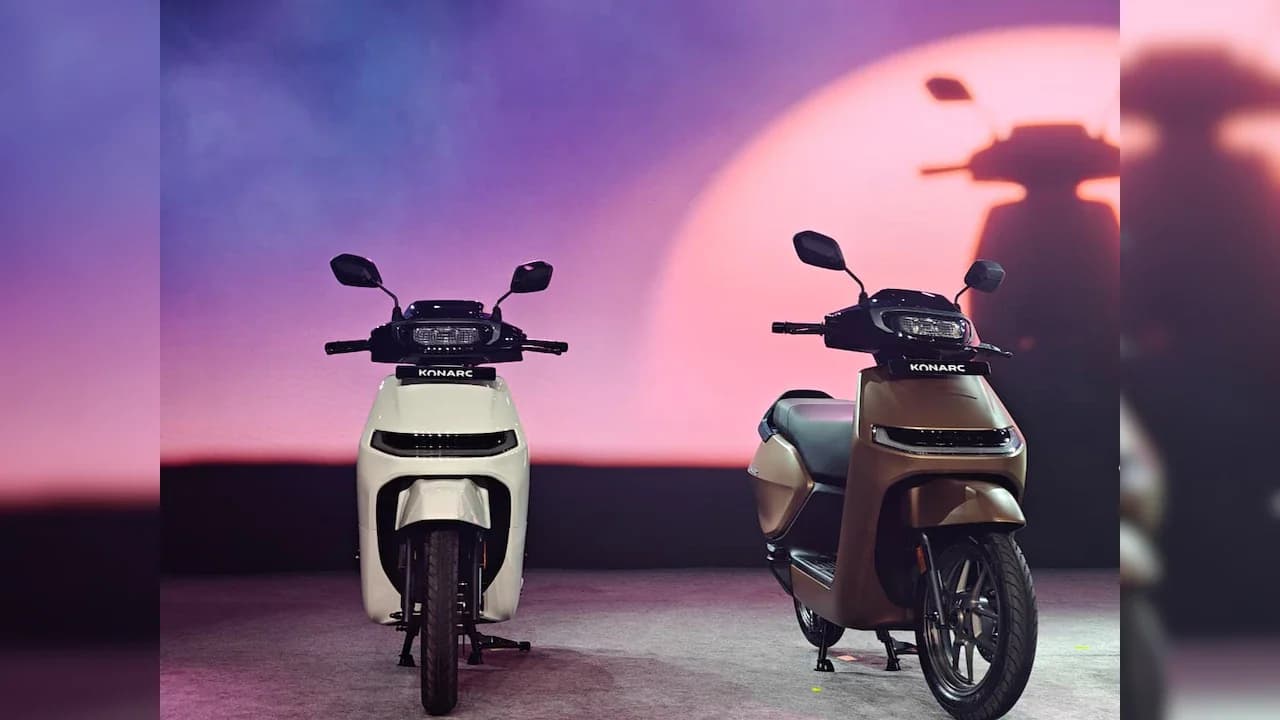
Central to closing the demand-supply gap is the imminent launch of Ather's EL scooter platform, for which manufacturing capacity is being scaled up to 60,000 units a month across Hosur and Aurangabad. "Obviously, it will not be called EL, it will be called — it'll have a brand name. We'll be unveiling the brand name in a couple of days, so please do watch out for it," Mehta said. The scooter will launch at Ather's annual Community Day event on 29 August 2026 in Bengaluru, themed "A New Dawn of Magic", with the rollout initially leaning towards Middle India and northern markets, a reversal of the sequencing used for the Rizta launch. Ather to unveil the new EL scooter brand name this week, with the company expecting the EL platform launch during the festive period to sustain volume momentum and support margin recovery. Ather is gunning for 60,000 EL units per month, with the platform slated to debut later this month to underpin Ather's mass-market strategy. Ather is designs and manufactures premium electric two-wheelers, battery packs, charging infrastructure and software solutions, and operates Ather Grid, one of India's largest fast-charging networks for electric two-wheelers.