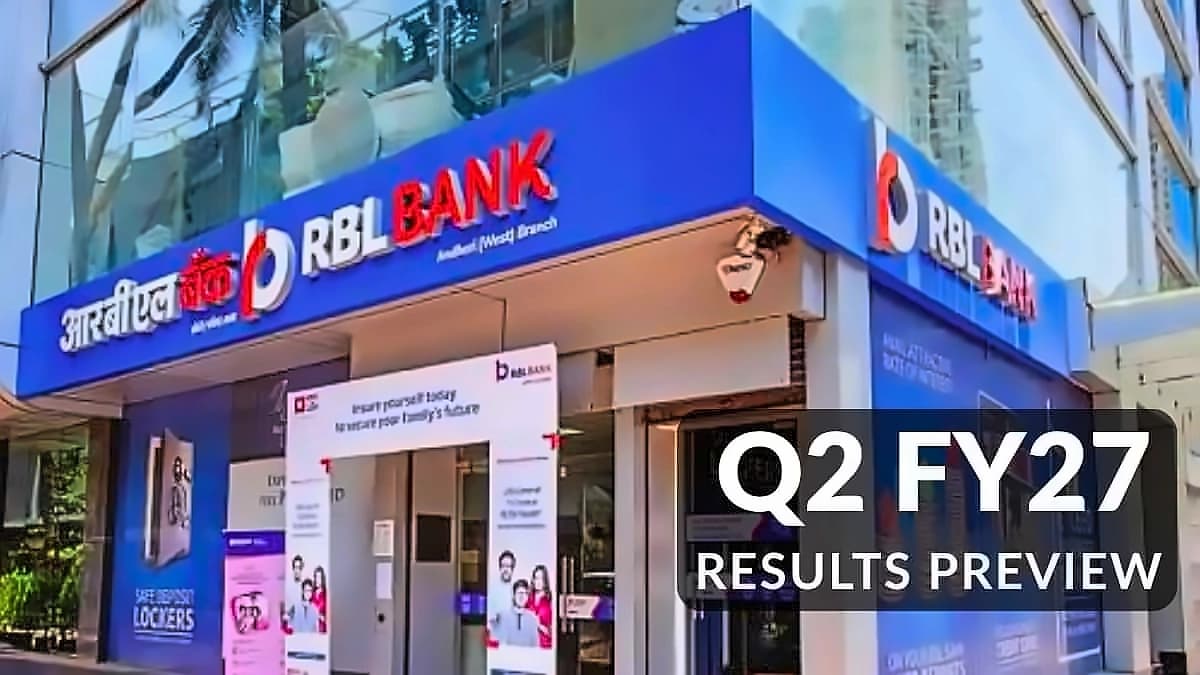
Private sector lender RBL Bank delivered exceptional financial results for Q2 FY27, with standalone net profit climbing to ₹482 crore from ₹179 crore in the corresponding period last year, representing a 2.7-fold year-on-year growth. The bank's net interest income rose 37% year-on-year to ₹2,131 crore from ₹1,551 crore in the year-ago period, while net interest margin (NIM) improved to 4.61% from 4.13% in the June quarter. As per The Economic Times, the bank beat Bloomberg estimates of ₹479 crore by a small margin, demonstrating strong operational performance. The bank's cost-to-income ratio declined to 56.48% from 64.70% in the preceding quarter. However, management indicated that NIM is likely to come under pressure in the December quarter as the cost of about ₹34,000 crore raised through FCNR(B) deposits kicks in, with these deposits costing the bank about 6.75% a year. According to Motilal Oswal, NIM may soften marginally in the near term before improving in Q4 FY27 aided by lower funding costs, gradual deployment of surplus liquidity and rate hike impact.
RBL Bank is leveraging its parent company Emirates NBD's global network to significantly expand its corporate and trade finance services in India and the Gulf region. As per The Economic Times, RBL Bank mobilised about $3.4 billion in FCNR(B) deposits, supported by Emirates NBD and its affiliates, and extended around ₹10,300 crore in loans against these deposits. The partnership has already demonstrated promising initial results through the bank's mobilisation of foreign currency non-resident deposits under the RBI's special swap window. R Subramaniakumar, managing director and chief executive of RBL Bank, told ET that the bank is working on a strategy to integrate corporate lending, international trade, NRI banking and remittances, seeking to capitalise on its new parent's overseas presence. The arrangement enables "one customer, two nations, one relationship" model, where RBL Bank will work with customers in India for credit origination and fund them for growth while following them internationally into GCC countries. The strategy targets four potential business flows of trade, movement of people, capital, and remittances including financing bilateral trade, servicing Indian expatriates, facilitating overseas investments into India and tapping inward remittances from the Gulf.
Despite the exceptional quarterly performance, RBL Bank shares crashed 7.55% to ₹388.30 on Tuesday, marking their steepest fall in nearly two years as higher-than-expected provisions overshadowed strong earnings. The sharp selloff came as concerns over elevated credit costs, sluggish core retail loan growth and expensive valuations overshadowed improvements in profitability and net interest margins. According to CNBC TV18, the sharp decline came after three brokerages downgraded the stock due to valuation concerns and earnings sustainability questions. Axis Capital downgraded RBL Bank to "Reduce" from "Add" and set a target price of ₹400, ICICI Securities downgraded the stock to "Add" from "Buy" while raising its target price to ₹460, and Investec downgraded RBL Bank to "Hold" from "Buy", retaining its target price of ₹440. The market reaction suggests investor concerns about the bank's ₹34,000 crore FCNR(B) deposit inflow during the temporary RBI window and its impact on margins. The bank's ₹34,000 crore FCNR(B) deposit inflow is expected to significantly impact margins in the near term, with much of the money currently parked in investments that earn less than the bank's regular loans. A senior executive explained that "Over a period of two to three years, you'll be seeing that much of it absorbed and introduced into the profitable environment", though deployment would be a continuous process with no fixed timeframe.
A major concern for investors was the sharp increase in provisions to ₹766.5 crore, which rose 53% year-on-year and 28% sequentially, significantly higher than expected. As per Motilal Oswal, provisions were 32% higher than expected, partly offsetting the strong earnings performance. The bank reported slippages of ₹743 crore in Q2FY27, largely from its unsecured retail portfolio, with credit cards, personal loans and microfinance accounting for ₹688 crore of the total slippages. The credit cost ratio increased to 63 basis points from 54% in the June quarter, with unsecured retail accounting for 51 basis points. However, management remains optimistic about future trends, with Subramaniakumar stating "We are encouraged with the asset quality trends and we expect slippages to trend materially downwards". As per Emkay Global, asset quality continued to improve, with gross slippages at 2.5% of loans, albeit still elevated, and management expects card slippages to stabilize at ~₹4bn in Q3/Q4FY27. The provision coverage ratio, including technical write-off was 95.31%, indicating strong provisioning buffers. Management has not seen any stress from the rural business or West Asia conflict, though it remains watchful.
A major concern for investors is the sharp decline in CASA ratio to 24% from 25.2% a year ago and a much steeper drop from 28.5% just a quarter earlier, indicating deteriorating deposit quality. As per latest reports, RBL Bank's CASA ratio fell to 24%, with deposits growing via costlier term and FCNR(B) funds rather than the cheap, sticky funds that support margins. The reliance on FCNR(B) deposits also creates a distorted picture of growth, as reported deposits rose an impressive 34% year-on-year, but strip out FCNR(B) deposits, and deposits actually shrank 1% from the previous quarter. This pattern repeats across the loan book, where advances grew 42% year-on-year, but excluding FCNR(B)-linked loans, underlying credit growth was closer to 30%, which is still healthy but well short of what the headline suggests. The bank's total capital adequacy ratio stood at 30.1% as of September 30, compared with 33.3% at the end of June, while the Common Equity Tier 1 (CET1) ratio declined to 29% from 32.2% in the previous quarter.
Brokerages offered mixed views on RBL Bank following its Q2 results, with Goldman Sachs maintaining its 'sell' rating but raising its target price to ₹310 from ₹285, citing strong foreign currency non-resident flows but noting muted retail loan growth. Citi maintained its 'buy' rating with a target price of ₹505, highlighting the bank's return on assets (RoA) of more than 0.9% in Q2 FY27 compared with 0.57% in the previous quarter, while Morgan Stanley maintained its 'equal-weight' rating with a raised target price to ₹370. Nuvama maintained its 'buy' rating and increased its target price to ₹500 from ₹470, while CLSA maintained its 'reduce' rating with a target price of ₹310, flagging higher-than-expected credit costs and muted average CASA growth of 5% YoY despite strong FCNR deposit accretion. The Hindu BusinessLine reports that Kwala Intel maintains a conditional bullish outlook only if the stock moves above the ₹401.3 mark, noting the stock has broken below the ₹393.79 swing level on 4.59× average volume. The lender, majority-owned by Dubai's Emirates NBD, saw strong loan growth during the quarter across both corporate and retail segments, with lending against FCNR deposits also contributing to growth. Kwala Intel maintains a conditional bullish outlook only if the stock moves above the ₹401.3 mark, noting the stock has broken below the ₹393.79 swing level on 4.59× average volume. The bank has surplus liquidity, which it plans to deploy in wholesale and secured retail lending, with margins expected to moderate in Q3FY27 due to full-quarter impact of FCNR(B)-led leverage before recovering gradually in Q4FY27.