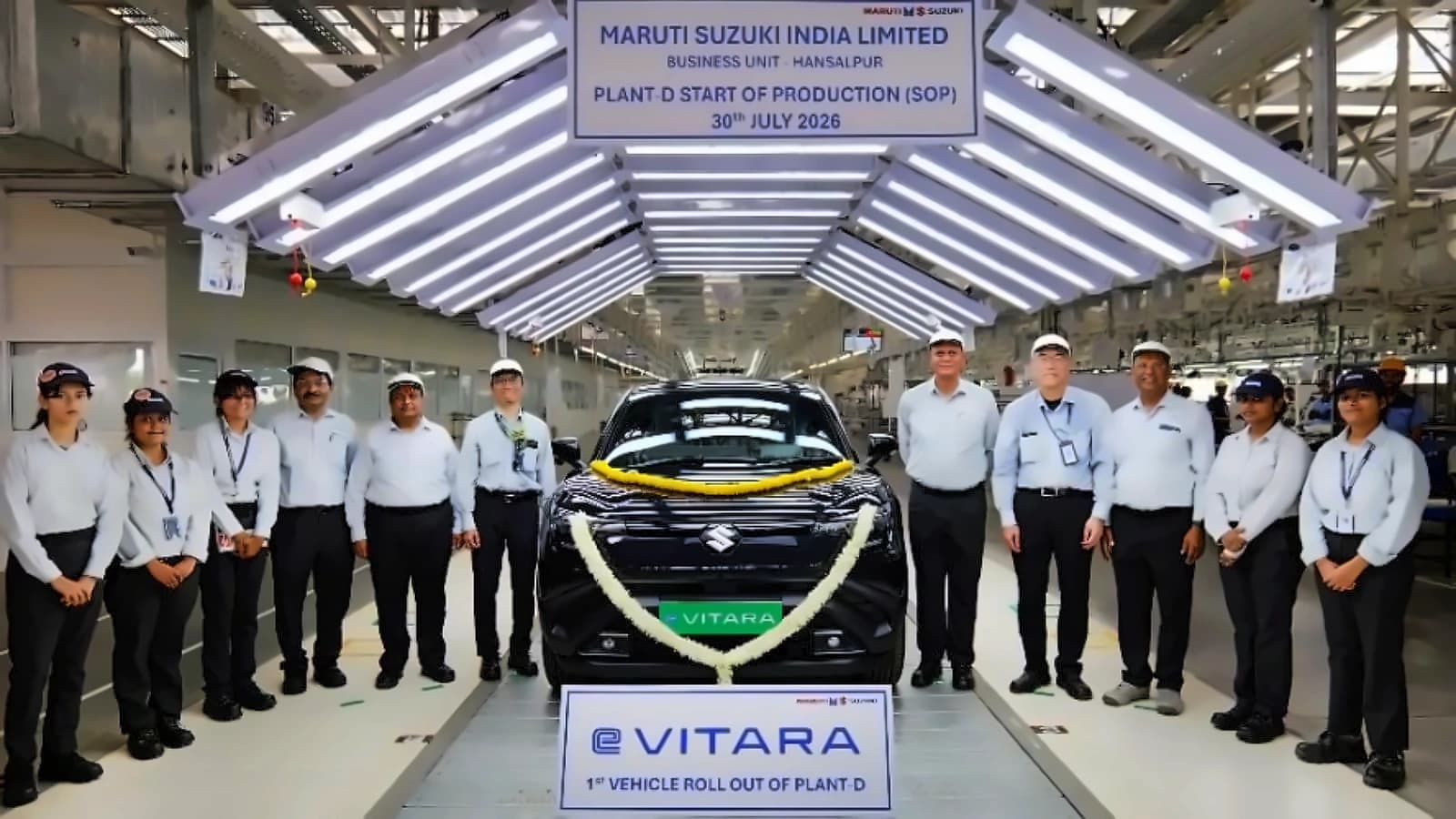
Maruti Suzuki India has commenced commercial production at the fourth plant of its Hansalpur facility in Gujarat, increasing the site's annual production capacity to 1 million vehicles. According to reports from CNBC TV18 and Zee News, the new plant, with an annual production capacity of 250,000 units, began operations on Thursday (July 30) and will initially manufacture the company's battery electric vehicle, the e VITARA. This milestone makes Hansalpur the first Suzuki manufacturing facility globally to achieve an annual production capacity of 1 million vehicles at a single location and India's largest passenger vehicle manufacturing facility at one site. The commissioning of the fourth plant makes Hansalpur the first Suzuki manufacturing facility globally to achieve an annual production capacity of one million vehicles at a single location, while the site's annual production capacity increases from 7.5 lakh units to 10 lakh units.
The company has invested ₹25,288.7 crore in the Hansalpur facility so far, including an estimated ₹3,900 crore for the fourth plant. As reported by CNBC TV18 and Zee News, the addition raises Hansalpur's annual capacity from 750,000 units to 1 million units, while the company's total manufacturing capacity now stands at 2.9 million units per year. The newly commissioned Plant D has an annual capacity of 250,000 units, bringing the total capacity to 1 million units annually. Hansalpur currently manufactures popular models such as the FRONX, Baleno, Swift and the e VITARA, with the facility also emerging as a key export base for the automaker, accounting for nearly 47% of Maruti Suzuki's total overseas shipments during FY2025-26. The facility has also become the global manufacturing hub for the e Vitara electric SUV, which is exported to over 100 international markets.
Following the commissioning of the fourth plant, Maruti Suzuki's manufacturing network comprises Hansalpur with an annual capacity of 1 million units, Manesar with 900,000 units, and Gurugram and Kharkhoda with 500,000 units each. According to CNBC TV18 and Zee News, the Hansalpur facility began operations in 2017, with subsequent plants commissioned in 2019, 2021 and now 2026. The site has crossed cumulative production milestones of 1 million vehicles in 2020, 2 million in 2022, 3 million in 2023, 4 million in 2025 and 5 million in May 2026. The Gujarat facility's importance has grown significantly as it serves both domestic and global markets, with the Gujarat plant accounting for nearly 47% of the company's total overseas shipments in FY 2025-26.
Beyond manufacturing, Maruti Suzuki has expanded its sustainable logistics initiatives at the Gujarat plant. In March 2024, the company commissioned India's first in-plant railway siding for automobiles at the Hansalpur facility under the Prime Minister's GatiShakti programme. Since railway dispatches began in March 2023, the company has transported more than 750,000 vehicles through the network, helping reduce carbon emissions, fuel consumption and road congestion. In February 2026, the Gujarat in-plant railway siding became the world's first modal shift transportation project to be registered under Verra's Verified Carbon Standard (VCS) programme, recognising its contribution towards reducing transportation-related emissions. The company also undertakes various CSR initiatives in the facility's vicinity, including establishing a modern CBSE English medium school in Sitapur, Gujarat in partnership with Podar Education Network in 2021, which currently serves more than 800 students from local villages. Additionally, Maruti Suzuki established a multi-specialty hospital at Sitapur in 2021 in partnership with Zydus group of hospitals, providing affordable and advanced tertiary care to more than 1.5 lakh people from 400+ nearby villages since inception.