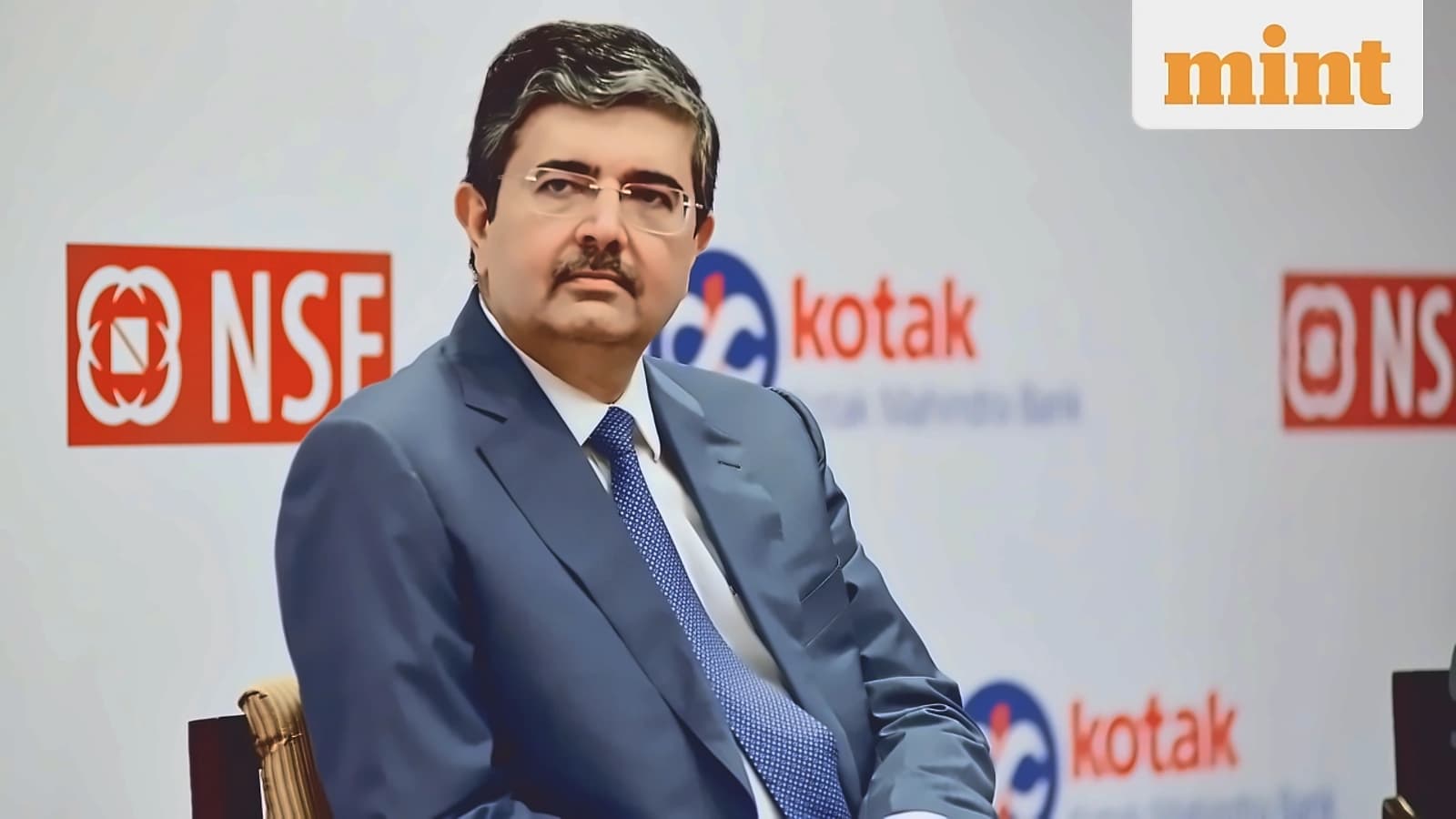
Uday Kotak, founder and non-executive director of Kotak Mahindra Bank, has advocated for India to maintain openness to Chinese investment and manufacturing partnerships amid escalating trade tensions. Speaking at the Bloomberg New Economy Forum 2026 in New Delhi on Tuesday, Kotak emphasized the need for India to diversify its sources of capital as global trade relationships shift and tariffs become instruments of economic policy. According to reports from Bloomberg, Kotak argued that Indian companies partnering with Chinese firms could help accelerate India's manufacturing refocus and drew parallels with China's earlier strategy of collaborating with American companies. As reported by Times Now, Kotak stated that "if you can't beat them, join them, and we need to be open" and highlighted that "in a world where tariffs are a weapon, Chinese strategics may be more open to come and invest in a domestic situation."
Kotak drew a parallel between India's current position and China's earlier strategy of collaborating with American companies to strengthen domestic manufacturing capabilities. The veteran banker pointed to early signs of Indian companies partnering with Chinese counterparts and suggested that joint ventures could provide a way forward for India's manufacturing ambitions. According to Bloomberg, Kotak emphasized that India was refocusing on manufacturing and that partnerships between Indian and Chinese companies could help accelerate this move. He noted that Chinese companies should be welcome to participate in India's Make in India initiative, reflecting a broader strategy of leveraging international partnerships to strengthen domestic manufacturing capabilities and economic growth. This comes as India seeks to strengthen its manufacturing base amid shifting global supply chains and growing uncertainty over trade with the US.
Kotak addressed India's currency challenges, advocating for the rupee to be allowed to find its own level after weakening for eight years. Speaking at the Bloomberg New Economy Forum, Kotak stated that "We should let the rupee find its own level and overtime the true strength of the economy will play out." He explained that India has faced greater pressure from portfolio investment flows than from its current account, with global capital concentration in just seven to eight stocks worldwide. As reported by Business Standard, Kotak noted that "One of the reasons why India is where it is is because we had very significant portfolio investments. The stock of portfolio investments was high, and there was this crazy concentration where what mattered in the world was not more than ten stocks, and all the money went in there." He described the current period as a transition phase and emphasized that for India to sustain its economic ambitions, greater competitiveness in research and innovation would be important. The rupee gained 1.5 per cent in the last two trading sessions after steps by the Reserve Bank of India to curb speculative bets.
Foreign portfolio investors (FPIs) have pulled a record ₹3.08 trillion out of Indian equities in just nine months of calendar year 2026 – nearly double the ₹1.66 trillion withdrawn in 2025, according to Business Standard. The outflow has exerted pressure on the rupee, which has depreciated 5.7 per cent in 2026 so far. The central bank has also intervened in the foreign exchange market to curb undue volatility. Kotak emphasized that India has to consider this as an important signal that we need to do a lot more to be competitive, efficient, self-reliant, and stronger in our research and innovation. Speaking at the same panel discussion, Surendra Rosha, Co-CEO, Asia & Middle East, HSBC, noted that while negotiating the US-China divide in the technological stack may be harder to manage for India, the country has a history of managing different poles of power.
Kotak confirmed that "early signs of partnerships between Indian and Chinese companies" are already visible, with specific examples already emerging. According to Times Now, Kotak noted that "a few such partnerships have already emerged" between Indian and Chinese companies for manufacturing in India. This practical evidence supports his broader strategy of diversifying India's foreign investment sources beyond Western economies, particularly amid changing global trade and investment dynamics. Kotak emphasized that India needs to focus on producing what it consumes and building the capacity to reduce dependence on countries it considers adversaries. His analysis goes beyond attracting factories to include strengthening India's ability to manufacture at scale, become more competitive in research and innovation, and develop domestic capabilities rather than depend primarily on consumption-led growth. Speaking at the forum, Waleed Al Mokarrab Al Muhairi, Deputy Group chief executive officer, Mubadala Investment Company, noted that "a fragmented world is here to stay" and described it as "the new normal, at least for the next five, ten, maybe even 15 years."