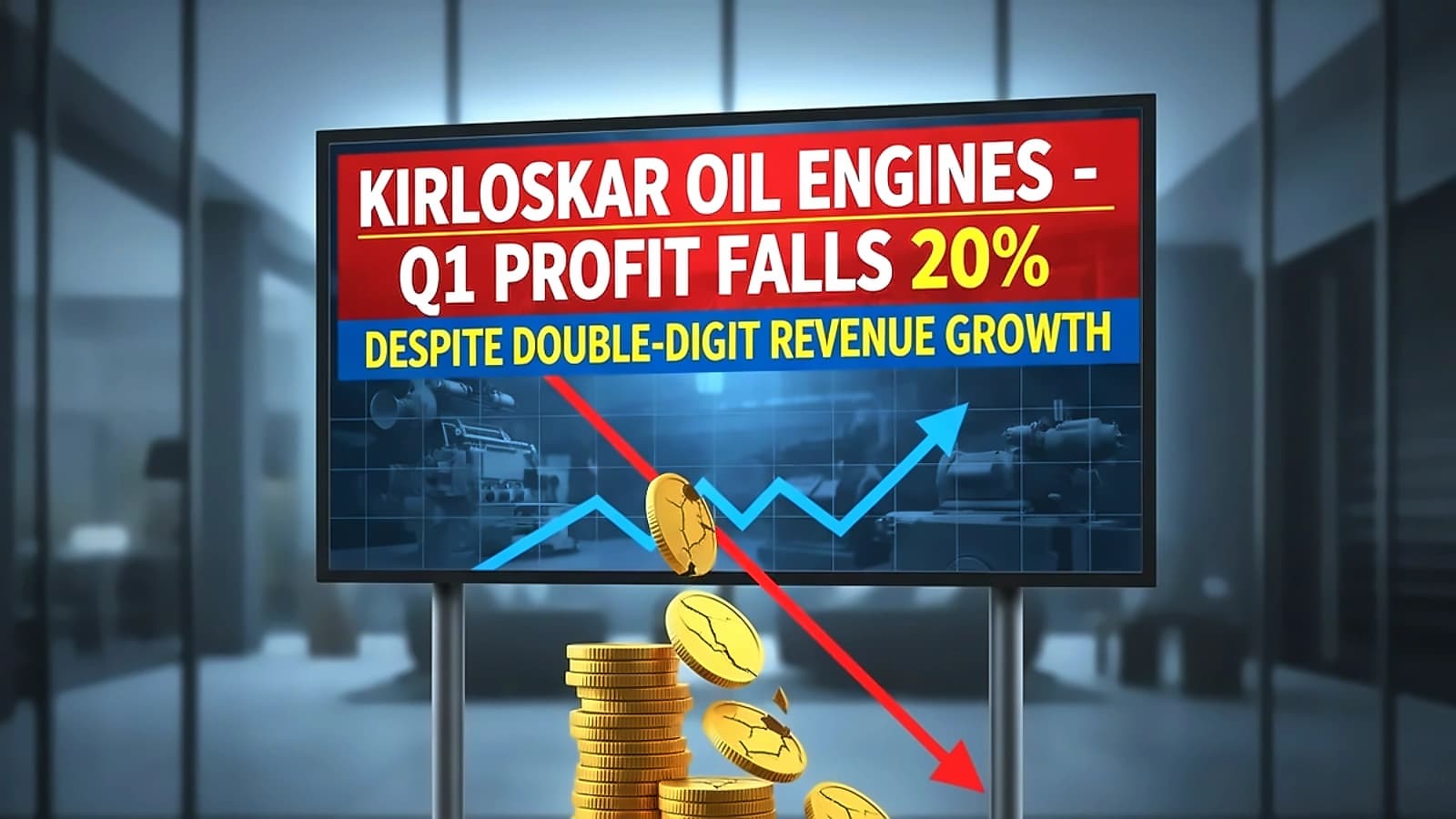
Kirloskar Oil Engines delivered robust fourth-quarter results with net profit rising 21% to ₹158.6 crore for the quarter ended March 31, compared to ₹131 crore in the same period last year. According to reports from CNBC TV18 and latest market data, the company's revenue from operations increased 21% year-on-year to ₹2,116.2 crore, while EBITDA grew 19.8% to ₹375.5 crore. The EBITDA margin remained largely flat at 18% compared to the year-ago quarter, indicating costs kept pace with revenue growth despite operational efficiency. On May 14, 2026, KOEL's stock closed marginally down at ₹1,594.90 on the NSE, with trading data showing the price around ₹1,619.40 and a market capitalization of approximately ₹23,403.56 crore, reflecting mixed investor sentiment despite the record financial results.

The company's quarterly performance was supported by strong demand across multiple business segments, as reported by CNBC TV18. Kirloskar Oil Engines experienced growth across low, medium and high horsepower power-generation segments, along with momentum in marine, railways and construction-related industrial applications. This diversified growth across both power generation and industrial sectors contributed to the overall positive financial results for the quarter. The performance benefited from execution focus, market-share gains in power generation and increased traction in international markets, with sector-wide absorption in industrial and warehousing rising 15.6% year-on-year in Q1 2026, fueled by manufacturing expansion and India's manufacturing Gross Value Added (GVA) growing robustly in Q1 and Q2 of FY25-26.
Despite strong operational performance, the company faced significant regulatory challenges during the quarter. According to CNBC TV18 and latest reports, Kirloskar Oil Engines recorded an exceptional item impact of ₹32.45 crore linked to proposed labor code-related regulatory changes. India unified its labor laws into four codes effective November 2025, while the '50% Wage Rule' impacting contributions like Provident Fund and gratuity may increase wage-linked costs. This regulatory shift, while potentially offering long-term efficiencies, introduces short-term cost pressures and uncertainty. The flat EBITDA margins in Q4 FY26, despite revenue growth, are a concern, indicating costs rose alongside revenue, meaning no cost savings from increased sales. Analyst ratings remain mixed, with KOEL being upgraded to 'Buy' in late March 2026, then downgraded to 'Hold' in early April 2026, reflecting mixed signals on valuation and technicals.
The current muted stock reaction to stronger profit growth indicates investor concerns offset the celebration of record financial results. KOEL's stock often reacted positively to earnings in the past, for example jumping over 10% on Q4 FY25 results in May 2025. However, the current muted response reflects other factors influencing the stock, with the company's Price-to-Earnings (P/E) ratio around 43.32x, higher than the Indian Machinery industry average of 26.1x but lower than a peer average of 51.8x. Competitors like Bharat Forge trade at a P/E of roughly 82.6x, and Cummins India at 62.63x, positioning KOEL at a moderate valuation among growth peers. The company maintains positive leverage with Debt/Equity of 1.24x, an exception among peers with negative leverage, indicating potentially higher financial risk.
The board recommended a final dividend of ₹4.5 per share for FY26, subject to shareholder approval, according to CNBC TV18. Including the interim dividend of ₹2.5 per share already declared, the total dividend for the fiscal year stands at ₹7 per share, representing 350% of face value. This substantial dividend payout reflects the company's strong cash generation capabilities and commitment to returning value to shareholders despite regulatory challenges. Looking ahead, investors will watch KOEL's cost management strategies and its capacity to capitalize on the recovery in private capital expenditure and infrastructure development. The company's ability to manage the financial impact of new labor codes and maintain margin growth amid rising industrial demand will be key factors for future performance.