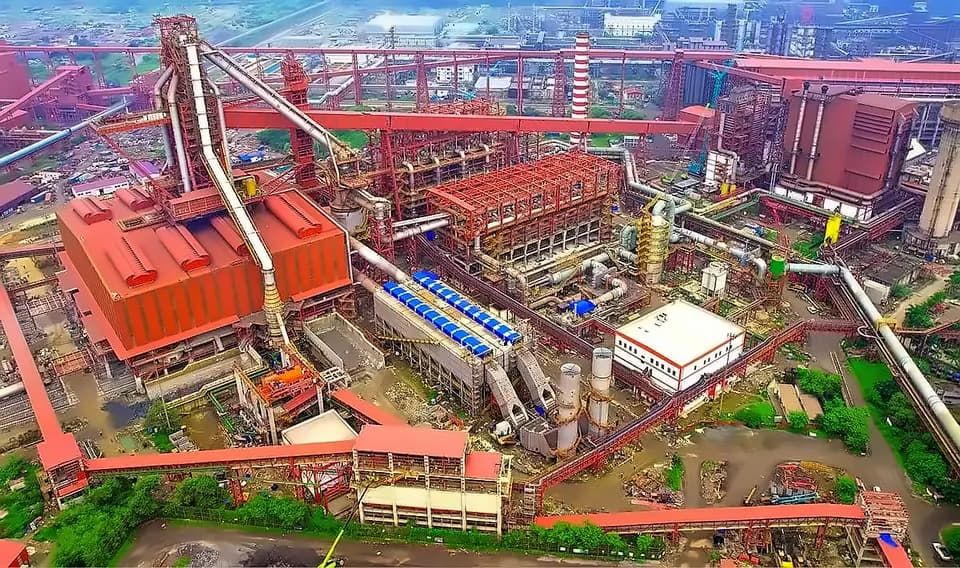
JSW Steel reported consolidated crude steel production of 6.59 million tonnes for the first quarter of FY 2026-27, representing a 3% year-on-year growth and 2% quarter-on-quarter increase. According to reports from The Hindu BusinessLine, the production growth was primarily driven by the full ramp-up of JVML operations and improved utilisation at the Dolvi Unit, despite challenges from capacity upgrades. The quarter had a mixed start with April production dipping about 1% due to a temporary shutdown of Blast Furnace-3 at Vijayanagar for capacity expansion work, but output rebounded sharply in May, rising 15% year-on-year as operations normalised, helping the overall quarter post a 3% gain despite the early disruption. The company's Indian operations specifically produced 6.35 million tonnes, up 3% year-on-year from 6.14 million tonnes and 0.3% sequentially from 6.32 million tonnes in the preceding quarter. As per The Hindu BusinessLine, the company's US subsidiary, JSW Steel USA – Ohio, produced 0.24 mt, flat year-on-year but up sharply from 0.15 mt in the preceding quarter. The production figures for prior periods have been restated to exclude output from the steel business of Bhushan Power and Steel Ltd (BPSL), which was transferred to JSW-JFE Steel Ltd, a joint venture company, in March 2026.
The Blast Furnace 3 (BF3) at Vijayanagar was under shutdown for capacity upgradation during the quarter, which began hot-metal production from June 23, 2026, leaving it operational for just over a week during the three-month period. As reported by The Hindu BusinessLine, excluding the BF3 production impact from the previous year's base, Q1 FY27 volumes would have grown approximately 15% year-on-year, demonstrating strong underlying operational performance. The company noted that the muted headline growth was largely attributed to the planned shutdown of Blast Furnace 3 at the Vijayanagar plant in Karnataka for capacity upgradation. This temporary disruption was part of the company's aggressive capacity build-out, expanding capacity by roughly 20% in 15 months to about 35.7 million tonnes per annum, with a longer-term target of 50 million tonnes by FY31. The strategic focus on excluding shutdown capacity from the utilization headline highlights management's intent to showcase the true health of active assets, which is a positive signal for margin stability. Unlike JSW Steel, Tata Steel benefited from higher production at its Jamshedpur and Kalinganagar facilities, supporting the company's double-digit production growth in India.
The capacity utilisation for Indian operations for Q1 FY27 (excluding BF3 capacity under shutdown) reached approximately 94%, indicating efficient operational management despite the temporary capacity constraints. According to The Hindu BusinessLine, this high utilisation rate demonstrates the company's ability to optimise production across its operational facilities during the quarter. The volume growth of 3% year-on-year indicates sustained demand in the domestic infrastructure and automotive sectors, with the company's ability to maintain 94% utilization while expanding production base by 3% YoY underscoring a structurally strong domestic demand environment. The exclusion of shutdown capacity suggests that underlying assets are running near peak performance, which typically leads to better absorption of fixed costs and improved EBITDA margins. The company also noted that the steel business undertaking of Bhushan Power and Steel Ltd. was transferred to JSW-JFE Steel Ltd. on a slump-sale basis in March 2026, with previous year's production figures adjusted for comparison. JSW Steel has a combined crude steel capacity of 37.9 million tonnes per annum (MTPA), including 4.5 MTPA through the JSW-JFE Steel joint venture, and plans to raise combined capacity to 54.8 MTPA over the next four years.
On July 3, 2026, JSW Steel commenced development work on a ₹16,350 crore integrated steel project in Andhra Pradesh's Rayalaseema region, marking a significant milestone in its expansion strategy. According to The Hindu BusinessLine, the project will be developed in two phases - the first involving an investment of ₹4,500 crore for an MTPA plant, while a second phase involving up to ₹11,850 crore will double the capacity to 2 MTPA. The facility will use electric arc furnace technology, with recycled scrap and high-grade direct-reduced iron as key raw materials, to produce structural steel for infrastructure and urbanisation-related demand. Additionally, on July 8, 2026, JSW Infrastructure announced a ₹2,100 crore captive jetty in Odisha to support JSW Steel's 13.2 MTPA expansion. The company is also expanding its Vijayanagar facility in Karnataka from 19.5 MTPA to about 25 MTPA by FY30, which would make it the world's largest single-location steel plant. The production update comes days after the major project announcement, with the company continuing to demonstrate its dominance in the Indian market through consistent volume growth and high asset utilization, positioning it well for its ongoing ₹20,000 crore annual capex trajectory as internal cash flows remain tied to high-utilization volume growth.
JSW Steel shares were trading at ₹1,228.50 on the NSE at 11.51 am on Thursday, up 0.74% from the previous close of ₹1,219.50, giving the company a total market capitalisation of approximately ₹3,00,497 crore. As per The Hindu BusinessLine, the stock has gained around 18% over the past year and trades at a trailing price-to-earnings multiple of 11.48. The company's robust financial performance, combined with consistent operational improvements and strategic capacity expansion plans, positions it well for continued growth in the Indian steel market. The strong market response reflects investor confidence in the company's operational efficiency and strategic expansion initiatives, with the stock trading at a premium valuation reflecting its growth prospects and market leadership position.