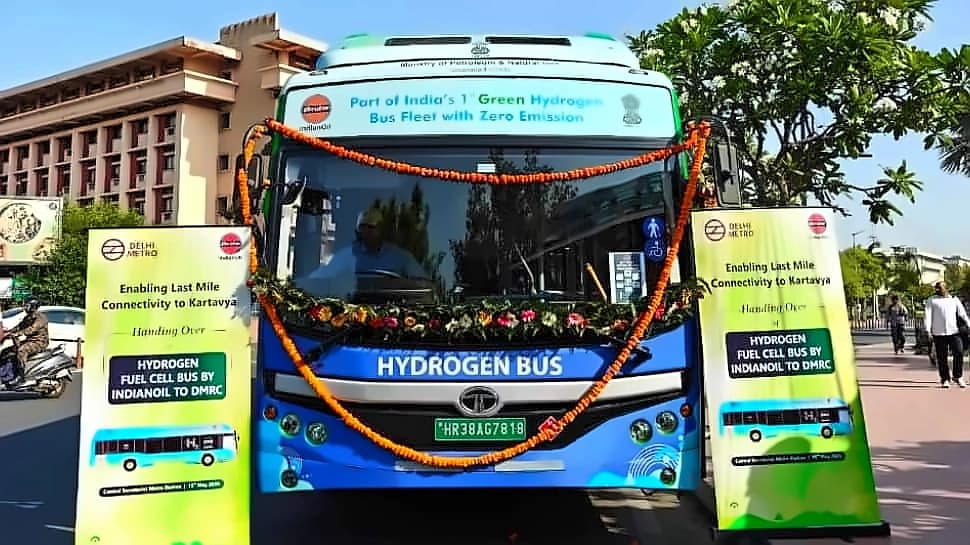
Delhi on Friday launched India's first hydrogen-powered shuttle bus service, marking a historic milestone in the country's transition towards zero-emission mobility. The Delhi Metro Rail Corporation (DMRC) introduced the clean-energy public transport initiative in the Central Vista area as part of India's broader push towards sustainable transport systems. The hydrogen fuel cell shuttle service began operations between Central Secretariat Metro Station and Seva Teerth Metro Station using two advanced hydrogen-powered buses supplied by Indian Oil Corporation Limited (IOCL). According to India Today, the initiative is aimed at promoting clean mobility and improving last-mile connectivity for commuters travelling between Central Secretariat and Seva Teerth Metro stations.
The latest service expansion has significantly enhanced the buses' route coverage, now connecting Central Secretariat and Seva Teerth metro stations with key landmarks and government offices including India Gate, Vigyan Bhawan, Kartavya Bhawan, and National Stadium. This expanded route network provides comprehensive connectivity for government officials and visitors to major administrative and cultural sites in the Central Vista area. The service operates every 30 minutes, with one bus moving clockwise and the other anti-clockwise through the Central Vista circuit, ensuring reliable and frequent service for commuters.
Each bus has a seating capacity of 35 passengers and comes equipped with GPS tracking, CCTV surveillance, intelligent transport systems, electronic braking systems and telematics-enabled maintenance monitoring. The service operates every 30 minutes, with one bus moving clockwise and the other anti-clockwise through the Central Vista circuit. The buses are built on Proton Exchange Membrane (PEM) fuel cell technology and are equipped with a 70-kilowatt fuel cell stack along with a 350-bar hydrogen storage system. The buses are 12-metre-long and operate on all working days from Monday to Friday, excluding gazetted holidays. Passengers can pay using the National Common Mobility Card (NCMC) with stage-wise ticket pricing kept affordable at ₹10 and ₹15. DMRC will manage bus operations, ticketing, passenger support and conductors, while IOCL will provide drivers and hydrogen fuel infrastructure support.
The hydrogen fuel supply mechanism is highly sophisticated, with IOCL sourcing fuel from its hydrogen plant and supplying it through a Hydrogen Refuelling Station (HRS) established at Indian Oil's Research and Development Centre. The hydrogen is produced using electrolyzer technology and elaborate safety arrangements have been built into both the buses and refuelling infrastructure. The Hydrogen Refuelling Station is equipped with hydrogen leak detectors, sprinkler systems, alarms, fire suppression systems and automated control logic to ensure safe storage and refuelling operations. Inside the buses, hydrogen leak detection systems and automated safety controls have been installed to ensure safe passenger operations at all times. The buses are currently operating in a trial phase and IOCL confirmed that all mandatory safety certifications and technical approvals were completed before the launch.
According to Kumar's statements to Zee News, India continues to face pressure in securing crude oil at the right price and at the right time, with around 89 per cent of India's crude oil requirement being imported. He emphasized that India has to continuously rebalance and re-navigate supply equations due to global energy uncertainties and crude oil supply tensions in the Gulf region. Despite these challenges, Kumar assured that IOCL's refinery operations remain stable, with all 10 refineries currently operating at over 100 per cent capacity. The hydrogen bus initiative represents a strategic move towards energy independence and fuel efficiency in India's transportation sector.