Maharashtra Chief Minister Devendra Fadnavis launched the cooperative-based ride-hailing platform 'Bharat Taxi' at Navi Mumbai International Airport, marking a significant shift from traditional app-based taxi aggregators. According to reports from The Economic Times, Devdiscourse, and Rediff Moneynews, the service was inaugurated in the presence of Union Minister of State for Cooperation and Civil Aviation Murlidhar Mohol, Maharashtra Cooperation Minister Babasaheb Patil, MPs, MLAs, senior government officials and representatives of the cooperative sector. The launch follows the successful rollout of the platform in Delhi and Gujarat as part of the Centre's push to expand the cooperative model into new sectors. Fadnavis addressed the gathering, stating that the vision of Prime Minister Narendra Modi and Union Cooperation Minister Amit Shah was now becoming a reality in Maharashtra through Bharat Taxi, marking a new chapter for the cooperative movement by expanding it into the digital mobility sector.
As reported by The Economic Times, Devdiscourse, and Rediff Moneynews, Fadnavis addressed the event highlighting that app-based taxi services had improved convenience for commuters but created problems including surge pricing, hidden charges and aggregator commissions for both passengers and drivers. He explained that whenever there is heavy rain, festivals or high demand, fares increase sharply, but the additional earnings rarely reach the drivers, instead the profits largely go to the aggregators. The Bharat Taxi platform addresses these concerns through a cooperative model where drivers, referred to as 'Sarathis', would not only provide services but also become owners and shareholders of the cooperative institution. Union Minister Mohol stated that under the 'Sahakar Taxi' framework, drivers become direct owners and profit-shareholders rather than employees. Approximately 8 lakh drivers nationwide have enrolled in the broader cooperative network, receiving over ₹77 crore directly into their accounts without middleman deductions. The platform offers transparent fares, direct payments and no surge pricing, with payments credited directly into drivers' bank accounts and every driver becoming a member of the cooperative, making them eligible to receive dividends whenever the cooperative earns profits.
The initiative aims to improve urban mobility by integrating cooperative transport services with Mumbai's public transport network, providing on-demand connectivity between Metro stations, railway stations, bus terminals and commuters' final destinations. According to mid-day online, the Brihanmumbai Municipal Corporation (BMC) signed an MoU with Bharat Taxi to strengthen last-mile connectivity across Mumbai by integrating app-based transport services with railway stations, Metro stations and bus terminals. The MoU was exchanged by Abhijit Bangar, Additional Municipal Commissioner (Projects), BMC, and Colonel Himanshu Singh, Chief Executive Officer of Sahakar Taxi Co-operative Limited. Similar partnerships have been signed in other cities, with the Ahmedabad Municipal Corporation signing an MoU with Sahakar Taxi Co-operative Limited in June to strengthen first- and last-mile connectivity through its Mobility as a Service (MaaS) platform. State Cooperation Minister Babasaheb Patil, legislators Mahesh Baldi, Prashant Thakur and Manda Mhatre, Cooperation Secretary Pravin Darade, Joint Secretary in the Union Ministry of Cooperation Raman Kumar, Cooperation Commissioner Deepak Taware, Sahakar Taxi Chairman Dr Jayen Mehta, Thane Municipal Commissioner Saurabh Rao, and other dignitaries were present at the launch event.
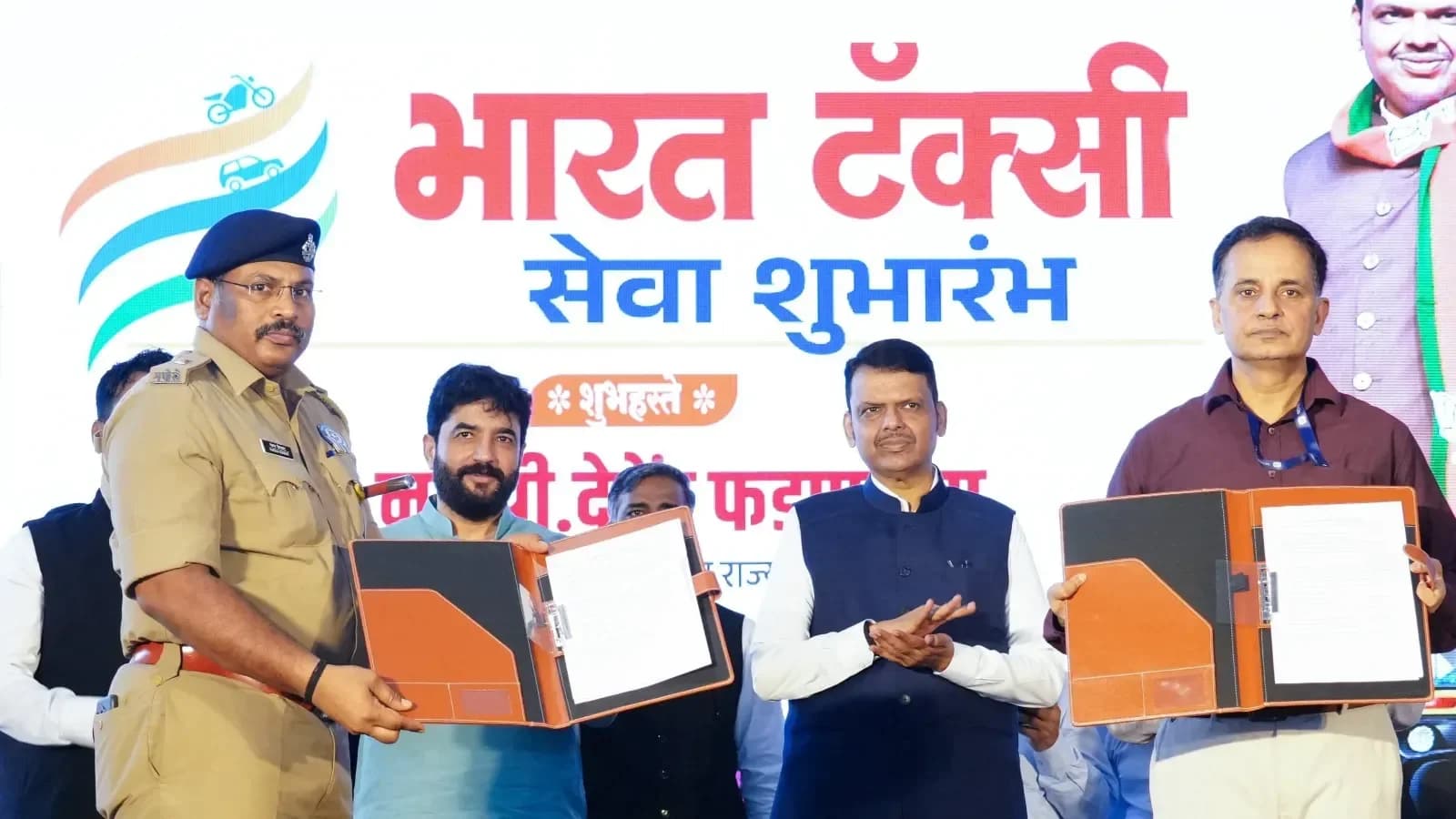
According to Rediff Moneynews, Bharat Taxi operates on a zero-commission and surge-free pricing model with direct profit distribution to drivers, positioning it as an indigenous alternative to foreign investment-based platforms. Fares are capped at ₹31 for the first 1.5 kilometers and ₹21 per kilometer thereafter, aligned with traditional meter-taxi rates. Speaking at the joint launch event, Fadnavis emphasized that commuters won't face surge pricing during festivals and heavy monsoon downpours while using Bharat Taxi. He stated that "Private aggregators made significant contributions, but passengers and drivers face severe hardship from inflated surge fares and heavy commissions." In the first phase, 600 taxis are affiliated to the service in the Mumbai Metropolitan Region, with plans to scale beyond 1,000 units shortly before expanding across Pune and Maharashtra. An MoU was signed between the state government and Sahakar Taxi Co-op Ltd during the event, with the state's Cooperative Department overseeing all financial transactions.
According to the government reports, an agreement with the Late D. B. Patil Cooperative Transport Society will help provide taxis through credit facilities to around 3,000-4,000 local youth living around the Navi Mumbai International Airport. Union Minister Mohol stated that the launch marked a new chapter in Maharashtra's cooperative movement and would create employment and self-employment opportunities for youth and women. Cooperation Minister Babasaheb Patil said Bharat Taxi would provide safe and reliable transport while creating employment opportunities for thousands of youths, empowering drivers through digital booking, transparent fares and cooperative ownership. The platform offers emergency insurance cover of up to ₹5 lakh and support from institutions such as NCDC, IFFCO, NAFED, Amul, KRIBHCO, NDDB, NABARD and NCUI to help the platform expand across the country.