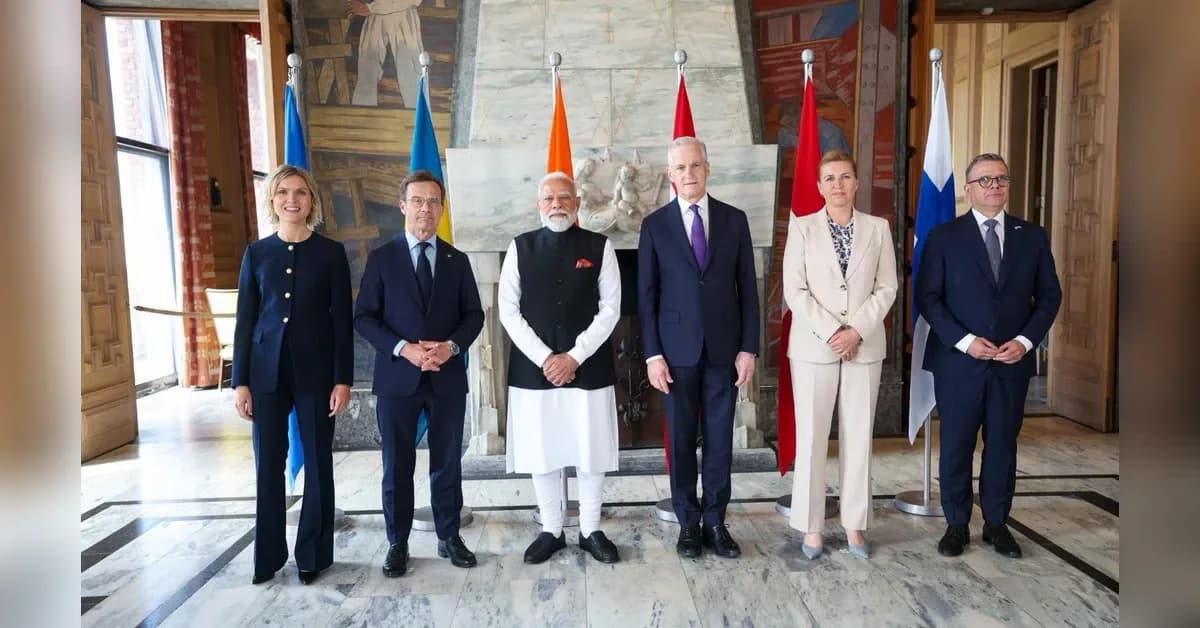
The 3rd India-Nordic Summit in Oslo has emerged as far more than a routine diplomatic gathering, representing a structural shift in how India is positioned within the emerging global order. When Denmark's Prime Minister Mette Frederiksen described India as "not a middle power, but one of the world's greatest powers," it signalled a broader geopolitical transition where India is increasingly being seen as a co-author of global climate, technology and governance frameworks. According to analysis by Akshara Agrawal in One World Outlook and Somen Chatterjee in India Narrative, the summit represented "the moment a relationship that had been, at best, a 'nice-to-have' arrangement crystallised into a strategic alignment." The partnership has moved beyond symbolic engagement into a purpose-driven framework built around green transition, technological collaboration and geopolitical coordination. As noted by Chatterjee, the summit marked "a quiet but consequential re-wiring of global technology governance," where New Delhi was no longer functioning as a passive consumer of global rules but increasingly as "a co-author of digital and AI norms."
Indian Prime Minister Narendra Modi's whirlwind tour of Nordic countries and Italy over the past week has yielded significant strategic breakthroughs in technology and defense sectors. Dutch chip equipment giant ASML agreed to a deal with India's Tata Electronics during Modi's trip, marking a major milestone in India's semiconductor manufacturing capabilities. The summit has provided institutional scaffolding for ambitious partnership goals, with the India-EU Free Trade Agreement concluded in January 2026 and the India-EFTA Trade and Economic Partnership Agreement operationalised in late 2025 creating the foundation for strategic ambitions announced in Oslo. Under the EFTA agreement, which includes Norway and Iceland, the bloc has committed to a USD 100 billion investment ambition in India over fifteen years, with substantial focus areas including green hydrogen and digital infrastructure. Current trade between India and the Nordic countries stands at roughly USD 19 billion, while more than 700 Nordic companies already operate in India and around 150 Indian companies are present across the Nordic region.
The strategic convergence is built on deeply complementary capabilities, with Nordic economies possessing advanced expertise in wind energy, geothermal systems, green hydrogen, maritime decarbonisation, battery technology and digital governance, while India offers scale, manufacturing capacity and a rapidly expanding technology ecosystem. As noted by Akshara Agrawal, "For Nordic innovation to achieve global impact, it needs markets and manufacturing partners of India's size." The partnership extends into digital governance and AI frameworks, with the summit's emphasis on "inclusive, human-centric AI" reflecting convergence between Nordic governance values and India's emerging digital diplomacy. The Nordic countries' endorsement of India's AI Impact Summit in New Delhi carried major political significance, recognising India as capable of shaping global AI governance frameworks rather than merely adopting standards designed elsewhere. Chatterjee specifically highlights that the "AI Impact Declaration organises cooperation around seven chakras," including inclusion, resilience, safe AI and democratising AI resources, creating an alternative developmental framing that differs sharply from security-centric AI debates in Washington and Brussels.
The summit fundamentally reframed India's role in global climate governance, with Nordic leaders endorsing India-led initiatives such as Mission LiFE and LeadIT 3.0, signalling that advanced economies increasingly see India as a co-architect of the global climate transition. Akshara Agrawal argues that "the language of donor and recipient has been replaced by the language of co-authors," with India now occupying a unique diplomatic position capable of articulating the developmental concerns of the Global South while simultaneously engaging advanced economies on technology partnerships and rules-based governance. The partnership extends to Arctic cooperation, with India and the Nordic countries agreeing to deepen collaboration in Arctic research, sustainable economy initiatives and maritime governance. Chatterjee links Arctic cooperation directly to climate governance and digital systems, noting that "the future of climate action will increasingly rely on AI, remote sensing, data infrastructure and digital monitoring systems," areas where India and the Nordic countries are now building alignment. The summit's Arctic cooperation agenda also drew significant attention, with Agrawal noting that "India's role as an observer in the Arctic Council is increasingly being viewed not as symbolic but strategic," especially as climate change opens new Arctic shipping routes and transforms energy geopolitics.
While both analysts celebrate the India-Nordic partnership as evidence of a "more plural, post-Western, yet still rights-conscious order," they acknowledge potential challenges in maintaining democratic values. Chatterjee warns that India's expanding digital governance ecosystem raises concerns regarding surveillance, exclusion and concentration of state power, arguing that "for India, this will require humility as well as ambition," including stronger protections for privacy and dissent within digital governance frameworks. He suggests that Nordic countries, with stronger traditions of civil liberties and data protection, could provide important democratic counterweights within the partnership. Agrawal similarly argues that India's rise reflects "strategic multi-dimensionality," the ability to operate simultaneously as a developing economy advocating climate equity and as a major power shaping global technology and governance frameworks. The "Green Technology and Innovation Strategic Partnership" formally established at the summit represents a long-term institutional framework linking cooperation to clean energy, blue economy initiatives, shipping, climate innovation and digital systems. As Chatterjee concludes, "If this works, norms about 'trusted' infrastructure, open standards and interoperability will not be written solely in Brussels boardrooms or Silicon Valley campuses, but co-crafted in a New Delhi-Helsinki-Stockholm triangle."