HDFC Bank announced that Managing Director and CEO Sashidhar Jagdishan will retire on October 26, 2026, after deciding not to seek a third term. According to reports from Business Standard, Jagdishan told the bank's board on Saturday that he wanted his successor to start with a 'clean slate' after the pending issues have been addressed. The bank's board accepted Jagdishan's decision after persuasion efforts failed, with the announcement made in a stock exchange filing. This succession occurs amid ongoing governance scrutiny and recent regulatory issues, creating additional challenges for the bank's leadership transition. The bank's shares have significantly underperformed its peers and the broader market, highlighting the urgent need for new leadership to restore investor confidence and address business challenges.
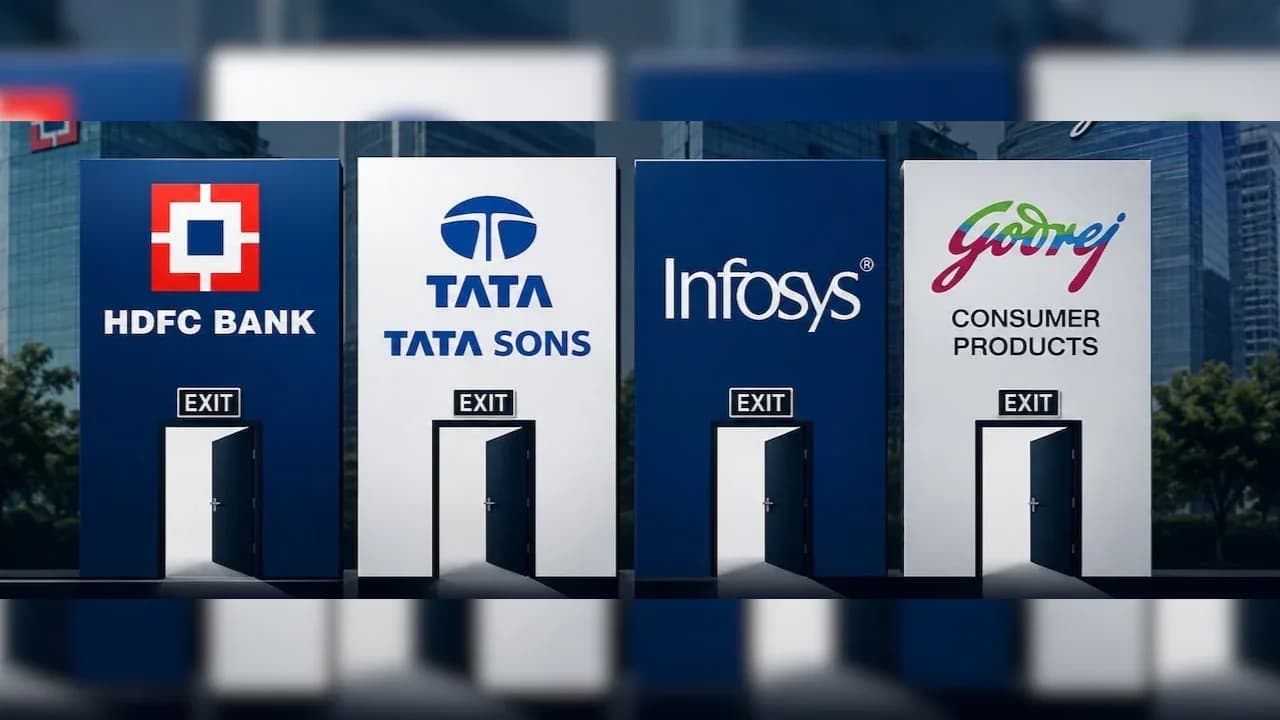
Tata Sons Chairman N. Chandrasekaran stepped down in August 2026 ahead of the group's annual general meeting, bringing an end to his tenure at the helm of the Tata Group. As reported by Essential Business Intelligence, his exit triggered a sell-off across several listed Tata companies, highlighting the significant impact of leadership changes on market sentiment. The timing of his departure ahead of the AGM underscores the strategic nature of this transition within India's largest conglomerate.
Godrej Consumer Products CEO Sudhir Sitapati resigned as MD and CEO in August 2026, just three months after being reappointed for another five-year term. According to Essential Business Intelligence, the company appointed CFO Aasif Malbari as his successor. Meanwhile, Colgate-Palmolive India's MD and CEO Prabha Narasimhan is stepping down to take up the position of executive vice president, marketing, for the company's Asia-Pacific division. Manish Anandani will succeed her as MD and CEO of the India business.
Infosys CEO and MD Salil Parekh is set to step down in 2027, ending his tenure after nearly nine years with the company. As reported by Essential Business Intelligence, Infosys has appointed Ashiss Kumar Dash as his successor. This transition comes as the IT services giant prepares for a significant leadership change in one of India's most prominent technology companies.
HDFC Bank's Part-Time Chairman Atanu Chakraborty abruptly resigned in March 2026, while Rajiv Kumar, former NITI Aayog vice chairman, was appointed as an additional independent director and designated part-time chairman in June, subject to RBI approval. According to Business Standard, Puneet Sharma was appointed as CFO-designate in June and is slated to take over as CFO from December 1, 2026. The bank is considering Kaizad Bharucha as a potential next CEO and seeking an external candidate for the top position, following recent leadership changes and governance concerns. The Reserve Bank of India must approve the final appointment for the MD and CEO position. The board's Nomination and Remuneration Committee has been asked to fast-track the process, and a successor would be identified within two months, with Kaizad Bharucha being the only internal candidate who could potentially take over.
The bank faces significant governance scrutiny following recent internal investigations and disciplinary actions. On May 27, The Indian Express reported that HDFC Bank's Audit Committee had ordered an internal vigilance investigation into payments totalling ₹45 crore made to the Maharashtra State Road Development Corporation's deposits during FY2024 and FY2025. The payments were allegedly routed through the bank's marketing department and presented as contributions to a road-safety campaign rather than as differential interest on deposits. In late July, the bank's board concluded an internal disciplinary process relating to the MSRDC arrangement and issued warning letters and imposed a monetary penalty of ₹1 lakh each on Jagdishan, Chief Financial Officer Srinivasan Vaidyanathan and Group Head of Retail Assets Arvind Vohra. The board characterised the conduct as 'business overreach' rather than mala fide action, personal enrichment or improper motive, and decided that the matter should be communicated to the RBI. Earlier in March this year, the bank had taken action against three executives, including Sampath Kumar, group head of branch banking, for their alleged involvement in mis-selling of Credit Suisse Additional Tier-1 bonds. The bank had in September 2025 informed the stock exchanges about an action taken by the Dubai Financial Services Authority (DFSA) barring its Dubai International Financial Centre (DIFC) branch from onboarding new clients. The bank's executives were accused of inflating income details of NRI clients to qualify them for AT-1 bond purchases, a product typically reserved for high-net-worth investors.
HDFC Bank's institutional ownership has remained remarkably stable despite recent challenges. According to ET Now, foreign ownership in HDFC Bank stood at 39.46% in June 2021 and remained at 39.6% at the end of June 2026, yet the number of foreign investors holding the stock increased from 1,325 to 2,065. This data reveals that while foreign ownership percentage has barely moved, the ownership base has expanded significantly. The bank's shares have significantly underperformed its peers and the broader market, highlighting the urgent need for new leadership to restore investor confidence and address business challenges. The recent governance concerns raised by former Chairman Atanu Chakraborty have added another layer of uncertainty, but the bank's systemically important status means stability comes before everything else for the RBI.