Bharti Airtel delivered impressive financial results in Q4FY26, with consolidated revenue growing 15.7% year-on-year to ₹55,383 crore and EBITDA rising 16.6% to ₹31,492 crore. The company achieved margins of 56.9% and demonstrated strong operational efficiency. For the full year FY26, revenue grew 22% to ₹2.11 lakh crore while EBITDA increased 28.5% to nearly ₹1.2 lakh crore. The balance sheet showed significant improvement with free cash flow generation remaining strong and consolidated net debt excluding leases declining by nearly ₹47,500 crore year-on-year to roughly ₹91,000 crore, with leverage falling to 0.84 times from nearly 1.5 times.
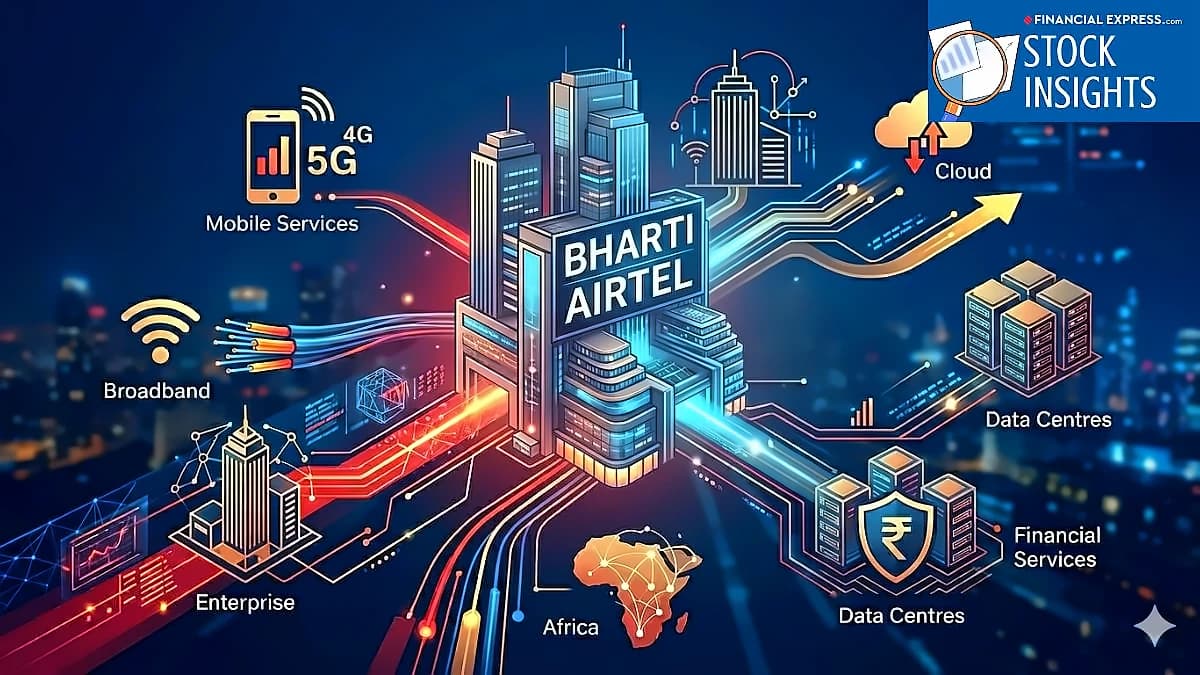
The company is positioning itself as part of India's digital infrastructure layer, moving beyond traditional telecom operations. Home broadband revenue rose 37.3% year-on-year in Q4FY26 with subscriber base reaching 14.2 million users. The enterprise business is scaling across cloud, connectivity, security and IoT solutions with order book growth of 17% during FY26. Management has outlined ambitious plans to build nearly one gigawatt of data centre capacity over the next few years, which would imply a 25% market share according to company management. The company is also building 56 edge data centres over the next 18 to 24 months while continuing investments in fibre backhaul and cloud infrastructure.
Despite strong financial performance, investor focus has shifted from subscriber growth to ARPU optimization. In Q4FY26, India mobile ARPU stood at ₹257 compared to ₹259 in the previous quarter, representing a ₹2 decline. Market expectations for FY28 ARPU have moderated from around ₹318 to nearly ₹308. The company's cloud business is gaining traction with nearly 25 cloud deals already signed, indicating growing demand for sovereign cloud offerings. Management highlighted that Africa now contributes nearly 29% of Airtel's overall revenue with revenue from Airtel Africa growing 40.9% year-on-year in Q4FY26.
The market is increasingly valuing Airtel as a premium digital infrastructure business rather than a traditional telecom operator. India business excluding Airtel Africa and Indus Towers trades at 12.8x and 11.6x FY27E and FY28E Enterprise Value to EBITDA respectively, higher than both global telecom peers and Airtel's historical valuations. Management has indicated that FY27 capital expenditure is likely to remain broadly similar to FY26 levels as the company continues investing in fibre, cloud and data centre infrastructure. The transformation from a survival-focused telecom operator to an infrastructure platform for India's digital economy represents a significant shift in the company's strategic positioning.