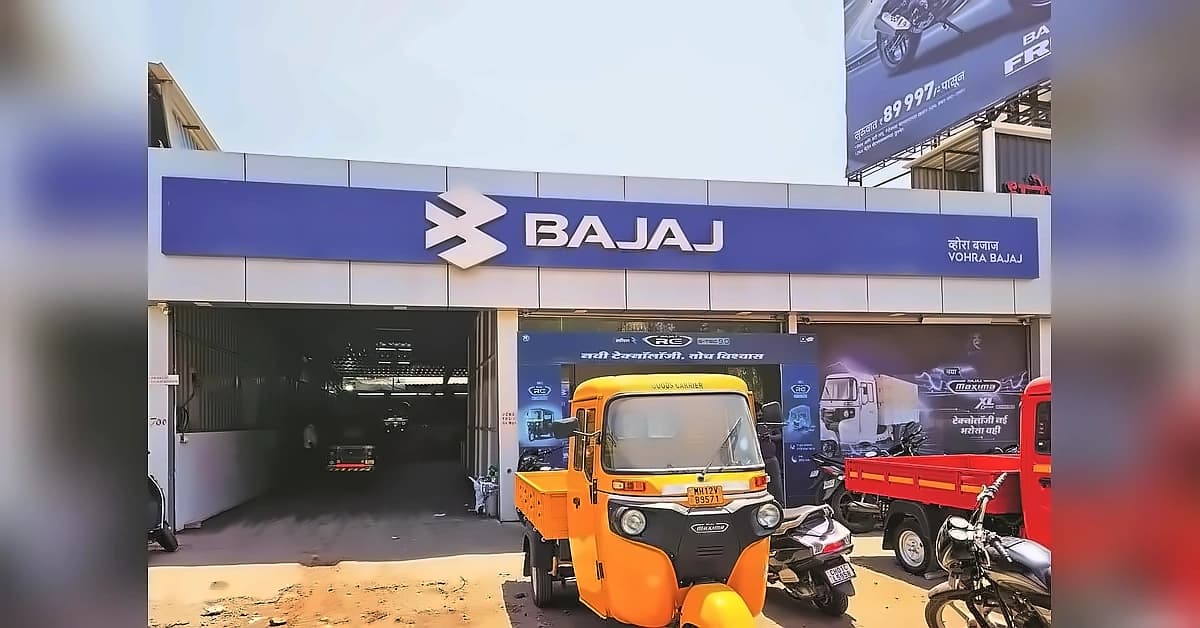
Bajaj Auto shares hit a 52-week high of ₹12,470 in Tuesday's intraday trading, gaining 3% and appreciating 31% from its three-month low of ₹9,505 hit on June 30, 2026. The stock currently trades above its share buyback price of ₹12,000 per share, with the company having repurchased 4.69 million shares through the tender route in July 2026. As per Business Standard, the stock is trading close to its all-time high level of ₹12,772.15 touched on September 27, 2024, reflecting strong investor confidence in the company's performance trajectory.
Bajaj Auto reported total sales of 5,35,764 units in August 2026, up 28% year-on-year compared with 4,17,616 units in the same month last year. As per The Economic Times, two-wheeler sales were particularly strong, rising 30% to 4,43,748 units from 3,41,887 units in August 2025. The key highlight was the sharp rise in exports, with domestic two-wheeler sales increasing 10% to 2,55,708 units, while exports surged 51% to 2,80,056 units, underscoring the growing contribution of overseas markets to Bajaj Auto's overall sales performance. The commercial vehicle segment also maintained healthy momentum, with sales rising 22% to 92,016 units, supported by an 11% increase in domestic sales and a stronger 39% growth in exports.

According to ET Now, Rakesh Sharma, Joint Managing Director of Bajaj Auto, revealed that while the company is experiencing strong growth in electric scooters, supply constraints for its Chetak EV are limiting the ability to fully capitalise on robust demand. Sharma noted that electric scooters are witnessing a strong growth rate and are increasingly cannibalising ICE scooters, with EVs expected to become a substantial part of the overall scooter segment going forward. However, the company is losing some market share in electric scooters due to supply constraints, even as it maintains more than 70% market share in ICE scooters. On the broader two-wheeler market, Sharma indicated that the 150cc-plus motorcycle segment is driving industry growth, while the entry-level 100cc segment continues to remain weak despite witnessing the lowest prices.
The company's strong operational performance extended beyond August sales, with Bajaj Auto delivering robust quarterly results for Q1 FY27. As per Business Standard, the company's standalone profit after tax increased 42.3% year-on-year to ₹2,983 crore in Q1 FY27, while PAT rose 8.6% quarter-on-quarter from ₹2,746 crore in Q4 FY26. Revenue from operations climbed 37.0% YoY and 7.7% QoQ to a record ₹17,244 crore in Q1 FY27, marking a significant milestone for the automotive manufacturer. These quarterly results demonstrate the company's ability to translate strong sales performance into improved profitability and revenue growth across its diversified automotive portfolio.
According to ET Now, Sharma said the company's next phase of capacity expansion will focus on electric two-wheelers, electric three-wheelers and premium motorcycles, signalling a greater emphasis on EVs and higher-value segments. The company expects exports to remain at sustainable levels of around 2.5 lakh units per month. Bajaj Auto is currently transitioning to a new product portfolio with recent launches, which has resulted in some moderation at dealerships. The company's management expects exports to pass the 250,000 units per month level based on leadership in the sports segment of Latin America and more aggressive share gains in commercial bikes in Africa, while focusing on seven key areas including domestic motorcycles and achieving superior competitive position in the 125cc-plus segment.