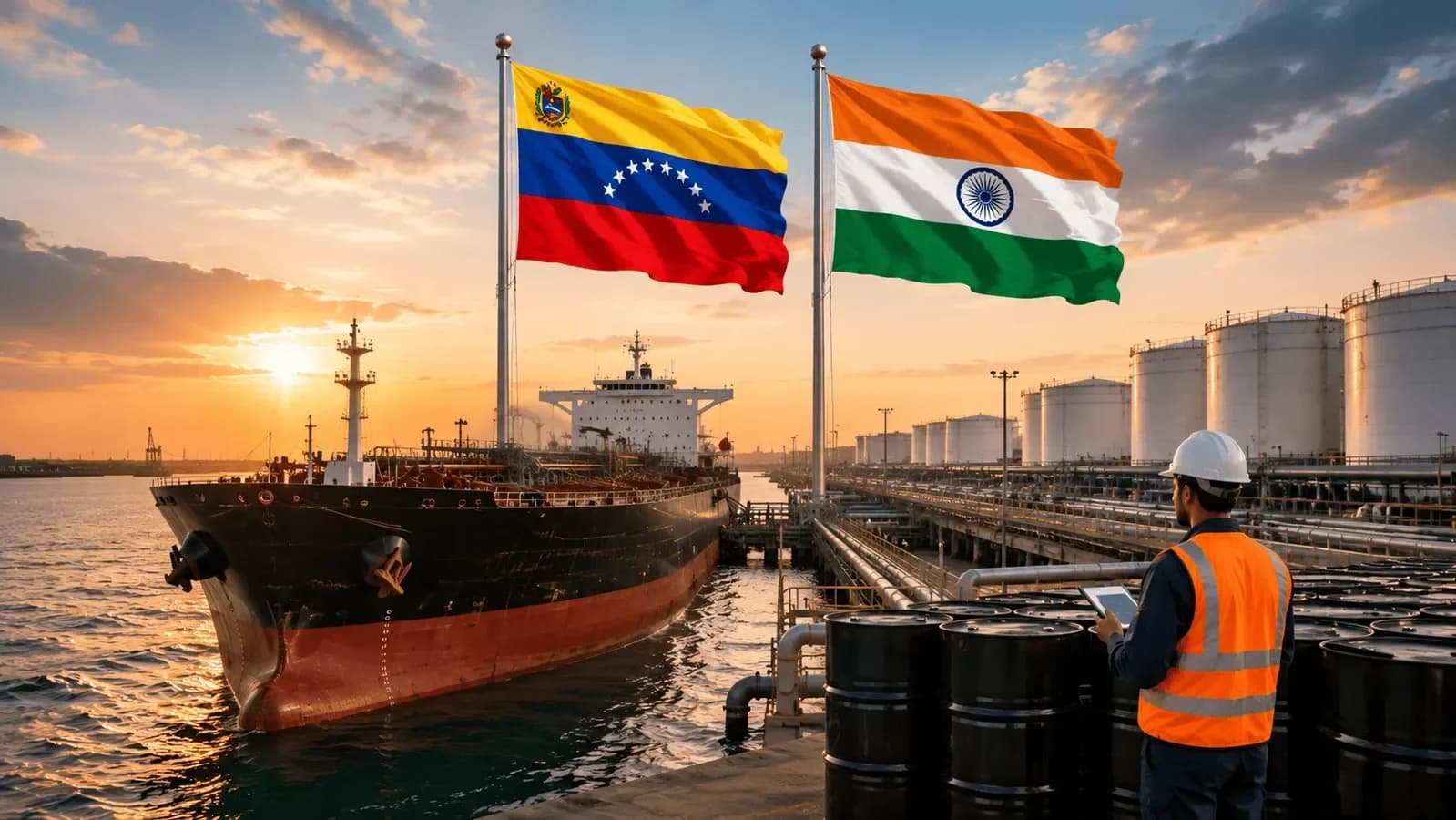
Venezuela has emerged as India's third-largest crude oil supplier in May 2026, overtaking Saudi Arabia and the United States, as Indian refiners increased purchases of cheaper heavy crude amid disruptions linked to the ongoing West Asia conflict. According to energy cargo tracker Kpler, the South American nation supplied around 417,000 barrels per day (bpd) to India this month, sharply higher than 283,000 bpd in April and compared with zero supplies during the previous nine months. The surge comes after the US eased restrictions on Venezuelan oil exports following the January capture of Venezuelan President Nicolás Maduro. As per Kpler analyst Nikhil Dubey, Indian buyers have historically shown strong interest in Venezuelan barrels due to their attractive economics and compatibility with complex refining systems, with Venezuelan crude particularly suited to Reliance Industries' advanced refinery in Gujarat. Only Russia and the United Arab Emirates supplied more crude oil to India than Venezuela in May, highlighting the dramatic shift in India's crude sourcing strategy.
Indian refiners have historically shown strong interest in Venezuelan barrels due to their attractive economics and compatibility with complex refining systems, as noted by Kpler analyst Nikhil Dubey. Venezuelan crude is particularly suitable for complex refineries such as Reliance Industries' refinery in Gujarat, which can efficiently process heavier and high-sulphur crude grades. According to The Economic Times, a number of Indian refiners, particularly Reliance Industries, have upped their buys from Venezuela. Nayara Energy, Indian Oil Corporation Limited (IOCL), and HPCL-Mittal Energy Limited (HMEL) are also among the refiners that can process Venezuela's Merey blend, which is a heavier and sour crude grade. India's overall crude imports rose 8 per cent month-on-month to 4.9 million barrels per day in May, though imports still remained below the 5.2 million barrels per day recorded in February before the Iran war disrupted regional shipping routes. However, most other Indian refiners can process this high-sulphur, heavy grade only in limited quantities, making Reliance Industries one of the biggest beneficiaries of the Venezuelan surge due to its advanced refining infrastructure.

Saudi Arabia's supplies to India nearly halved to 340,000 bpd in May from 670,000 bpd in April, largely due to what analysts described as aggressive pricing of Saudi crude. According to The Economic Times, analysts blamed "aggressive pricing" by Saudi producers, which in turn increased the allure of Venezuelan crude. Saudi Arabia and the UAE have been rerouting oil through alternative pipelines to bypass the Strait of Hormuz, with Saudi crude being moved through the East-West pipeline to Yanbu on the Red Sea. As per Kpler analyst Nikhil Dubey, this decrease happened primarily due to the aggressive pricing of Saudi barrels, making them less competitive compared to Venezuelan crude in the current market environment.
The parallel visits by US Secretary of State Marco Rubio and Venezuelan Acting President Delcy Rodriguez to India demonstrate how energy diplomacy is increasingly being shaped by the geopolitical fallout from the wars involving Iran and Venezuela. Rubio, who will travel to India from May 23 to 26 for talks on trade, defence cooperation and energy security, said Washington wants to make sure India buys as much energy as it will purchase. "We also think there's opportunities with Venezuelan oil. In fact, it's my understanding that the interim president of Venezuela will be travelling to India next week as well," Rubio stated. India has longstanding ties with Venezuela's oil sector, with Indian state-owned firms led by ONGC Videsh entering Venezuela in 2008 seeking access to heavy crude reserves. By 2010, Indian consortia had secured stakes in major projects, including Carabobo-1 in the Orinoco Oil Belt, while in 2012, India overtook China as the largest Asian importer of Venezuelan crude. Before US sanctions intensified in 2019, Venezuela was among India's biggest oil suppliers, but sanctions imposed by Washington on PDVSA forced Indian refiners to sharply reduce purchases to avoid secondary sanctions.
India has significantly diversified its crude sourcing strategy since the Strait of Hormuz effectively became inaccessible due to the ongoing conflict in West Asia. Russian crude continues to form the backbone of India's oil imports, with flows estimated at around 1.6 million barrels per day in April and 2 million bpd in May, the highest since June 2025. However, analysts say the measure is only a short-term fix as India faces growing pressure from Washington to reduce its dependence on Russian energy imports. "India's options right now are essentially sanctioned Russian crude or heavy crude from Venezuela," Marc Ayoub, an energy policy researcher and consultant, told Al Jazeera. "The waiver on Russian oil only applies to cargoes that were already loaded, and much of that supply has already been depleted." India increased imports due to cheaper pricing, compatibility with complex refineries, and disruptions in West Asian supply routes. The easing of US sanctions had also briefly allowed India to resume imports from Iran in April after a seven-year gap, though no Iranian cargoes have reached India this month because of the US naval blockade of Iranian ports.
India currently holds around 60 days of petroleum supplies, including strategic reserves, according to government estimates. According to The Times of India, New Delhi currently has around 60 days of oil left, including its strategic reserves. Analysts believe that India's crude basket is likely to remain diversified in the coming months, with Russian and Venezuelan barrels expected to play a larger role as refiners continue prioritising supply security and refinery optimisation amid ongoing geopolitical uncertainty. The ongoing reshuffle in crude sourcing highlights how geopolitical tensions, sanctions and oil prices are forcing Indian refiners to rapidly diversify supply sources. The development comes at a time when petrol and diesel prices have risen in India, the rupee has weakened sharply, and inflation concerns are increasing due to elevated crude oil prices, making cheaper Venezuelan crude a welcome relief to refiners facing margin pressure amid volatile global energy markets.