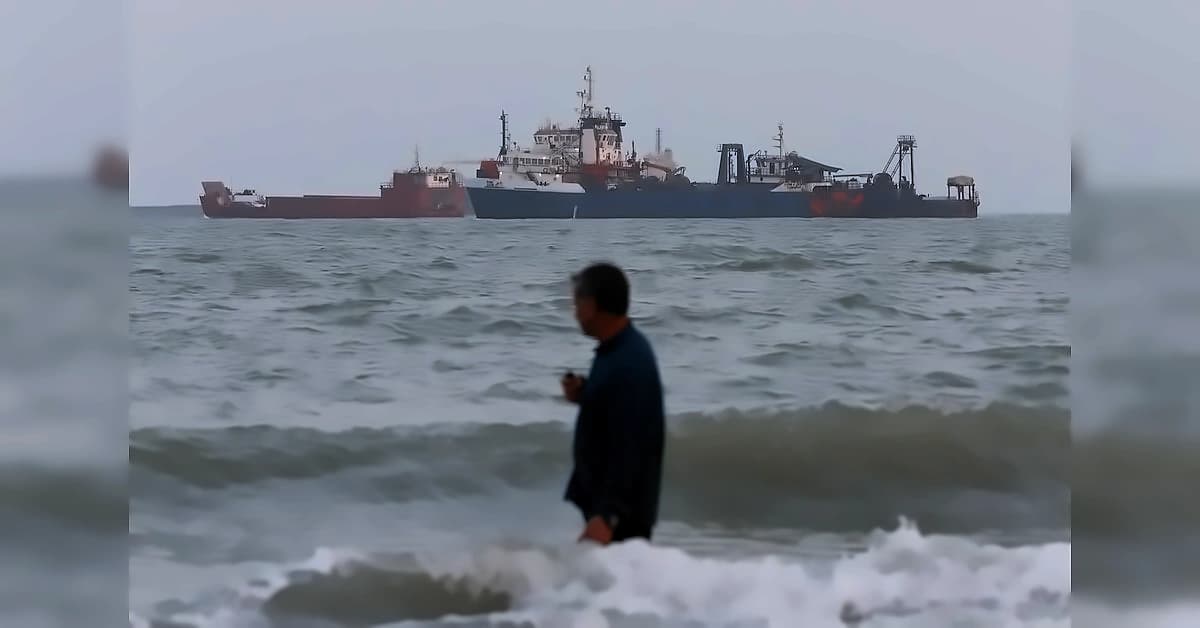
Iran has closed the vital Strait of Hormuz after firing a warning shot that struck a vessel traveling on an unapproved route, marking a significant escalation in the ongoing conflict with the United States. According to Business Standard, Iran warned that any retaliation over the incident would be met with a 'severe response' as the strait remains closed until 'the end of US interference in this region,' the Revolutionary Guards said. The closure comes after Iran confirmed eight members of its armed forces were killed after US strikes targeted military sites in the southern cities of Bandar Abbas and Bushehr early on Wednesday, marking a sharp escalation in tensions between Tehran and Washington despite a fragile ceasefire. US Central Command identified the vessel as the M/V GFS Galaxy, a Cyprus-flagged container ship, saying it suffered significant engine-room damage and that a civilian crew member was missing. Iran said several ships attempted to move through the waterway on an 'unauthorized route' and disregarded warnings to correct their course. As per Business Standard, the Navy of Iran's Islamic Revolutionary Guard Corps said in a statement that a vessel that had jeopardized maritime security by switching off its systems was struck and brought to a halt, without giving any details about the ship.
President Donald Trump ordered the strikes after the Islamic Revolutionary Guard Corps struck the M/V GFS Galaxy container ship traveling through the Strait of Hormuz on Sunday, as reported by Business Standard. Central Command said it began its strikes at 7:15 p.m. ET (2315 GMT) on Saturday, roughly an hour after the Iranians released their statement, which included a warning that 'new enemy bases' in the Middle East would be targeted if the United States retaliated for the container ship incident. The fresh round of strikes came after the US military accused Iran of attacking commercial vessels transiting the Strait of Hormuz, a key global oil shipping route. Trump shared fresh visuals on Wednesday showing US strikes across multiple Iranian cities, with footage depicting large fires and explosions in the southeastern city of Iranshahr. In a further post on Wednesday, Trump reshared footage showing a large orange fireball and rising smoke over a built-up area, with a silhouette resembling an aircraft visible in the sky above rooftops and palm trees in the foreground. The United States is demanding that Iran publicly state it will stop attacks on ships in the strait - and that all lanes will be open with no tolls through the waterway, senior US officials told reporters on Friday, as reported by Business Standard.
Iran's Central Military Command has announced that the Strait of Hormuz is 'completely closed' to all ships following the fresh US attacks, with the Khatam al-Anbiya command saying it will target 'any vessel traffic' through the Strait, including oil tankers and commercial ships, and warned that any vessel attempting passage 'will be shot at'. According to Associated Press, Iran has told ships not to leave anchorage in the Persian Gulf and the Sea of Oman, saying that 'approaching the Strait of Hormuz will be considered cooperation with the enemy'. Iran's Revolutionary Guards navy, quoted by state media, claimed it had already hit two ships it accused of trying to 'illegally' pass through Hormuz, and declared that 'following repeated violations of the ceasefire by the American enemy, the Strait of Hormuz will be closed until further notice'. This represents a significant escalation from previous warnings, with Iran now explicitly threatening to fire on any vessel attempting to cross the strait. Iran's Armed Forces of the Islamic Republic of Iran will deliver a crushing response to the U.S. aggression and terrorist action, as stated by the command carried by state broadcaster IRIB.
Kuwait, Bahrain and Qatar activated emergency alerts after Tehran launched attacks following renewed US strikes on Iranian military targets. On Wednesday, Iran launched attacks on Bahrain and Kuwait over an earlier round of US airstrikes against Iran, as reported by Business Standard. Both Bahrain, home to the US Navy's 5th Fleet, and Kuwait, home to US Army forces, sounded missile alerts on Wednesday morning. The Revolutionary Guard issued a statement acknowledging targeting US military installations in both countries. Kuwait said it intercepted two ballistic missiles and 13 drones launched by Iran. The Kuwaiti Electricity Ministry said a number of lines were out of service after shrapnel fell on them. Bahrain sounded its missile alert a second time later Wednesday morning, according to NPR reports, suggesting the escalation continued throughout the day. Qatar has condemned the attacks as a 'serious and explicit violation' of international law, with the country's foreign ministry saying it 'holds Iran fully legally responsible' for the strike on the Al Rekayyat tanker. This marks the first time an LNG ship from Qatar, a mediator in talks between the US and Iran, has been struck since the start of the Iran war on February 28. The current escalation represents the most serious confrontation since the US and Israel have been at war with Iran and its regional allies since 28 February, after strikes killed Khamenei and several other officials.
A senior Iranian source told Reuters that Iran, the US, Qatar and Pakistan had agreed to negotiate in a call that mediators were trying to arrange for Saturday while Foreign Minister Abbas Araqchi was in Oman, a Gulf state trying to mediate an end to the war. According to CNN, Oman made a draft proposal for the strait, including free navigation through its southern corridor in Omani territorial waters. The plan called for vessels transiting the northern corridor through Iranian territorial waters to obtain prior approval from Iran, although no tolls would be imposed. Araqchi and Omani Foreign Minister Badr Albusaidi met in Oman to exchange 'views on appropriate mechanisms for the safe passage of ships through the Strait of Hormuz,' according to a statement from the Iranian foreign minister. Oman's state news agency said Omani and Iranian negotiators would continue talks 'at the technical and political levels.' However, it was not immediately clear whether those efforts succeeded. Qatari mediators held talks in Tehran on Friday, as reported by Business Standard, with the flare-up casting further doubt over the future of an interim agreement aimed at ending the conflict and pushing oil prices higher, a politically sensitive issue for Trump ahead of November congressional elections. Iran's Foreign Minister Abbas Araqchi has accused the United States of violating the ceasefire agreement, writing on X on Friday that 'There can only be mutual compliance.'
The escalating conflict has created significant disruptions to global oil markets and shipping operations. Iranian state media reported explosions on Kharg Island, the country's main oil export terminal that typically handles about 90% of Iran's crude exports, as well as on Qeshm Island near the Strait of Hormuz, following the US strikes. The United States also revoked a temporary license that had allowed Iran to openly sell crude oil on international markets under an interim understanding linked to the ceasefire. The Treasury Department notice issued Tuesday said the earlier authorisation had now been 'revoked and superseded in its entirety,' with buyers of Iranian crude having until July 17 to wind down transactions already in progress. The temporary easing had allowed Iran, for the first time in years, to openly market its crude in US dollars, helping increase traffic through the Strait of Hormuz and contributing to a decline in global oil prices in recent weeks. Brent crude, the international benchmark, rose about 3% to around $76 a barrel, while US benchmark West Texas Intermediate surged nearly 6%, climbing back above $70 a barrel for the first time since June 30, as traders weighed the risk of further disruption to oil supplies passing through the Gulf. The Strait of Hormuz carries roughly one-fifth of the world's seaborne oil trade, making any threat to shipping there a major concern for global energy markets. There has been no official word yet on flight disruptions at Kuwait or Bahrain's airports, though both countries host major aviation hubs and US military assets that have previously seen air traffic affected during earlier rounds of hostilities. About a fifth of the world's oil supply transited through the Strait of Hormuz before the war, and Iran's effective blockade of the waterway has caused energy prices to surge, fuelling global inflation.