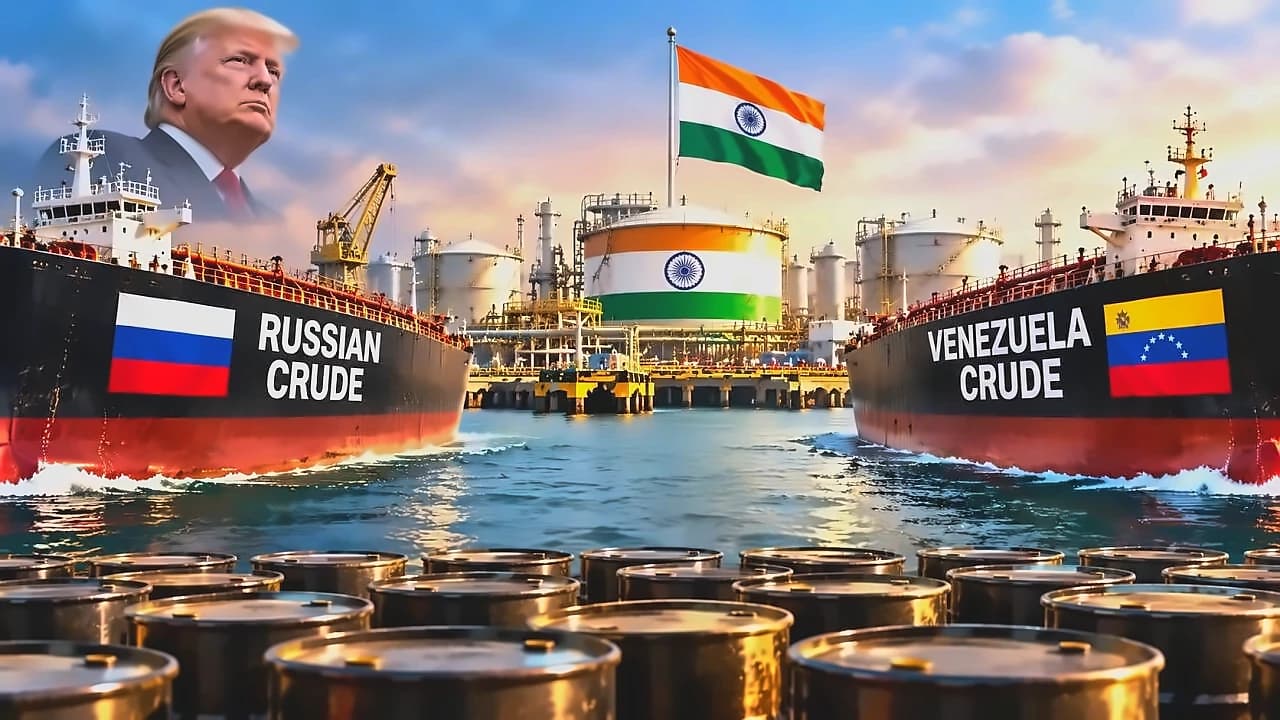
The Donald Trump administration is actively encouraging India to increase crude oil purchases from Venezuela as part of its strategy to reduce dependence on Russian energy supplies. According to reports from The Times of India, US Secretary of State Marco Rubio's recent visit to India to discuss these possibilities with Reliance clearly demonstrates America's push to increase the market for Venezuelan supplies while encouraging India to diversify away from Russian oil. Russia currently remains India's biggest crude oil supplier, having gained a substantial share of the country's imports after Indian refiners stepped up purchases of discounted Russian barrels.
India's attraction for the US lies in its sophisticated refining capacity, particularly Reliance's Jamnagar complex, which can process heavy Venezuelan grades that many refineries cannot easily handle. As reported by The Times of India, Rubio has called India a refining superpower, and expanding purchases could give Venezuelan oil a larger market while offering India another source of crude. The complex's ability to handle heavy-sour crude at scale makes it the principal buyer for Venezuelan crude, with IOC another potential buyer given its ability to manage large volumes of residue yield and sulphur content. Rubio visited Reliance's Jamnagar refinery complex in Gujarat, accompanied by US Ambassador Sergio Gor, and discussed the company's global energy landscape, technology, data centres and opportunities for commercial partnerships with chairman Mukesh Ambani and executive director Anant Ambani.
According to Kpler data reported by The Times of India, India imported 4.71 million barrels per day of crude in August and 5.33 million barrels per day in September. Venezuela's share was 7.4% at the August peak, 3.7% in September and 5.7% in October. Praveen Rai, Director at Grant Thornton Bharat, estimates that India can realistically absorb around 400,000–550,000 barrels per day of Venezuelan crude on a sustained basis, with short-term volumes potentially approaching 600,000 bpd under favourable conditions. The current Venezuelan imports reached around 444,000 bpd in August 2026.
The biggest challenge with Venezuelan crude is its high viscosity and complex refining requirements. As reported by The Times of India, the crude is high in metals such as vanadium and nickel and in acidity, which poison catalysts and corrode equipment. More than half of each barrel is residue, requiring sophisticated refineries with cokers, hydrocrackers and ample hydrogen to earn margins. Indian refineries are currently operating at 105-110% utilization rate, and higher portions of Venezuelan crude can hamper refinery runs. The September dip in Venezuelan purchases is consistent with this sensitivity, where coker margins on residue plus discount exceed freight and distillate yield penalty. Rubio indicated that Indian refiners had the technical capacity to handle heavy oil and that Reliance had processed Venezuelan crude in the past, with Washington wanting the company to process more Venezuelan oil and potentially increase production in Venezuela.
Indian customs data for August 2026 show Venezuelan crude landed at $66 per barrel, representing a $24 per barrel discount to the Indian Crude Basket compared with $88 for Russian and $93 for Iraqi and Arab Light grades. However, the headline discount can be eroded by freight costs, as Venezuela is roughly twice as far as Russia and about five times as far as the Middle East. Industry estimates suggest a discount of about $10-14 per barrel to Brent is needed to offset freight, insurance, and higher processing costs. The biggest competitive obstacle is the US Gulf Coast, whose refineries are well suited to Venezuelan crude and much closer to loading ports. The distinction between Venezuelan crude processing at Jamnagar and the proposed Brownsville refinery project is important, as the Texas deal involves capital investment and long-term purchase commitments for American shale oil processing, while the Jamnagar discussions focus on potential Venezuelan crude processing.