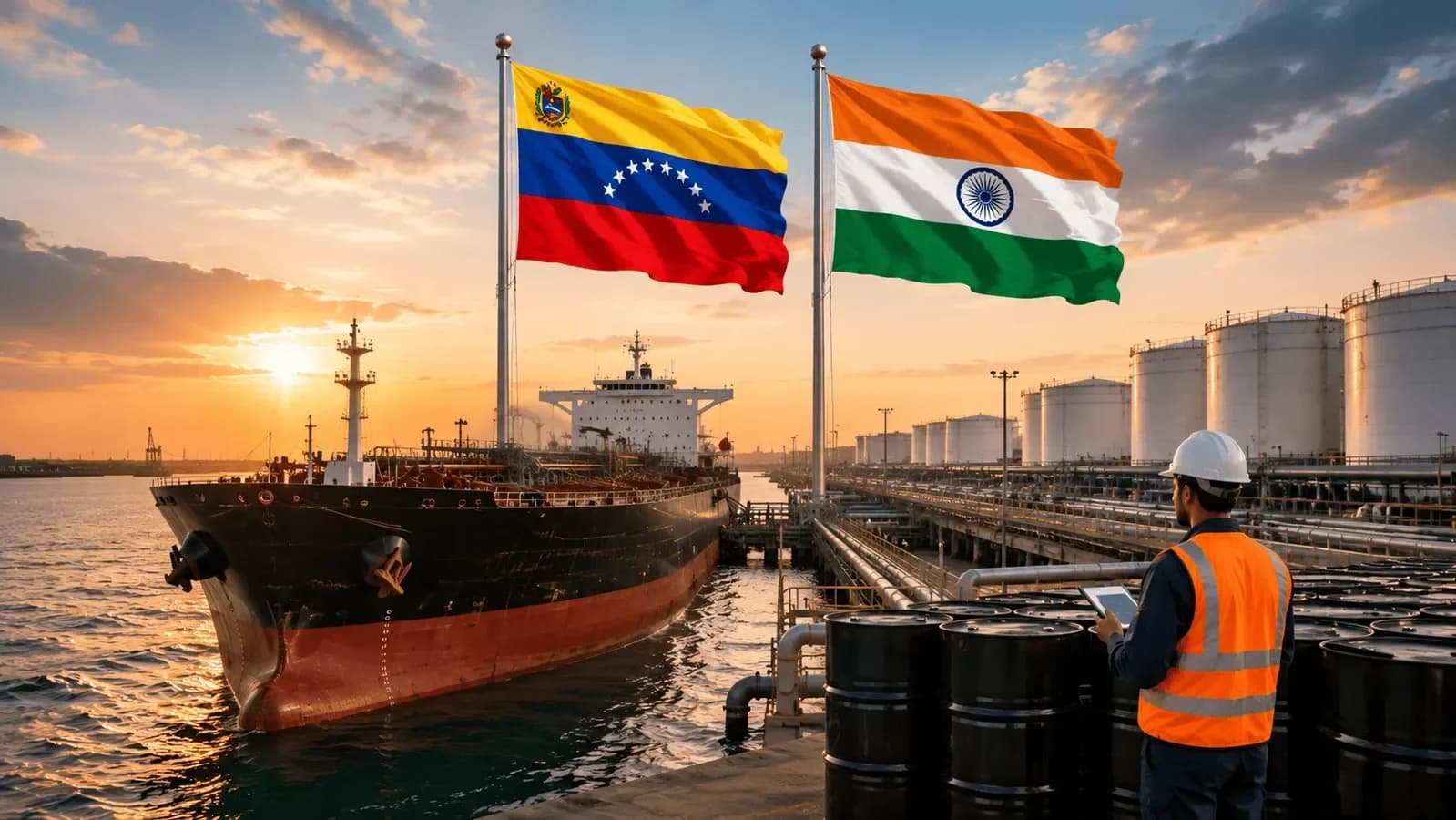
India may continue purchasing Venezuelan oil as long as US sanctions exemptions remain, balancing costs and logistics. According to reports from The Hindu BusinessLine, the easing of US sanctions on Venezuela has provided a window for India to source crude from the South American country, with Indian refiners likely to continue purchases as long as the exemption remains in place and the economics are favourable. As reported by sources tracking the matter, New Delhi does not want to make many long-term strategies around crude sourcing from Venezuela because one does not know when the US could reimpose sanctions.
Venezuela has emerged as a key crude oil supplier for India, making its way into the list of the top 5 suppliers since the US-Iran war began. According to The Times of India, Venezuela ranks as the fourth largest crude oil exporter for India, with supplies touching 444,000 barrels per day in August, which was more than more than the volumes India took from Iraq or the United States. As reported by Kpler data, Latin American crude now accounts for 12.7% of India's imports during April-July, up from 3.5% a year earlier, while the Middle East's share fell to about 30% from 43%. This crude oil goes almost entirely to a handful of refineries built to handle it, chiefly Reliance's Jamnagar, plus Paradip, Mundra and Vadinar.
Despite its emergence as a major supplier, Venezuela faces significant supply constraints that limit its ability to replace other sources. According to Rystad Energy, Venezuelan exports have averaged around 1 million barrels per day since March 2026, with India receiving approximately 300-400 thousand barrels per day. The US remains the primary destination for Venezuelan crude, as its complex refineries seek to maximize utilization of residue-conversion units. As noted by PwC India's Manas Majumdar, Venezuelan barrels have historically traded at discounts to benchmark crude, helping refiners improve margins, but logistical challenges, longer shipping distances and geopolitical uncertainties mean Venezuela cannot replace India's traditional dependence on Middle Eastern suppliers or recent Russian oil.
The economics cannot be assessed simply by comparing the price of a barrel of Venezuelan crude with other grades. As reported by sources to The Hindu BusinessLine, its heavy composition tilts the product slate toward more heavy fuel oil and bitumen, alongside diesel, kerosene, naphtha and other refined products. The product slate changes depending on the type of crude, with everything having a market value, although heavy fuel oil is among the lower-value products. Refineries may also need to be retooled to handle the heavier crude, requiring careful calculation of how much of each product can be extracted from a barrel and what those products are worth.
Experts emphasize that Venezuelan crude serves as an important diversification rather than a cornerstone for India's crude sourcing strategy. According to Kpler's Naveen Das, Venezuela could supply India perhaps 400-600 thousand barrels per day at a stretch, but it's a useful extra leg, not a pillar. PwC India's Manas Majumdar notes that Venezuelan crude can account for nearly 10% of India's approximately 4.5 million barrels per day of crude imports, providing valuable diversification and strengthening the country's crude-supply security. If Venezuelan crude cannot make up for the bulk and type that Russian crude provides, India would look to its diversified sources including the US, West African producers, Brazil, alternate routes from Saudi Arabia and UAE, and of course Venezuela as one component of a portfolio approach to maintain energy security.