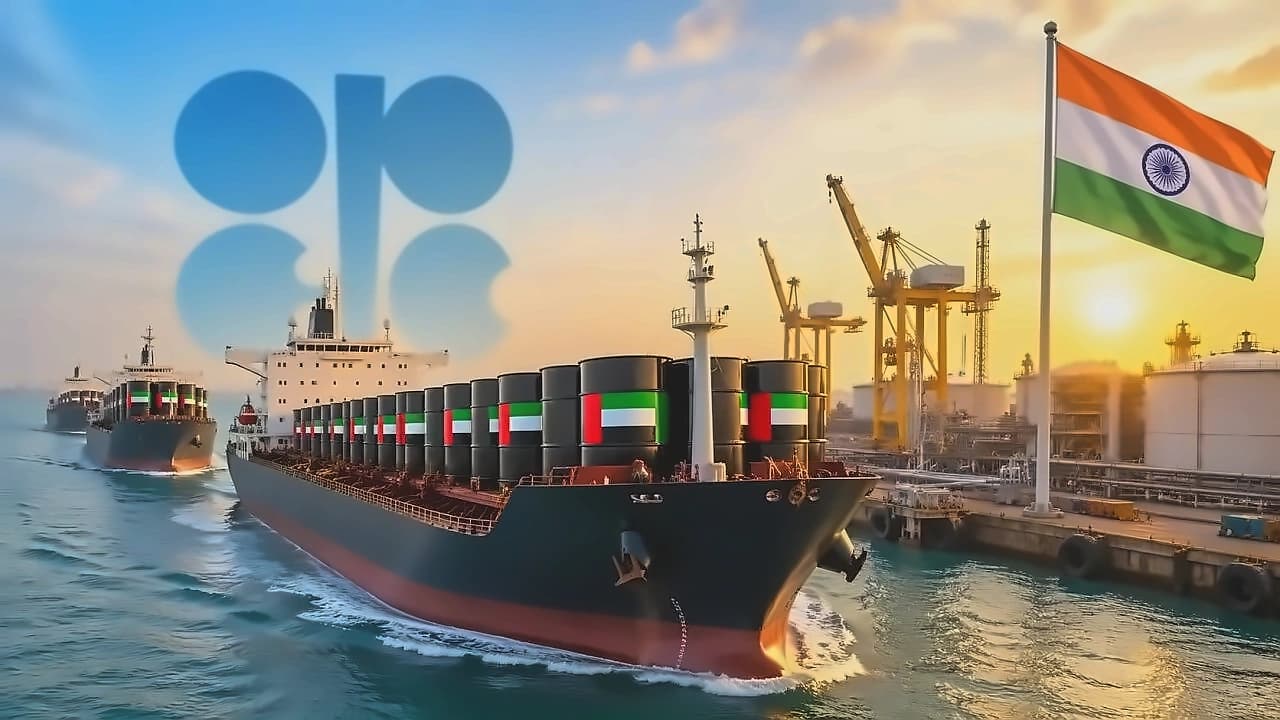
The United Arab Emirates officially left Opec on May 1, 2026, ending a longstanding disagreement over the group's quota system for oil production. According to reports from Business Standard, the UAE's Energy Minister Suhail Al Mazrouei told the New York Times that "The world needs more energy, the world needs more resources and the UAE wanted to be unconstrained by any groups." The UAE was the fourth-largest oil producer in Opec, accounting for 13% of its production, making its departure a significant loss for the cartel. The UAE's Fujairah port, which exports an average of 1.7-1.8 million barrels of crude oil and refined fuels per day, came under Iranian attacks during the recent conflict.
Following its Opec exit, the UAE's state-owned oil company, Abu Dhabi National Oil Company (ADNOC), pledged to spend $55 billion on new projects over the next two years. As reported by Business Standard, ADNOC aims to expand production capacity to five million barrels per day (bpd) by 2027 from the current 4.8 million bpd (as of April–May 2026). According to Ebtesam Al Ketbi, president of Emirates Policy Centre, "ADNOC's announcement of $55 billion in project awards signals that Abu Dhabi wants to monetise capacity faster and lock in future demand, especially in Asia." The UAE's former ambassador to the UAE, T P Seetharam, noted that "This decision obviously gives them (the UAE) freedom from many of the restrictions of Opec."

India stands to gain significantly from the UAE's newfound independence, as the emirate is no longer constrained by Opec quotas. According to Business Standard, India is one of the largest importers of crude oil, and the UAE is the fourth-largest crude supplier, behind Russia, Saudi Arabia and Iraq. The UAE and India already have a local-currency settlement framework, and analysts suggest the UAE may expand rupee-dirham settlement selectively for strategic India ties. Afaq Hussain from the Atlantic Council noted that "India is already part of the bloc. In India, the UAE, Israel and the US, there is already an I2U2 (strategic partnership) framework that exists."
Beyond crude oil, the India-UAE energy relationship extends to liquefied natural gas (LNG). In January, the two countries signed a deal worth $2.5 billion-$3 billion for ADNOC Gas to supply 500,000 tonnes of LNG every year to Hindustan Petroleum Corporation for the next 10 years. According to Business Standard, the UAE and India are evaluating a proposed deepwater subsea pipeline corridor to transport crude oil directly between the two nations. Under the strategic petroleum reserves programme launched in 2015, India now stores 5.33 million tonnes of UAE-supplied oil in underground caverns at Mangalore, Padur, and Visakhapatnam, with plans for another 6.5 million tonnes at Padur and a new facility in Odisha's Chandikol.
The UAE's departure from Opec represents a fundamental shift in global energy politics, with analysts questioning whether Opec will ever regain its former prominence. As reported by Business Standard, Jack Rystand from energy research firm Rystad Energy stated that "It is reasonable to question whether Opec will ever attain the prominence it once had." The current Iran war and blockade of the Strait of Hormuz have severely affected India-UAE trade, with Indian exports to the UAE crashing by 61.9%. However, experts remain hopeful that the situation will bounce back when normal passage resumes in the Strait. The UAE's newfound flexibility as an independent producer could potentially accelerate the shift away from dollar-denominated oil trade, with discussions already underway about rupee-dirham trade between India and the UAE.