The Decision That Shocked Oil Markets
On April 28, 2026, the United Arab Emirates announced its withdrawal from the Organisation of the Petroleum Exporting Countries and the broader OPEC+ alliance, effective May 1. This decision ends nearly six decades of membership that began in 1967 when Abu Dhabi joined the organization. The move comes at a critical juncture—the Iran war has created unprecedented supply disruptions through the Strait of Hormuz, with oil prices soaring from approximately $73 per barrel before the conflict to around $113 by late April 2026. The timing is strategic. Energy Minister Suhail Mohamed Al Mazrouei stated the decision was made to "limit the disruption to fellow producers" since the Strait of Hormuz remains effectively closed, meaning the immediate market impact is negligible. This allows the UAE to exit without triggering immediate price volatility or OPEC retaliation.
Strategic Objectives Behind the Exit
The primary strategic objective driving UAE's exit is the desire for greater flexibility in production decisions. Under OPEC quotas, the UAE was constrained to producing approximately 3-3.5 million barrels per day, despite having production capacity approaching 4 million bpd and ambitious plans to reach 5 million bpd by 2027. This meant holding more than 1 million bpd of unused capacity under quota constraints—one of the largest idle volumes among major exporters. The financial logic is straightforward: spare capacity that cannot be produced generates no revenue. Estimates suggest that deploying even half this capacity could generate $16.4-32.9 billion annually at $90 per barrel, with potential for $54.8 billion at higher prices. These projections align with Baker Institute estimates that freer production could generate $50 billion or more annually once capacity expansion is complete.
The Diversification Paradox
UAE's exit from OPEC must be understood within the context of its ambitious economic transformation agenda. Non-oil sectors already account for approximately 75% of UAE's GDP, representing remarkable progress from an economy that was overwhelmingly oil-dependent just decades ago. However, oil revenues remain crucial for funding the diversification transition. The UAE is racing to diversify its economy, expanding into sectors such as education and technology. Ironically, doing so requires pumping out more oil to accumulate the capital required to transition toward a post-oil economy. This creates a strategic imperative to maximize oil revenues while demand remains robust. The strategy embodies a counterintuitive but logical approach: maximum current production generates maximum current revenue, which funds diversification investments in technology, education, and renewable energy.
Impact on OPEC's Relevance
UAE's departure represents a significant blow to OPEC's effectiveness precisely when the organization faces its greatest challenge. The UAE was OPEC's third-largest producer, pumping approximately 3.4 million bpd pre-war—equivalent to about 4% of global production. More importantly, the UAE had the second-highest spare production capacity after Saudi Arabia. Spare capacity is the idle production that can be brought online quickly to address major crises. The UAE's departure removes one of the core pillars underpinning OPEC's ability to manage the market. OPEC loses approximately 12-15% of its total capacity with UAE's exit, and the organization also loses one of its most compliant members. This undermines OPEC's ability to present a united front and enforce discipline among remaining members.
Energy analysts have offered stark assessments of OPEC's post-UAE future. Saul Kavonic from MST Financial described UAE's exit as "the beginning of the end" for the alliance. Jorge León from Rystad Energy noted that OPEC will become "structurally weaker" as a consequence. Neil Atkinson, former IEA official, called it "a major blow to the future effectiveness" of OPEC. Once normal production resumes after the Iran conflict, OPEC's ability to influence price direction will be clearly weakened. The organization was already facing declining relevance due to the rise of non-OPEC production and the approaching peak in oil demand. Losing one of its most capable and compliant members significantly weakens OPEC's ability to manage markets during this turbulent period.
Market Implications and Price Volatility
The immediate impact of UAE's departure on oil prices is significantly muted by ongoing Iran-related supply disruptions. The Strait of Hormuz remains effectively closed due to the Iran conflict, making shipping rather than production the primary constraint. UAE's pre-war production of 3.4 million bpd fell to 1.9 million bpd in March 2026 due to these shipping constraints. With the market focused on supply disruptions rather than production policy changes, the near-term implications are relatively limited. However, once the Strait of Hormuz reopens and shipping constraints ease, UAE's independent production policy could introduce significant volatility. David Oxley from Capital Economics warned that UAE's departure could lead to lower oil prices but higher volatility on the market in the coming decades. David Goldwyn, former State Department special envoy, cautioned about significant risk of higher oil price volatility as a result of this decision.
The transition from coordinated to independent production will alter price discovery mechanisms. Reduced OPEC influence means greater reliance on market fundamentals for price formation. Increased competition among producers could lead to more efficient price discovery. However, loss of coordinated supply management could also lead to greater overshooting in both directions. ING analysts suggested that increased UAE supply means that the Brent forward curve should move into deeper backwardation—where near-term prices are higher than future prices—indicating tight current supply expectations followed by increased supply.
Regional Geopolitics and GCC Dynamics
UAE's withdrawal represents far more than an economic decision—it signals a fundamental reorientation of regional relationships. The decision follows Qatar's exit from OPEC in 2019, creating a pattern of Gulf producers seeking independent energy policies. Notably, UAE Energy Minister Al Mazrouei stated that no consultations had taken place with any other country before the announcement. This unilateral approach underscores diminished Saudi influence and Abu Dhabi placing national interests above regional consensus.
The timing and context of UAE's decision reveal deeper tensions within the GCC. Anwar Gargash, diplomatic adviser to the UAE president, openly criticized the response from both Arab states and Gulf allies during repeated Iranian attacks amid the ongoing conflict. He expressed disappointment with what was perceived as weak political and military response from Gulf Cooperation Council member states. This frustration suggests that UAE's energy independence may be part of a broader strategic recalibration away from reliance on regional collective action. Within the GCC, relations are unlikely to fracture but will become more competitive. Saudi Arabia continues to prioritize price stability through disciplined supply control, while the UAE signals willingness to maximize output flexibility.
Implications for India and Major Oil Importers
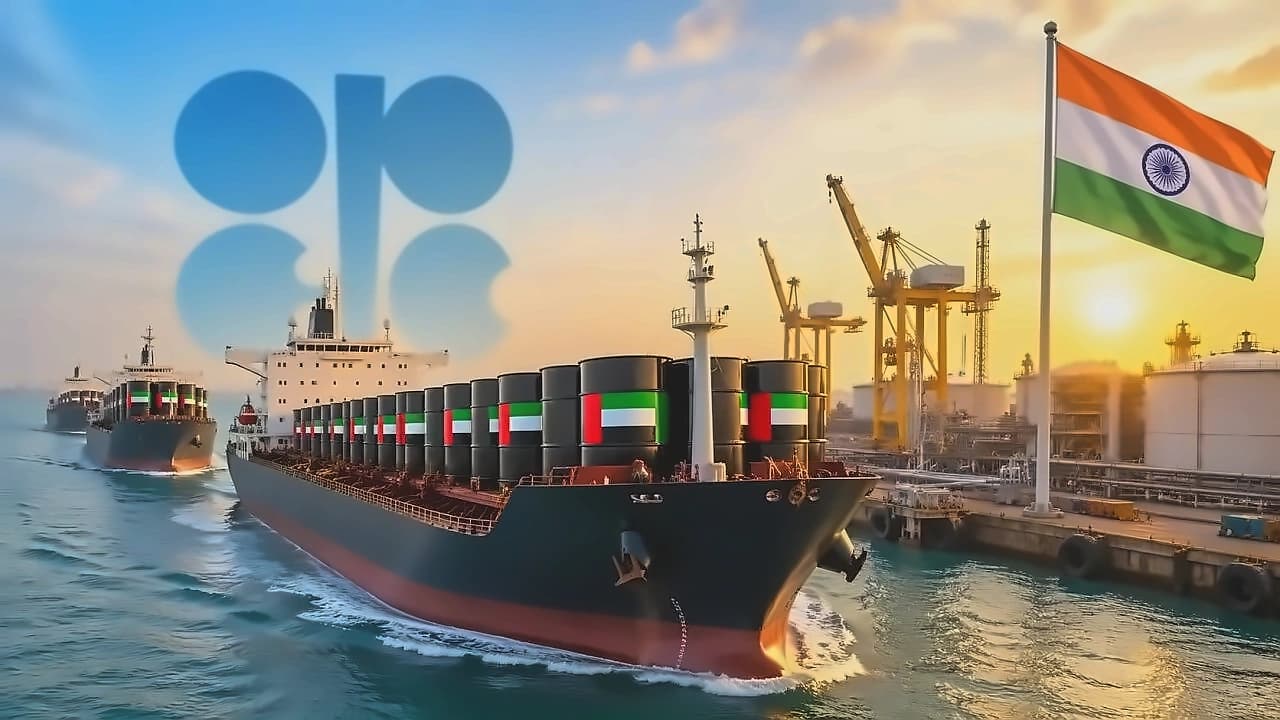
India, as the world's third-largest oil importer with heavy dependence on Gulf crude supplies, faces significant implications from UAE's withdrawal. Middle East oil accounts for roughly 60-65% of India's total crude imports, with UAE typically providing 5-8% of total crude imports. The immediate impact on India's import costs is shaped by the Iran conflict premium and limited immediate impact from UAE exit. Once the Strait of Hormuz reopens and UAE ramps up independent production, increased UAE supply could exert downward pressure on prices as the country pursues market share over price support. Analysts suggest UAE could boost production by approximately 1 million bpd outside OPEC constraints. However, experts warn of higher oil price volatility, which creates hedging costs and planning uncertainty for Indian importers.
UAE's exit could eventually lead to a wider pool of oil-supplying countries for India to choose from. India can leverage increased competition among producers to negotiate better terms. Reduced dependence on any single supplier or cartel enhances bargaining power. The evolution of UAE-India bilateral relationships will be particularly important to watch. As UAE operates outside OPEC's framework, both countries have the opportunity to develop a more direct, flexible, and mutually beneficial energy partnership.
The Precedent Effect and Future Outlook
UAE's exit creates a powerful precedent that other members are likely to consider. The historical pattern is clear: Qatar left OPEC in 2019 over output quota disputes, Angola left in 2023 over similar issues, and now UAE's departure in 2026 continues this pattern. If UAE successfully pursues independent production and achieves its economic objectives, other members will take notice. Different OPEC members face different calculations about their future participation. High-cost producers like Venezuela, Nigeria, and Algeria may be reluctant to leave as they depend more on OPEC's price support to maintain economic viability. Low-cost producers like Saudi Arabia, Kuwait, and Iraq could potentially compete effectively outside OPEC. However, Saudi Arabia in particular has invested heavily in OPEC's credibility and may resist leaving.
UAE's exit from OPEC signals the emergence of a new Gulf energy order characterized by strategic autonomy over collective coordination, competitive rather than cooperative energy policies, bilateral over multilateral partnerships, and economic diversification driving energy policy. The Iran conflict and Hormuz Strait blockade have acted as a catalyst for this transformation, exposing the vulnerabilities of collective arrangements and accelerating the pursuit of independent strategies. While this shift enhances UAE's strategic autonomy and bilateral leverage, it also carries risks for regional cohesion and stability. The success of this approach will depend on multiple factors, including Saudi Arabia's response, the evolution of the Iran conflict, and UAE's ability to maintain security for its independent energy infrastructure. What is clear is that the era of automatic Gulf solidarity on energy policy has ended, replaced by a more complex and competitive landscape that will require careful navigation by all regional players.