The India Meteorological Department (IMD) has confirmed that moderate El Niño conditions currently prevail over the equatorial Pacific Ocean, with sea surface temperature (SST) anomalies remaining above normal across the central and eastern equatorial Pacific. According to Business Standard, forecasts from the Monsoon Mission Coupled Forecast System (MMCFS) indicate that these conditions are expected to strengthen further during the remaining Southwest Monsoon season. This development reinforces Skymet's earlier downgrade of monsoon forecasts, with both agencies now pointing to the same underlying driver — a strengthening El Niño paired with an uncertain, potentially late-developing positive Indian Ocean Dipole — but differing sharply on severity assessments.
Countrywide rainfall between June 1 and July 31 remained 13% below LPA, with June ending particularly weak at 65% of LPA after the monsoon nearly stalled during its onset phase. July saw a stronger start before a "break monsoon" phase in the second week, though the latter half of the month helped rainfall recover to near break-even levels. As reported by Business Standard, during week ending 19 August, rainfall was 16% below Long Period Average (LPA) over the country as a whole. The cumulative rainfall from 1 June to 19 August 2026 shows the country as a whole had rainfall under the normal category, -13% of LPA. Regional performance varies significantly, with East and Northwest India recording 25% below LPA, South Peninsula down 22%, Northwest India dropping 10%, and Central India showing only a 1% deficit compared to LPA.
Looking ahead, Skymet forecast August rainfall at 84% of LPA (against a benchmark of 254.9mm) and September at 80% of LPA (against 167.9mm). Both months carry a 70% chance of deficit rain, a 20% chance of below-normal rainfall, and only a 10% chance of normal rainfall. Skymet predicts that August may end with a monthly shortfall of 16% rainfall of LPA, with the remaining month likely to see inequitable distribution over the four homogeneous regions of the country. The month of September is likely to be rain-deficit by 20% of LPA, with growing El Niño and weak Indian Ocean Dipole (IOD) causing the deficit to increase further. Business Standard reports that forecasts by IMD show the monsoon is already weakening in the second half of the month, with the trough shifting to the foothills.
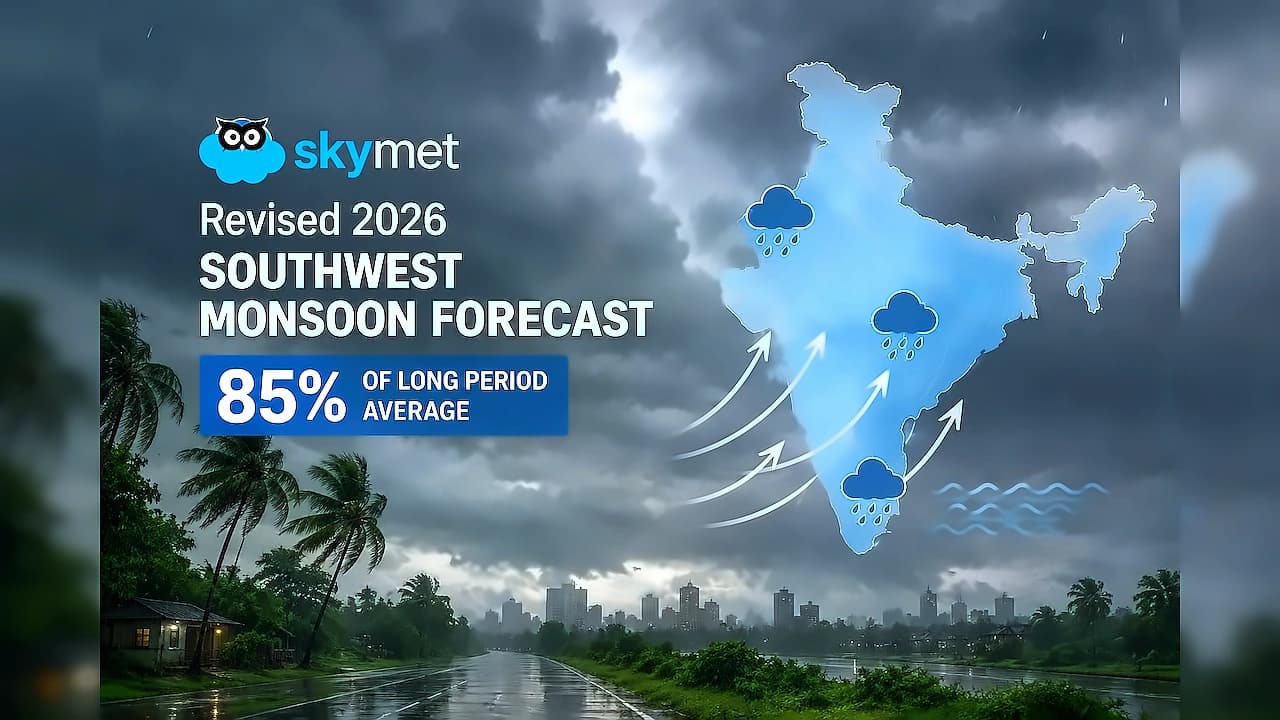
For the full June-to-September season, Skymet's risk assessment, carrying a margin of error of plus or minus 4%, puts the probability of outright drought — seasonal rainfall below 90% of LPA — at 70%. The assessment also includes a 20% chance of below-normal rainfall, a 10% chance of normal rainfall, and no probability assigned to an above-normal or excess monsoon. Business Standard reports that IMD on July 31 had said the cumulative rainfall for the August-September period will likely stay below normal – at less than 94% of LPA. The India Meteorological Department (IMD) in its April forecast had said the monsoon rainfall was likely to be 92% of LPA, but revised this forecast downward to 90% in June with a 60% probability of deficient season, meaning there is a better-than-even chance that total rainfall falls below the threshold that even qualifies as below-normal. Skymet's 85% LPA figure and 70% drought probability effectively double down on the risk compared to IMD's below-94% call, with both agencies pointing to the same underlying driver — a strengthening El Niño paired with an uncertain, potentially late-developing positive IOD — but differing sharply on severity.
Experts warn that the monsoon adjustment to 85% of LPA conceals an even harsher ground reality, with the geospatial and temporal distribution of rainfall far worse than the headline average suggests. Currently, 71.7% of tehsils (4,562 out of 6,363) are facing deficits exceeding 10%, and 72% are enduring prolonged dry spells of two weeks or more with critical agrarian belts having slipped into severe distress conditions. As reported by Deepak Pareek, founder of HnyB, an agri market intelligence firm, "The consequences for Indian agriculture are severe. Key kharif pulses, particularly urad and tur, along with oilseeds like soybean, are taking an immediate hit during critical vegetative and flowering stages. Concurrently, staple cereals such as corn, rice, and future Rabi (the winter crop) wheat cycles will face depressed yields due to plummeting reservoir levels and soil moisture depletion. This is not just a statistical deficit; it is an acute production shock that will strain rural incomes and drive food inflation." The monsoon typically logs 870mm (87 cm) in the entire monsoon season, making the current deficit particularly concerning for agricultural productivity across the country. India gets 75-80% of its annual rainfall during the four-month-long monsoon season, accounting for more than half of the country's foodgrain production.