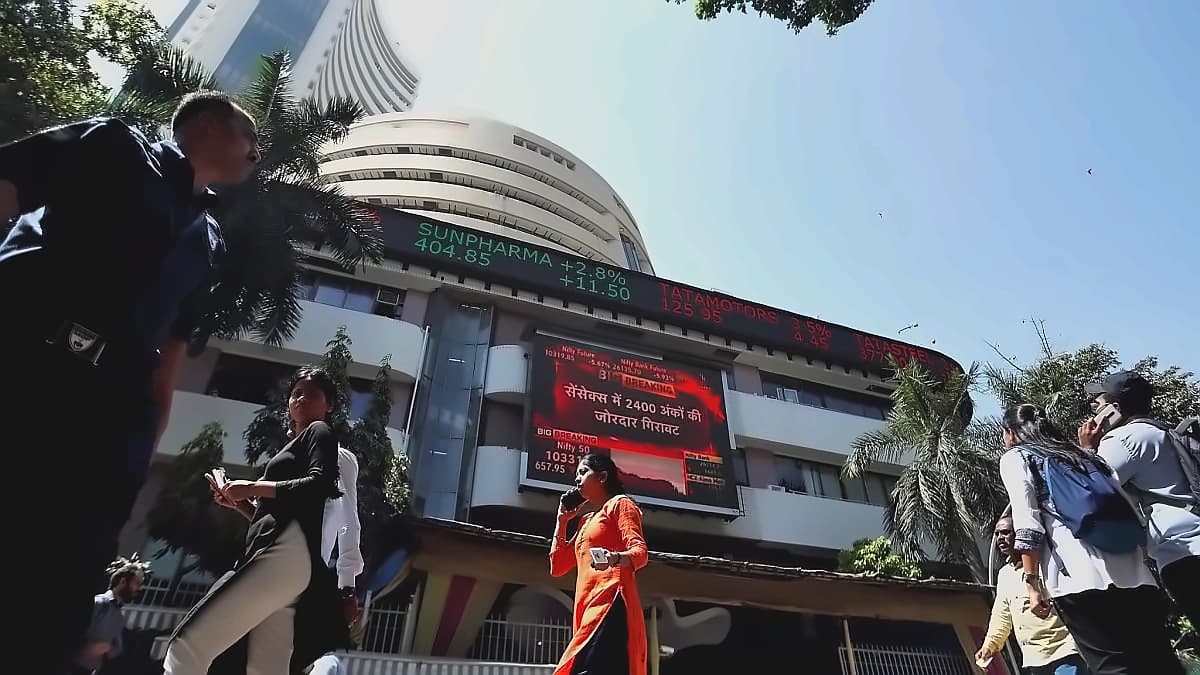
State Bank of India shares fell nearly 7% in a single trading session following the bank's latest quarterly results, marking a sharp decline that caught market attention due to the bank's significant weightage in India's banking and benchmark indices. According to multiple reports, the decline reflects a mix of investor concerns around earnings quality, valuation expectations, and aggressive trading activity in derivatives markets. The reaction was particularly notable because SBI is not just India's largest public sector bank but also one of the most closely tracked stocks in the banking sector, with movements in the stock often influencing broader banking sentiment as well.
A significant development accompanying the stock decline was the nearly doubling of leveraged positions linked to SBI shares during the earnings period. As reported by market analysts, leveraged positions refer to trades where investors use borrowed funds or derivatives exposure to amplify their bets on stock price movements. The rise in leverage indicates that market participants were aggressively positioning themselves around the earnings event and post-results movement, with traders significantly increasing derivative and margin-based exposure to SBI shares. This increased leverage can amplify both profits and losses, with the potential for rapid moves in either direction if leveraged traders are forced to exit positions due to losses or margin calls.
The Securities and Exchange Board of India (Sebi) has unveiled comprehensive reforms for agricultural commodity derivatives, including doubling client-level trading limits and introducing a cap on penalties for violations. According to the consultation paper released on Tuesday, the regulator noted that the current position limit framework for agri commodities, introduced in 2017, may no longer adequately reflect the evolution in market participation and product offerings over the years. Under the proposed changes, client-level position limits would be doubled to 2% for broad commodities, 1% for narrow commodities and 0.5% for sensitive commodities, up from the current limits of 1%, 0.5% and 0.25% respectively. The regulator has also proposed relaxing the definition of a 'broad commodity' to allow qualification if commodities meet either quantitative or monetary thresholds, potentially expanding the number of commodities in this category.
Under the revised framework, Sebi has proposed capping penalties for violations exceeding 2% of position limits at ₹2 lakh, whichever is lower between the formula-based calculation and the cap. For smaller breaches of up to 2%, the existing ₹10,000 ceiling would continue. The regulator has also introduced stricter operational actions, with trading members breaching limits more than three times in a month potentially being placed in square-off mode for one trading day if violations are linked to the same client. Additional penalties may also be imposed for habitual breaches. Separately, Sebi has proposed changes to the penalty framework for breaches of position limits in both agri and non-agri commodity derivatives, with the draft paper proposing capping penalties for violations exceeding 2% of prescribed limits at ₹2 lakh, replacing the existing system where penalties are linked to the value of the violation with no upper limit.
The agricultural derivatives reforms mark a significant policy shift for India's agricultural derivatives market, where compulsory physical settlement has long been mandatory to ensure alignment between futures and spot prices and curb excessive speculation. Under the proposed framework, contracts would shift to physical delivery once they cross specified thresholds linked to average daily traded volume (ADTV) or open interest, or after two years, whichever is earlier. Currently, physical delivery is mandatory for all farm derivatives, meaning traders must hand over or take receipt of the physical goods once the futures or options contract expires. Sebi has invited public comments till June 2, 2026 on the comprehensive set of proposals, indicating the regulatory body is actively seeking stakeholder feedback on these significant market structure changes.