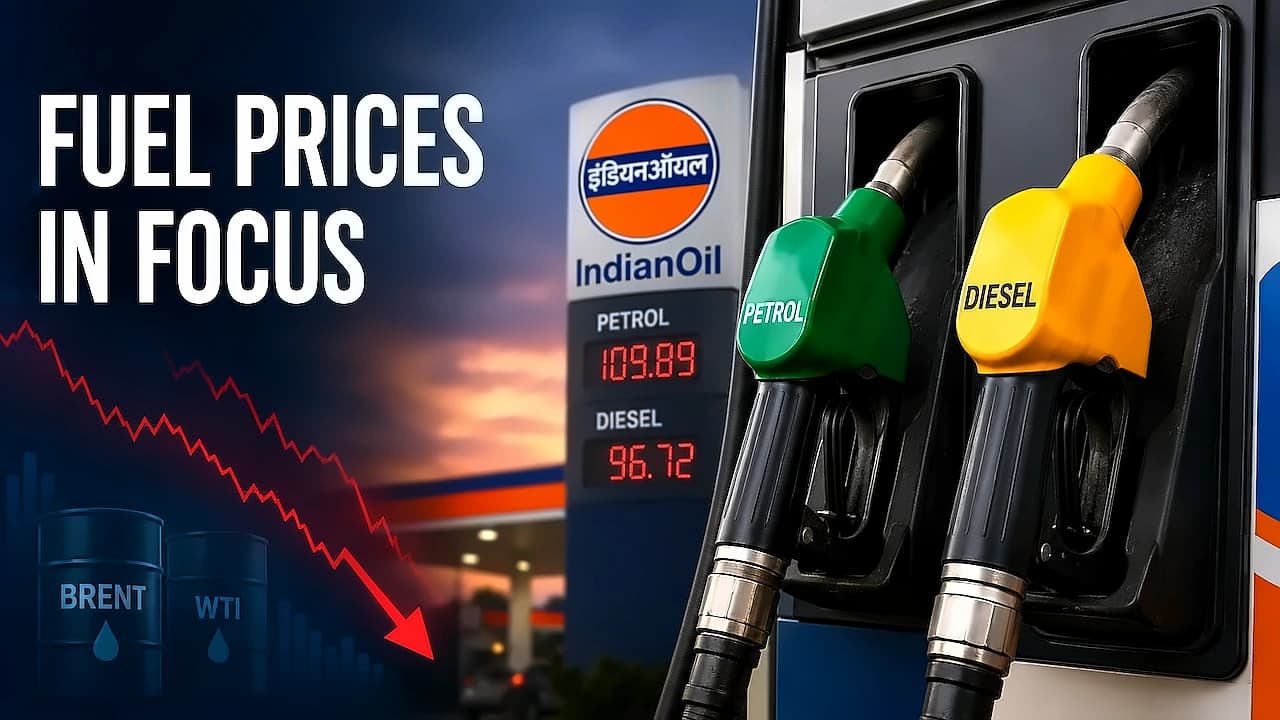
Oil prices traded lower on Friday morning as the US reported 'some encouraging signs' of a possible deal with Iran to end the West Asia war. July Brent oil futures were at $104.24, down by 0.66%, while July WTI crude futures were at $97.50, down by 0.51% at 9:08 am on Friday. According to The Hindu BusinessLine, US Secretary of State Marco Rubio told reporters in Washington that there had been some progress in talks with Iran, stating that the US is dealing with 'a system that itself is a little fractured'. Rubio cautioned that while there are good signs, he doesn't want to be overly optimistic, adding that 'let's see what happens over the next few days'. However, neither the US nor Iran have confirmed reports that they had reached a final draft for a peace deal.
Oil marketing companies in India increased petrol and diesel prices by ₹3 per litre on 15 May, ending a two-year freeze on rates. As reported by Goodreturns, petrol in the national capital now costs ₹97.77 per litre, while diesel is priced at ₹90.67 per litre, reflecting sustained pressure from expensive imported crude. The India basket of crude stood at $108.36 per barrel on 14 May, combining Sweet grade Brent Dated and Sour grade Oman and Dubai crude. On the domestic front, June crude oil futures were trading at ₹9,406 on Multi Commodity Exchange (MCX) during the initial hour of trading on Friday, up by 0.69% from the previous close of ₹9,342, while July futures were trading at ₹9,125 against the previous close of ₹9,042, up by 0.92%.
Iran announced a new 'Persian Gulf Strait Authority' on Wednesday, saying there would be a 'controlled maritime zone' in the Strait of Hormuz, effectively closing the waterway that before the war carried oil and liquefied natural gas shipments equal to about 20% of global consumption. As reported by The Hindu BusinessLine, Rubio strongly rejected Iran's proposal to implement a tolling system in the Strait of Hormuz, stating 'No one in the world is in favour of the tolling system. It can't happen. It would be unacceptable. It would make a diplomatic deal unfeasible if they were to continue to pursue that'. He called it 'a threat to the world' and 'completely illegal', warning that its implementation would set a risky precedent for the free flow of vessels through key chokepoints globally. The latest developments show even more dramatic price movements, with Capital Economics warning that Brent could reach $130-140 per barrel if current trends continue, as the closure of the Strait of Hormuz is draining global oil inventories fast.
The supply losses from the key Middle Eastern region have forced countries to pull from their commercial and strategic inventories at a rapid rate, raising concerns about draining them. The US Energy Information Administration reported on Wednesday that the country withdrew nearly 10 million barrels of oil from its Strategic Petroleum Reserve last week, the biggest drawdown on record. The EIA also said commercial crude inventories fell by 7.9 million barrels to 445 million barrels last week, compared with analysts' expectations in a Reuters poll for a 2.9 million-barrel draw. Gasoline inventories fell by 1.5 million barrels, while distillates rose by 372,000 barrels. As per Mingyu Gao, chief researcher for energy and chemicals at China Futures, "The drawdown in oil inventories will make it difficult for oil prices to remain low, with global refined-product and onshore crude inventories expected to fall below their lowest levels for this time of year in the past five years by late May and late June."
Global bond markets were hammered on Friday on concerns that energy costs would stay high and thus continue to drive inflation. Yields on US 10-year notes hit a 15-month top of 4.631%, having already surged 23 basis points last week, while yields on 30-year bonds reached 5.159% after jumping 18 basis points on the week. Japanese yields hit peaks not seen since 1996 as the government proposed issuing fresh debt to fund a planned extra budget to cushion the economic blow from the US-Israeli war on Iran. According to ING Think's Warren Patterson and Ewa Manthey, 'markets are still searching for signs of progress in a potential deal between the US and Iran', while there are signs of optimism, uncertainty reigns as this is not the first time a deal seemed close, only for negotiations to break down. They noted that 'there's a large segment of the market that will be more sceptical about the positive signals we are seeing', citing Iran's uranium enrichment issues and the US's demand for transferring the uranium stockpile out of the country.