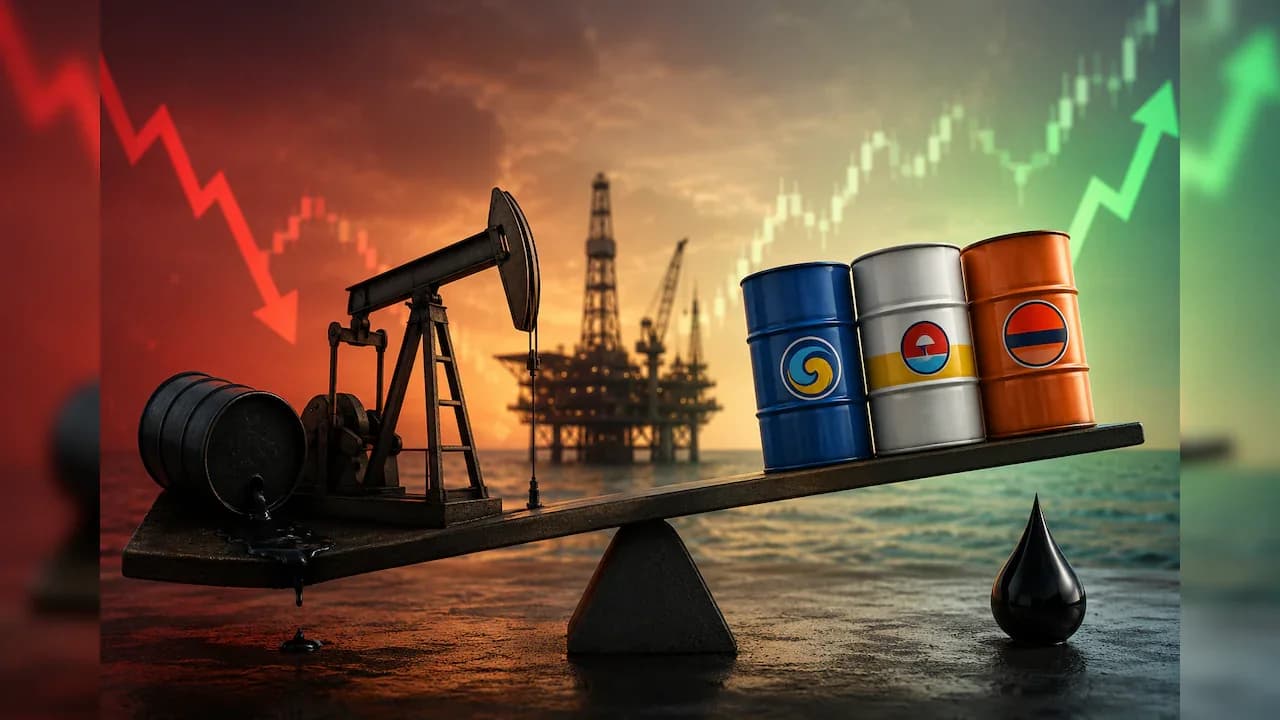
Oil prices have surged past $100 per barrel, with Brent crude holding above $111 per barrel, triggering a cascade of impacts across India's economy. According to reports from The Times of India, petrol and diesel prices saw another hike on Tuesday, rising by around 90 paise, following the government's increase of ₹3 per litre last Friday. The price rises were introduced as higher import costs finally caught up after weeks of absorbing the global oil shock. India had kept fuel prices unchanged for several weeks despite the global oil shock, but this created a growing gap that was hurting the finances of Oil Marketing Companies, which were reportedly losing around ₹1,000 crore per day. The latest increase comes as global crude oil prices surge due to the ongoing West Asia conflict, disruptions around the Strait of Hormuz and uncertainty in global oil supplies.
The Middle East conflict has severely impacted Indian equity markets, with investor wealth taking a cumulative hit of ₹5,85,751.13 crore since February 28. As reported by The Times of India, the market capitalisation of BSE-listed companies fell from ₹46,325,200.41 crore (February 27 close) to ₹41,241,172.45 crore (March 30 close). The BSE Sensex, which ended February at 81,287.19, has since slipped by over 6,000 points. Foreign Portfolio Investors have withdrawn a massive ₹2.2 lakh crore from Indian equity markets in 2026 so far, with net outflows touching ₹27,048 crore in May alone. Economists warn that rising fuel costs could increase inflation and push up transportation, logistics and food expenses in the coming months.

The rupee has been under severe pressure, slipping to a fresh all-time low of 96.25 against the US dollar on Monday, with the currency falling about 5.5% this year. According to The Times of India, India imports more than 85% of its crude oil needs, making any rise in global oil prices hit the economy through higher import costs and pressure on the currency. The import bill rebounded in April, rising 10% year-on-year, with the oil import bill increasing to $18.6 billion compared with an average of $13 billion in the fourth quarter of FY26. The trade deficit widened to $28.4 billion in April 2026, compared with $27 billion in April 2025. India imports the majority of its crude oil requirements, meaning payments are made largely in US dollars. Even if crude oil prices fall internationally, a weakening Indian rupee can offset much of the benefit because importing oil becomes more expensive in rupee terms.
SBI Research projects India's economy to grow at 6.6% in FY27, compared with an estimated 7.5% in FY26, according to reports from The Times of India. The research estimates that every $10 per barrel increase in oil could widen the current account deficit by 30–35 basis points, raise inflation by 35–40 basis points, and reduce GDP growth by 20–25 basis points. Despite these challenges, India appears to be managing the energy supply situation better than many other economies, with fertiliser availability for the 2026 kharif season remaining comfortable at 51% of total requirement.
Helios Capital founder Samir Arora has pushed back on the narrative that rising crude oil prices pose a serious threat to India's economy. Speaking to NDTV Profit, Arora argued that the panic is disproportionate to the actual damage, noting that India imports roughly 5 million barrels a day, making a $30-35 per barrel difference equivalent to $150 million extra per day. He emphasized that the burden of oil prices gets distributed across oil companies, the government, oil-producing nations and consumers. Arora also addressed India's underperformance compared to Asian peers, attributing it to identifiable and time-bound factors rather than structural issues, noting that India got isolated when massive flows went into non-US markets after April and the Trump tariffs were rolled back.