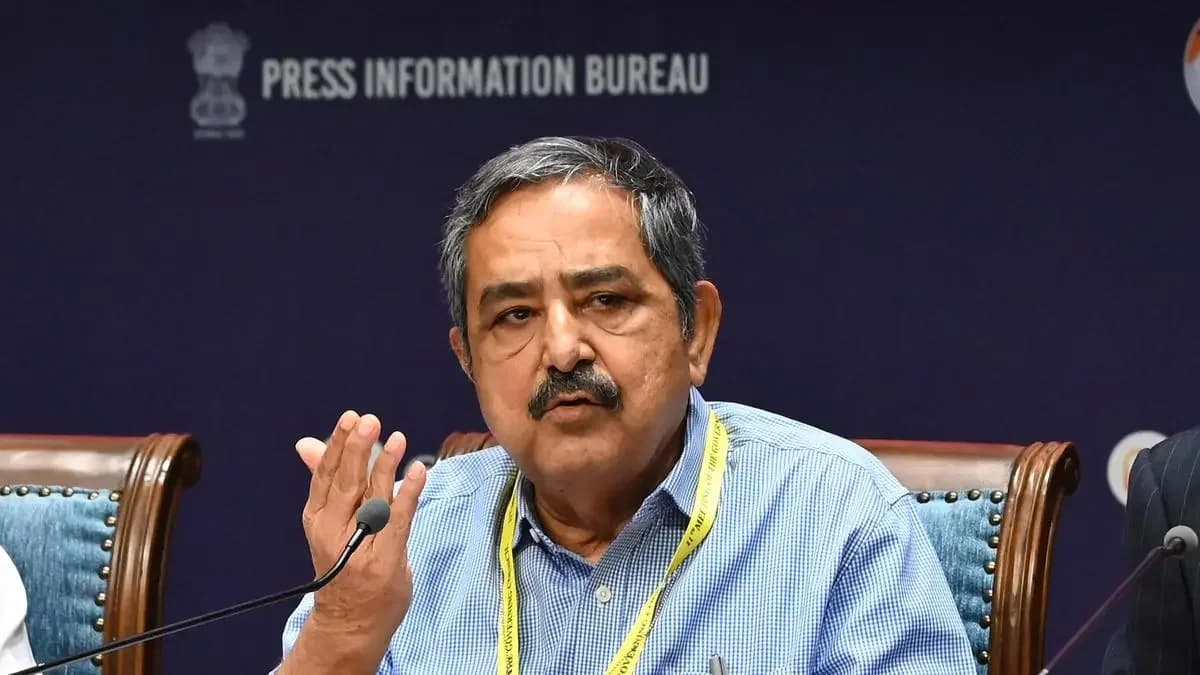
NITI Aayog Vice-Chairman Ashok Lahiri has issued a stark warning about India's fertilizer usage, revealing that unbalanced fertilizer use, driven by excessive reliance on nitrogen, is degrading soil health and lowering crop yields. Speaking at an event organized by the International Chamber of Commerce, Lahiri highlighted that the Nitrogen-Phosphorus-Potassium (NPK) ratio of 9.8:3.1 is heavily skewed towards nitrogen compared to the recommended 4:2:1 ratio. According to Lahiri, the systemic overuse of nitrogen relative to other nutrients is degrading soil health and lowering crop yields, with the correction requiring immediate action, but it is stalled by a socio-political logjam. He emphasized that strengthening balanced fertilisation practices and promoting phosphatic and potassic fertilisers are essential to improve soil health and nutrient-use efficiency.
NITI Aayog Vice-Chairman Ashok Lahiri and Chairman of the Economic Advisory Council to the Prime Minister (EAC-PM) S Mahendra Dev advocated a fundamental shift in India's agricultural approach during an event organized by the International Chamber of Commerce. According to reports from Rediff Moneynews, Lahiri emphasized that the time has come to view farmers not just as food providers but as 'businessmen', marking a significant change in agricultural policy perspective. Speaking at the same event, Dev emphasized that India must shift from a production-centric approach to an income-centric agriculture strategy, noting that agriculture, livestock and fisheries account for about 17% of India's GDP and 43% of employment, with the purchasing power of nearly half the population crucial for generating demand for manufacturing and services. As per Rediff Moneynews, Lahiri noted that India's journey towards Viksit Bharat by 2047 must be anchored in the transformation of the rural economy, with agriculture serving as a key engine of livelihoods, food security, and inclusivity.
Lahiri outlined three strategic shifts to transform Indian agriculture as reported by Rediff Moneynews. The first involves moving from raw produce to value-added products - for instance, from raw pineapple to sliced and tinned pineapple. The second shift focuses on transitioning from fragmented farming to strong producer institutions, while the third emphasizes moving from input-intensive agriculture to climate-smart and sustainable agriculture. These transformations are designed to enhance productivity, reduce costs, and strengthen climate resilience through the adoption of artificial intelligence, drones, remote sensing, satellite imagery, the Internet of Things and precision agriculture. Dev highlighted the potential of gene-editing technology and genetically modified crops to raise yields, while calling for higher investment in agricultural research and development by both the government and private sector.
EAC-PM Chairman S Mahendra Dev outlined four pillars to increase farmers' income as reported by Business Standard. These include diversification towards high-value agriculture, focus on post-harvest management and marketing, food and agro-processing, and helping small and marginal farmers with input and output marketing. Dev emphasized that farmers should be encouraged to move beyond traditional rice and wheat cultivation towards horticulture, fisheries, oilseeds, pulses and other high-value activities, though he cautioned that diversification would not happen unless alternative crops offered better returns. He called for agricultural market reforms, saying farmers need better access to markets and higher prices, noting that while agriculture is primarily a state subject, states have an important role in implementing market reforms. Dev also argued that India needs to move towards an export-led agriculture strategy, pushing for greater market access for agricultural products while addressing non-tariff barriers.

According to Lahiri's address reported by Rediff Moneynews, India's foodgrain production reached an all-time high of 376.5 million tonnes in the 2025-26 crop year, demonstrating significant progress from the days of food insecurity. The country's agri-exports exceeded $51 billion, highlighting India's growing role in global agricultural markets. Both experts commended farmers for delivering one of the world's highest farm sector growth rates over the last decade, providing a strong foundation for the proposed agricultural transformation. Dev noted that India had transformed from a food-deficit nation into one of the world's largest producers of foodgrains, fruits, vegetables, milk and fisheries since the Green Revolution. As per Rediff Moneynews, Lahiri emphasized that India's journey towards Viksit Bharat by 2047 must be anchored in the transformation of the rural economy, with agriculture serving as a key engine of livelihoods, food security, and inclusivity.
Dev called for a forum where the Union and state governments can build consensus on common issues concerning the agricultural sector as reported by Business Standard. He emphasized that a food-systems approach spanning production, processing, distribution and consumption demands cross-ministerial and Centre-state convergence. Dev stressed the need for greater convergence across ministries to achieve better results, greater value addition and more employment. He highlighted the growing role of Farmer Producer Organisations (FPOs), cooperatives, Primary Agricultural Credit Societies and other farmer institutions as essential for producers to access inputs, technology and markets at scale, noting that the most powerful lever for small and marginal farmers is collective strength in the marketplace. According to Rediff Moneynews, Lahiri emphasized that to transform Indian agriculture in line with Prime Minister Narendra Modi's Viksit Bharat 2047 vision, it needs to move from raw agriculture produce to value-added products, from fragmented farming to strong producer institutions, and from input-intensive agriculture to climate-smart and sustainable agriculture.