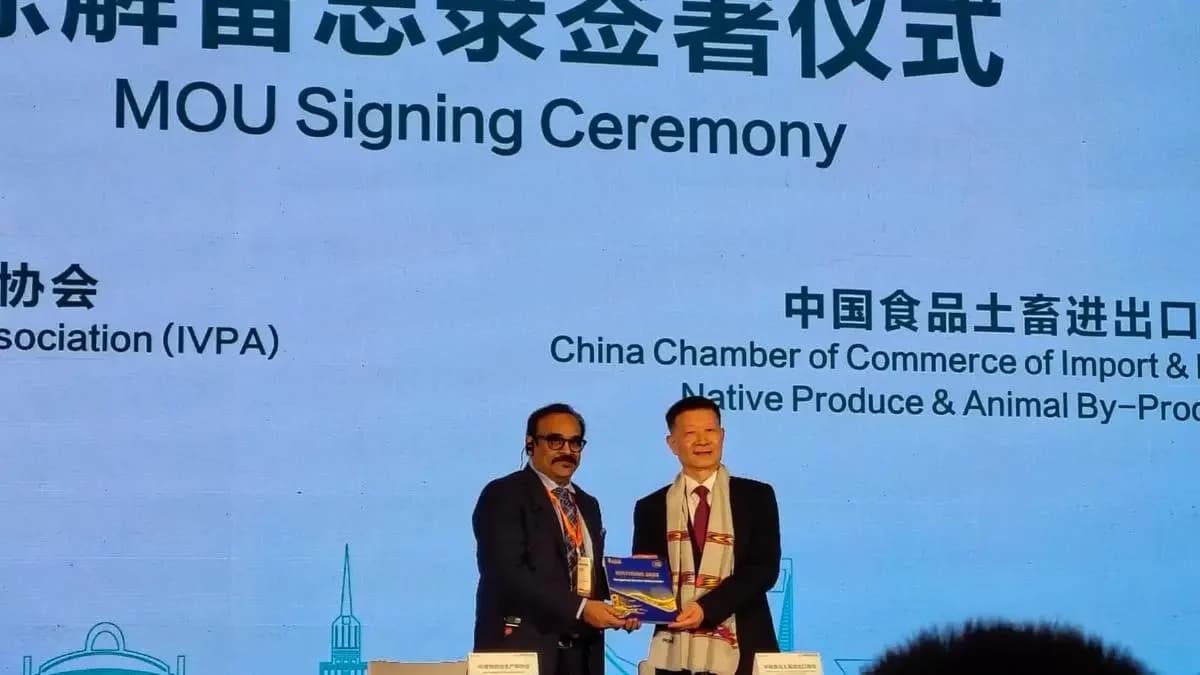
The Indian Vegetable Oil Producers' Association (IVPA), the apex body representing India's edible oil refining industry, has signed a memorandum of understanding (MoU) with China's China Chamber of Commerce of Foodstuffs and Native Produce (CFNA). According to reports from The Hindu BusinessLine and Rediff Moneynews, the agreement was formalized at the CCOC 17 Conference in Shanghai on July 1, with the objective to foster strong industry linkages between the two countries. The MoU reflects a shared commitment to fostering stronger industry linkages, promoting mutual growth, and building a more resilient and future-ready global vegetable oils and oilseed sector. This cooperation establishes a strategic platform for sustained dialogue, buyer-seller connect, and collaborative initiatives that advance innovation, sustainability, and potential trade development.
Speaking at the 17th China International Conference on Oils and Oilseeds (CCOC-17) in Shanghai, Sudhakar Desai, President of IVPA, revealed that global vegetable oil production is projected to increase by 3.1 per cent to around 212.5 million tonnes (mt) in marketing year 2025-26, while global consumption is expected to grow by 1.9 per cent to nearly 211 mt. According to The Hindu BusinessLine, the global supply balance remains broadly comfortable, but market direction will increasingly be shaped by policy developments and external macroeconomic factors. Malaysian palm oil production is expected to reach 19.8 mt, while Indonesian production is projected at 49.3 mt, representing a combined decline of about 900,000 tonnes from the previous year. However, Indonesia is expected to divert around 14.6 mt of palm oil towards biodiesel assuming implementation of the B50 mandate from July 1, 2026, which would translate into an additional 1.5-1.8 mt of palm oil being absorbed by the biofuel sector.
According to The Hindu BusinessLine, market direction over the coming months will largely depend on Indonesia's B50 biodiesel programme, evolving US biofuel policies, crude oil prices, currency movements, weather developments and export policies of major producing countries. Bursa Malaysia Derivatives (BMD) crude palm oil futures are expected to trade within a range of RM4,200-4,700 per tonne for the second half of the year. Desai noted that palm oil and soybean oil are likely to trade within a relatively narrow price spread, while sunflower oil is expected to lose its current premium of $150-200 per tonne and normalise to a premium of around $50-70 per tonne over soybean oil, supported by favourable global sunflower seed plantings. He emphasised that price behaviour is increasingly being driven by macroeconomic developments and policy interventions alongside traditional supply-demand fundamentals.
As reported by The Hindu BusinessLine, India consumes nearly 25 mt of edible oils annually, with imports meeting around 60 per cent of domestic demand. Desai expects India's edible oil imports to reach 16.8 mt in 2025-26, comprising 8.5 mt of palm oil, 5.1 mt of soybean oil, 3 mt of sunflower oil, and around 200,000 tonnes of other edible oils. The share of soyabean oil imports to India is steadily rising and is expected at approximately 5 million tonnes (mt) as against 8-8.5 mt of palm in the oil year 2025-26. India imports 60 per cent of its edible oil needs with imports remaining in the range of 15-17 million metric tonnes. Supply challenge and narrowing price premium in palm oil is prompting refiners to gradually shift to soyabean oil.
According to The Hindu BusinessLine, Sudhakar Desai stated that this marks a significant milestone in strengthening bilateral industry cooperation. As the world's two largest consumers of vegetable oils, India and China play a definitive role in shaping global demand, trade dynamics, and the future of the sector. The collaboration will not only give a fillip to soyabean oil imports from China but also enhance edible oil derivatives exports from India, primarily mustard and soyabean meals, through strengthened market linkages. Desai emphasised that India and China have significant opportunities to deepen cooperation across the vegetable oil value chain, stating that stronger engagement through efficient logistics, complementary market strengths and enhanced commercial partnerships can contribute to more resilient regional supply chains and sustainable growth for both countries. He noted that the global vegetable oil industry is entering a more interconnected and dynamic phase where informed policymaking, innovation and international collaboration will play an increasingly important role in shaping future trade and investment opportunities.