Vice President JD Vance and Iranian officials concluded their first round of talks in Switzerland on Sunday, with negotiations continuing into Monday as both sides work through nuclear, sanctions and security issues. According to Fox News, Vance arrived in Switzerland early Sunday and joined White House envoys Steve Witkoff and Jared Kushner for the talks, which were mediated by Pakistan and attended by Qatari officials. The talks produced a 60-day roadmap toward a broader agreement and established mechanisms addressing the Strait of Hormuz and the conflict in Lebanon. Swiss officials confirmed Sunday that the Iranian delegation had arrived and was traveling to Bürgenstock, where the discussions are expected to take place. Iranian Foreign Minister Abbas Araghchi reported 'major progress' in talks to end the war between Israel and Hezbollah in Lebanon, with the mediating parties praising the creation of a high-level committee and roadmap aimed at reaching a final agreement within 60 days.
IAEA Director General Rafael Grossi announced on Wednesday that nuclear site inspections of Iran will resume under the framework of the US-Iran memorandum of understanding signed on June 17. As reported by PTI, Grossi stated "this is going to happen" when asked about the timeline, emphasizing the urgency given the agreement's 60-day timeframe. Speaking to Japanese broadcaster NHK in Tokyo, Grossi identified the agency's top priority as confirming the location of Iran's highly enriched uranium, with Tehran required to disclose where the material is being held. The IAEA chief noted that inspections would take place under the Iran-US understanding, stating "We think that the sooner the better, especially since this agreement has a time frame of 60 days, so we will have to be working without losing much time." Grossi added that the IAEA has an idea of where the uranium could be, though some storage sites were attacked and partly destroyed during the conflict, requiring the agency to assess how to access the material.
Iranian crude sellers have significantly reduced prices for Chinese buyers following the interim peace deal with the US. According to reports from Bloomberg, spot cargoes of Iranian Light crude for July arrival are being offered at a discount of $2.50 to $5 per barrel to Brent benchmark prices, compared to approximately $1 offered before the deal. This substantial increase in discounts reflects the market's response to the resumption of Iranian oil exports after the lifting of US naval blockades. The latest developments show crude prices recently reached their lowest level in more than three months at under $80 per barrel, with the national average price of gasoline dipping below $4 a gallon, a roughly 30% decline over two months. However, Brent crude futures rose more than $1 a barrel on Monday as talks started between U.S. and Iranian officials in Switzerland, with the commodity climbing $1.09, or 1.35%, to $81.66 a barrel after reaching a session high of $82.30.
Recent shipping data reveals a significant increase in Iranian oil exports from key ports. As reported by Bloomberg, at least 11 tankers carrying a combined 20 million barrels were detected leaving the Iranian port of Chabahar in recent days. Additionally, Iran resumed loadings at Kharg Island — its main export terminal — after a roughly six-week halt under the US naval blockade, which was lifted as part of the interim deal. According to TankerTrackers, Iran has exported approximately 36 million barrels of crude oil since June 15, with another 36 million barrels currently traversing the Strait of Hormuz. Ship traffic through the Strait of Hormuz has returned to similar levels seen before the war with Iran broke out, with 67 ships traversing the vital waterway on Saturday, up from 55 ships the day before. U.S. Energy Secretary Chris Wright said Sunday that 19 million barrels of oil left through the Strait of Hormuz on Saturday, with the U.S. having opened a separate channel to the south of the strait where it has been escorting ships since Iran has not yet 'demined' a central shipping channel.
The diplomatic breakthrough is creating significant economic implications for energy markets and monetary policy. As Vice President JD Vance explained, "The President's peace plan with Iran is bearing real fruits for the American people. Last night, 12.5 million barrels of oil went to the Strait of Hormuz, that is a high since the beginning of the conflict." Senior Portfolio Manager Jason Katz argues that "if we get this deal... oil should continue to abate. If that happens, the Fed will be empowered... Every dollar not spent at the pump is a dollar the consumer spends elsewhere." The framework agreement includes a 60-day negotiation period to reach a permanent accord, with the bond market already pricing in potential rate cuts as the 10-year Treasury yield closed at 4.49% on June 17, down 0.12 percentage points over the past month. The broader thesis suggests that lower energy prices could reduce inflation pressure while boosting consumer spending across transportation, freight, aviation, manufacturing, and petrochemicals. However, President Trump has threatened to impose tolls in the Strait of Hormuz if negotiations fail to produce a lasting agreement, with Senator Lindsey Graham warning that "if this deal fails, President Trump is going to take over the Strait of Hormuz by force."
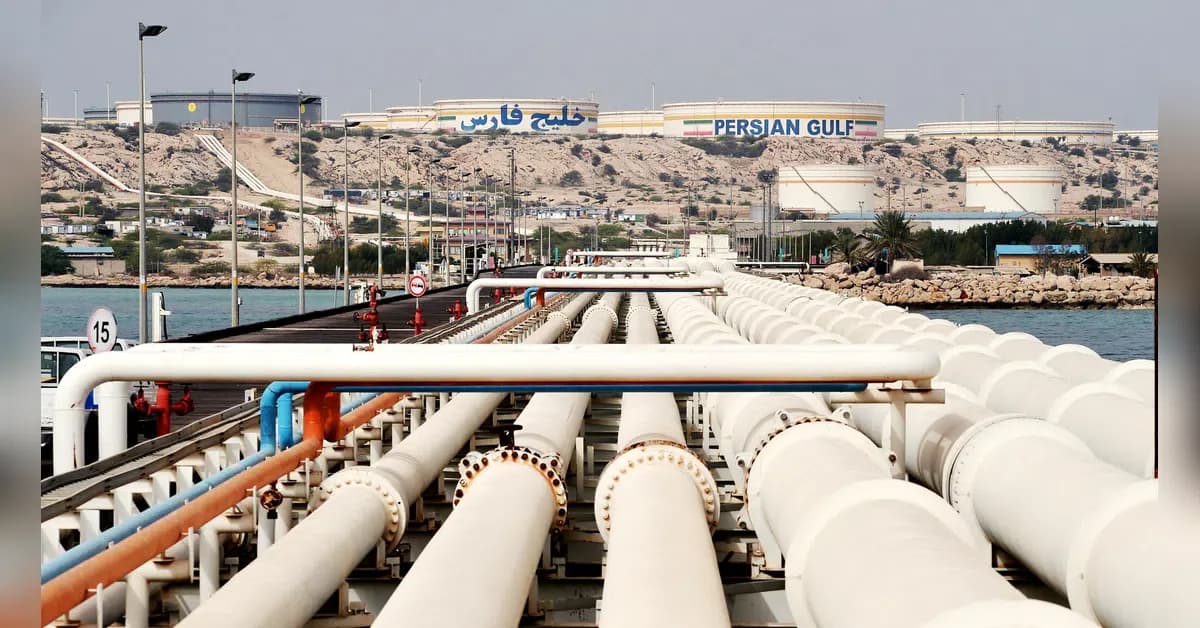
Despite the price reductions, Chinese demand remains constrained by multiple factors. According to Bloomberg reports, buying interest from China's independent refiners — known as teapots — remains muted due to mounting losses and run-rate curbs. Additionally, US sanctions on an arm of Hengli Petrochemical over alleged Iranian purchases, which the company denies, also contributed to some wariness among buyers. China typically takes about 90% of Iran's oil exports, though on paper, the Asian nation hasn't taken any Iranian crude since 2022 as shipments are often rebranded as Malaysian. The current negotiations are expected to address robust discussions on all elements of the nuclear deal, with the team planning to continue working through each issue and using the first hours of discussions as a starting point for ongoing technical talks.
Despite the increased exports, significant volumes of Iranian oil remain stranded in the region. As reported by Kpler, about 121 million barrels of Iranian oil is still sitting on tankers in and around the Persian Gulf and elsewhere, up 5% from the week before the peace deal. Approximately a quarter of that inventory is idling off China or is in the Singapore Strait, indicating the ongoing challenges in bringing Iranian crude to market despite the recent improvements in shipping operations. However, Iranian Foreign Minister Abbas Araghchi reported that 'oil and petrochem exports are waived, blockade lifted, some frozen assets released, and major reconstruction & development plan launched for Iran,' suggesting progress in addressing these stranded volumes. The framework agreement's success will depend on whether these stranded volumes can be brought to market and whether the current decline in oil prices proves durable beyond the 60-day negotiation window.