Industry experts are now supporting Prime Minister Narendra Modi's appeal to avoid non-essential gold purchases in order to save foreign exchange reserves, while emphasizing the need for balanced solutions. Gujarat President of India Bullion and Jewellers Association (IBJA) Nainesh Pachchigar said the Prime Minister's call could help conserve valuable foreign exchange at a time when the country is facing rising import pressures due to global uncertainties. However, he stressed that the government should also revive the old Gold Monetisation Scheme to bring idle household gold back into the market and increase recycling of the precious metal. As per Upstox, the All India Jewellers & Goldsmith Federation (AIJGF) had previously rejected PM Modi's call to delay gold purchases, warning of devastating consequences for 35 million jobs in the sector. The federation emphasized that reducing consumer demand without a structural alternative risks devastating the jewellery ecosystem, which supports approximately 35 million livelihoods across the sector.
India's bullion and jewellery industry has unveiled a comprehensive plan to recycle household gold and reduce the country's reliance on imported gold amid gold imports surging 24% to a record high of ₹71.98 billion in 2025-26. According to The Economic Times, the Precious Metals Refineries Forum (PMRF) has proposed a Gold Metal Loan (GML) mechanism that would provide one-year loans to jewellery exporters using imported gold, while extending similar facilities to domestic jewellers and retailers from locally refined bullion. The framework includes interest rates of 2-2.5% for depositors and 3-4% for GML, with depositors offered GST refunds when physical gold is converted to electronic gold receipts (EGR). As per The Economic Times, James Jose, president of PMRF, highlighted that the 3% notional GST loss on conversion currently deters customers, suggesting the government could recover this tax when EGR is converted back to physical gold for selling. IBJA Gujarat President Nainesh Pachchigar noted that such a move would help maintain steady work for lakhs of small and medium artisans associated with the jewellery sector while supporting the government's broader goal of reducing foreign exchange outflow.
The industry's comprehensive recycling proposals came after Prime Minister Narendra Modi asked Indians to postpone gold purchases to help conserve foreign exchange amid global supply disruptions triggered by the conflict in West Asia. As reported by Upstox, the appeal came a day after Modi's public statement, highlighting the immediate impact of such policy announcements on the jewellery trade. India's foreign exchange reserves fell to $690.69 billion by May 1, 2026, with gold holdings contributing to this decrease. JCBL Group Director and Chartered Accountant Renu Arora backed the Prime Minister's appeal, stating that India remains heavily dependent on imports for both gold and crude oil, and large-scale imports put pressure on the rupee and weaken its value against the dollar. She emphasized that reducing unnecessary consumption would help India better withstand global shocks and improve macroeconomic stability. The AIJGF's proposed solution centers on a strong strategy to mobilize and recycle domestic gold, establishing a dedicated bullion bank within the Gujarat International Finance Tec-City (GIFT City) or the India International Bullion Exchange (IIBX) ecosystem.
India's gold imports have reached unprecedented levels, with imports rising more than 24% to an all-time high of ₹71.98 billion in 2025-26 from ₹58 billion in the previous fiscal, according to commerce ministry data reported by Upstox. However, in volume terms, imports fell 4.76% to 721.03 tonnes from 757.09 tonnes. The increase was largely driven by prices climbing to ₹99,825.38 per kilogram in FY26 from ₹76,617.48 per kilogram in FY25. Manoj Kumar Jain, Director and Head of Commodity and Currency Research at Prithvi Finmart, explained that India accounts for nearly 25-26 per cent of global gold demand and imports around 800 metric tonnes of gold annually, requiring massive spending in dollars. He noted that all imports are paid for in foreign currency, mainly the US dollar, leading to significant pressure on India's foreign exchange reserves. The Precious Metals Refineries Forum (PMRF) reports that over 30,000 tonnes of gold is with Indian families, yet a bankable, institutional mechanism to tap this asset is missing.
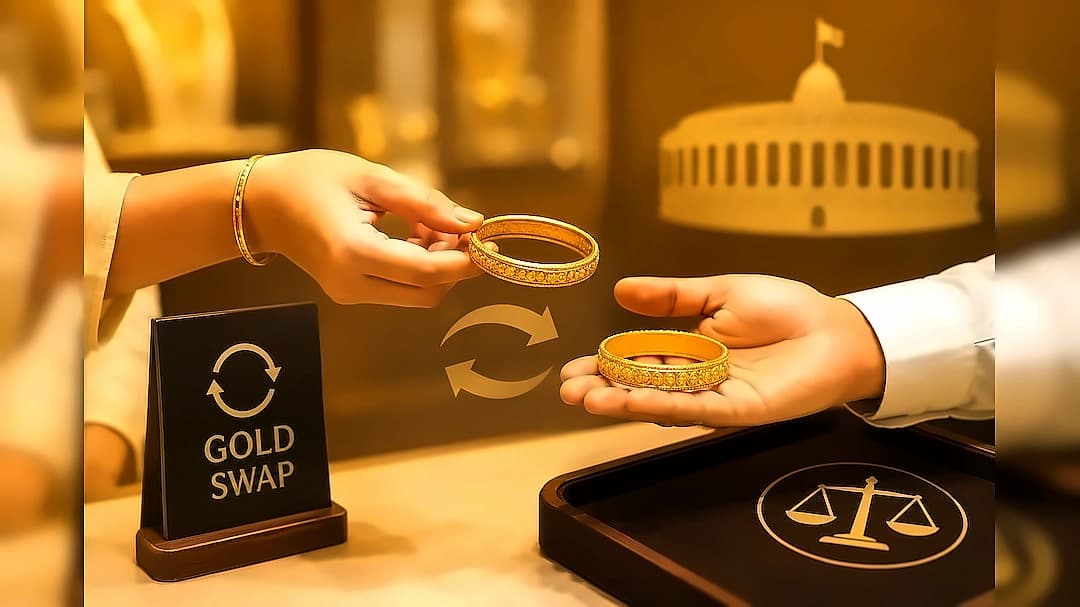
The industry's recycling proposals include allowing gold ETFs to lend up to 20-30% of their physical holdings through a regulated bullion bank framework, as reported by Upstox. The Precious Metals Refineries Forum (PMRF) has suggested a Gold Metal Loan (GML) mechanism that would provide one-year loans to jewellery exporters using imported gold, while extending similar facilities to domestic jewellers and retailers from locally refined bullion. According to The Economic Times, Rajesh Rokde, chairman of All India Gem and Jewellery Domestic Council (GJC), noted that about 10-20% of the gold with families would be in bullion form, suggesting that if some gold can be tapped and converted into digital gold in a system where jewellers are involved, imports would dip significantly. The federation also suggests revamping the current Gold Monetization Scheme (GMS), though the GMS has faced significant challenges with its medium and long-term components discontinued in March 2025 due to poor performance. The framework includes collection and purity testing centres (CPTCS) that can process gold within 48 hours and move it to secured vaults empanelled by banks.
The All India Gem and Jewellery Domestic Council (GJC) has echoed similar concerns, with GJC Chairman Rajesh Rokde stating that the sector and related industries such as retail, logistics and financial services could come under stress if consumers defer purchases. According to The Economic Times, Vipulbhai Shah, past president of GJEPC, emphasized that the industry has shown resilience in difficult times, working together and adapting to changing circumstances. IBJA Gujarat President Nainesh Pachchigar added that the jewellery industry is deeply linked with the livelihoods of millions of craftsmen across the country and any effort to reduce gold imports should be balanced in a way that does not hurt the sector's economic ecosystem. The AIJGF's call for a dedicated bullion bank and a renewed approach to gold mobilization offers a vision for long-term economic integration and stability. The industry believes that a robust and regulated Gold Monetisation Scheme could become a long-term solution for India, addressing both economic concerns and cultural traditions. Sources indicate that a week ago, there were discussions on exports and monetisation at a meeting between members of the Indian Bullion and Jewellers Association (IBJA) and central bank officials, though the IBJA spokesman declined to disclose the deliberations.