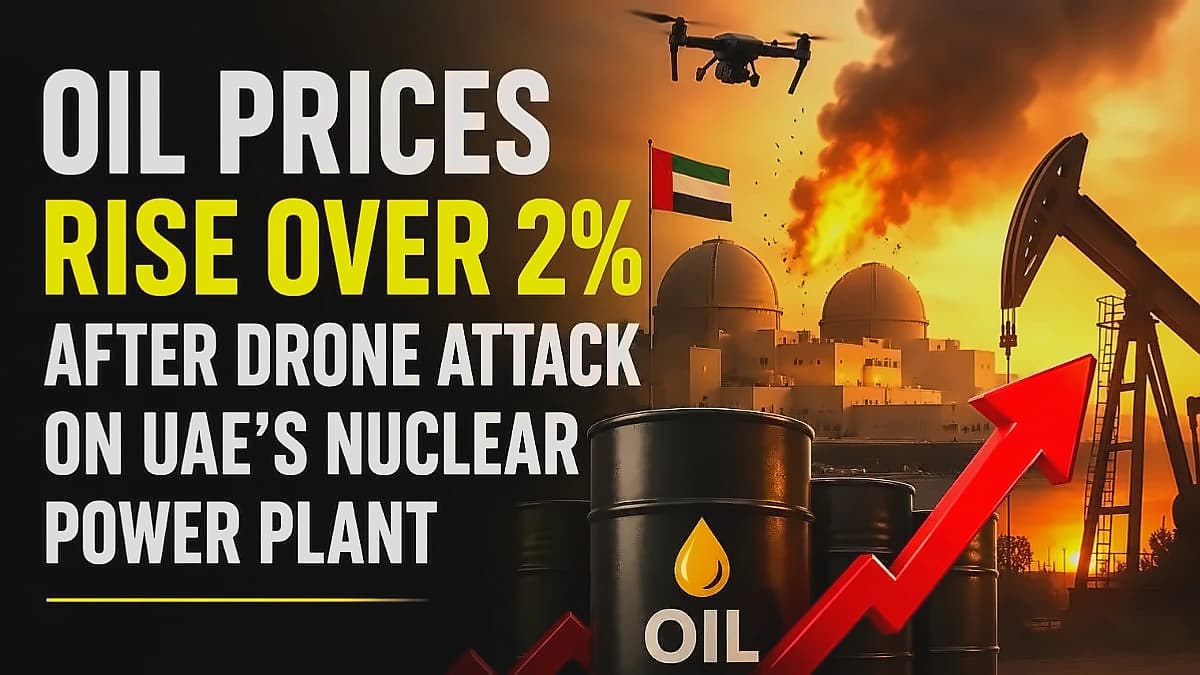
Oil prices fell in Asian trading on Monday after Brent crude reached a six-month high last week, with December Brent crude futures declining 2.05% to $114.33 per barrel and December WTI futures falling 2.25% to $100.95. According to The Hindu BusinessLine, November crude oil futures were trading at ₹9599 on the Multi Commodity Exchange (MCX), down from the previous close of ₹9800, while December futures were at ₹9475 against the previous close of ₹9643. The decline comes as investors weigh the risk of further escalation in the Middle East against signs that shipments from the region had recovered towards prewar levels. Brent crude had surged about 90% this year as the war disrupted energy supplies and widened to involve Yemen's Houthi rebels. Despite the recent retreat, Brent crude still sits near $115, representing a significant premium over pre-war levels, with Brent having already crossed $117 per barrel and analysts suggesting any disruption to energy facilities or shipping through the Strait of Hormuz could push global prices towards $120 per barrel. The US Federal Reserve's upcoming policy decision is another factor investors will watch as crude enters a potentially volatile week.
US President Donald Trump told Fox News that it was 'getting to be decision time' on whether he would reach a deal with Tehran or 'finish it off', signaling a potential shift in US policy toward Iran. According to NDTV Profit, Iranian Foreign Minister Abbas Araghchi said the US and Israel would not attempt an attack if rationality prevailed, referring to the possibility of further military action. On Friday, Brent crude futures settled at $116.72 a barrel and WTI settled at $103.27, with the Houthis claiming responsibility for attacking an airport in Saudi Arabia and oil facilities on Saturday. Saudi Arabia said it had intercepted missiles and drones in response to these attacks. Brent crude rose to its highest level since April on Friday after news reports suggested that the US and Israel could be preparing to strike Iran after the US midterm elections in early November. The conflict has also raised concerns about the security of oil supplies from the Middle East, with fighting between Saudi Arabia and Iran-backed Houthi rebels in Yemen adding to those risks. Israeli elections are scheduled for Tuesday, followed by the US midterm elections in early November, with the Federal Reserve also due to announce its monetary policy decision between those events.
The sustained crude price rally is driven by multiple escalating geopolitical developments in West Asia that have revived concerns over energy infrastructure and export security. According to Business Standard, the rally gathered pace as attention returned to escalating attacks around the Hormuz and Saudi Arabia, reviving concerns over energy infrastructure and export security. Escalating US-Iran tensions, fears of renewed military action, Houthi attacks on Saudi infrastructure and threats to critical shipping routes have sustained the geopolitical risk premium. Further uncertainty has emerged from reports that the US and Israel had prepared plans to target Iranian energy infrastructure, including nuclear facilities near Natanz after the US mid-term elections on November 3. Iran warned of repercussions if Washington and Tel Aviv launched an attack, adding to market anxiety. Despite supply-side interventions including the International Energy Agency's readiness for further strategic stock releases, the G7's additional 100 million barrels, and the first Russian diesel cargo bound for the US, the rally has failed to reverse the upward momentum, with the market increasingly focused on whether these developments can deliver meaningful additional supply.
The West Asia crisis is creating unprecedented disruptions across global energy and shipping networks, with oil prices for Indian refiners averaging $120 per barrel in October, the highest monthly average in 12 years. According to The Times of India, petrol is averaging $140 per barrel and diesel at over $154, creating mounting pressure on state-run retailers who incur losses given that pump prices are linked to import costs. The crisis has pushed freight rates beyond sustainable levels, with container rates to West Asian ports shooting up from $800 to $8,000 to $10,000. As reported by Drewry, the Drewry World Container Index was at $4,585 for a 40-feet container on October 22, compared with $1,746 on October 25, 2025. Security risks and attacks on ships continue to affect vessel movements through the Gulf, with only two containerships sailing into the Gulf in Week 42, down from five the previous week. The East-West container freight market remains uncertain with only 55 sailings through the Suez Canal in Week 42, compared to 54 in Week 41. Additionally, an oil spill from a tanker was detected off the coast of Umm Al Quwain in the United Arab Emirates, though authorities have yet to identify the vessel involved.

The sustained elevation in crude prices is expected to significantly impact India's economic performance, with real GDP growth projected to decline from 7.1% to 7% for 2026-27. As reported by The Hindu BusinessLine, D K Srivastava, Chief Policy Advisor at EY India, noted that a sustained increase of $20 per barrel compared to the RBI's baseline assumption of $95 per barrel will result in marginally lower real GDP growth. Additionally, CPI inflation is likely to increase by about 0.5 percentage points from 5.2% to 5.7%, while nominal GDP growth is expected to increase despite real GDP growth being lower than RBI projections. For India, a prolonged spell of elevated crude prices could mean mounting pressure on the rupee, inflation, the current account and corporate margins, according to Business Standard. This economic impact comes as India continues to prioritize crude oil imports based on the lowest landed cost strategy, with refineries seeking the most cost-effective supplies amid tightening global availability.
The elevated crude prices are creating significant fiscal challenges, particularly through increased fertilizer subsidy requirements. According to The Hindu BusinessLine, the Union Budget has estimated fertilizer subsidy at ₹1.70 lakh crore, but the Controller General of Accounts reports that outgo has already crossed ₹1.03 lakh crore in the first five months. A senior government official quoted by BusinessLine estimates that total outgo is likely to cross ₹3 lakh crore or even touch ₹3.5 lakh crore. Sunil Kumar Sinha, Professor of Economics at Institute for Development and Communication, estimated that possible increases in fertilizer subsidy could widen the 2026-27 fiscal deficit by 0.4-0.5% of GDP. Despite these pressures, the fiscal deficit target of 4.3% of GDP still appears achievable, with potential slippage not exceeding 4.4-4.5% of GDP. However, The Times of India reports that a spike in the import bill due to higher commodity prices will have impact on the trade deficit and the current account deficit, while a weaker rupee will make it less attractive for foreign funds to invest in Indian stocks.
Despite crude prices above $110, the rupee has remained relatively stable within a narrow trading range due to RBI measures introduced in October. As reported by ET Now, the rupee settled at 94.94 last week, little changed from the previous Friday, after climbing to a six-week high of 94.30 per dollar. According to Reuters, Carl Vermassen, a portfolio manager at Vontobel, said 'In contrast to the rate hike, we do not think the latest measures are helpful to foster long-term confidence'. The rupee has maintained a range between 94 on the downside and 97 on the upside since April, with the current range being 94-96 due to RBI measures. However, a surge in oil prices and broader risk aversion weighed on the currency late last week, with both factors likely to remain in focus. ET Now reports that the benchmark 10-year bond yield rose 9 basis points last week, its 10th consecutive weekly rise, to close at 7.4740% on Friday, with traders expecting it to move in the 7.41% to 7.50% range. The Fed's policy decision will be another focus, with markets looking beyond an expected pause for clues on whether further rate hikes remain on the table this year, with any hawkish shift potentially lifting US yields and adding pressure on the rupee.