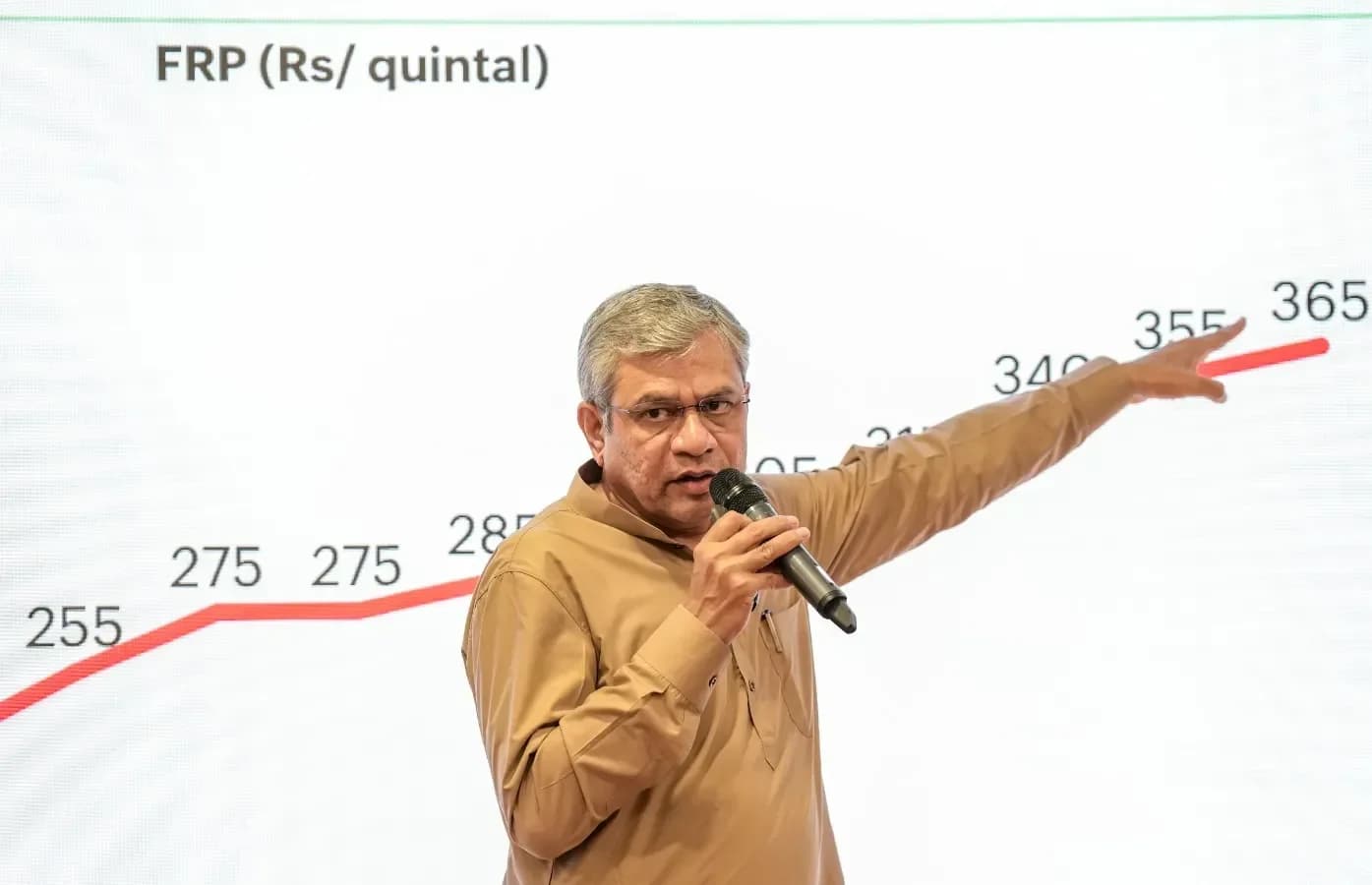
The Centre on Tuesday raised the Fair and Remunerative Price (FRP) for sugarcane by 2.81% for the 2026–27 sugar season. According to reports from Upstox News Desk and Devdiscourse, the Cabinet Committee on Economic Affairs, chaired by Prime Minister Narendra Modi, approved the FRP of ₹365 per quintal for sugarcane at a base recovery rate of 10.25%. Information and Broadcasting Minister Ashwini Vaishnaw announced the decision during a cabinet briefing, stating that the revised FRP will be applicable from October 1, 2026. The decision, approved by the Cabinet Committee on Economic Affairs chaired by Prime Minister Narendra Modi, will apply from October 1, 2026, according to an official press release. Prime Minister Modi highlighted this approval alongside other key decisions including the launch of a Cotton Productivity Mission and new semiconductor projects under the India Semiconductor Mission.
The government has implemented a performance-linked payment system for sugar recovery. As reported by Upstox News Desk and Devdiscourse, the government will pay a premium of ₹3.56 per quintal for every 0.1 percentage point increase in sugar recovery above 10.25%, and apply a similar reduction for lower recovery levels. However, the government has set a floor price of ₹338.3 per quintal to protect farmers, ensuring there will be no deductions for mills with recovery below 9.5%. This floor price will ensure farmers receive at least ₹338.3 per quintal even at lower recovery levels, with the government capping deductions to safeguard farmer interests.
The FRP of ₹365 per quintal is 2.81% higher than the current 2025–26 season and is approximately 100.5% above the estimated cost of production of ₹182 per quintal. According to Upstox News Desk and Devdiscourse, Minister Vaishnaw stated that the decision would result in payments of around ₹1 lakh crore to sugarcane farmers. The sugar season runs from October to September, making the revised FRP applicable from October 1, 2026. The FRP has been fixed based on recommendations of the Commission for Agricultural Costs and Prices (CACP) after consultations with state governments and other stakeholders. As per Devdiscourse, this policy shift aims to benefit approximately one crore sugarcane farmers and 5 lakh workers linked to the sugar sector.
The move will enable ethanol production from surplus sugarcane, as reported by Upstox News Desk and Devdiscourse. Sugar mills are mandated to purchase sugarcane from farmers at the FRP or above. The sugar sector supports the livelihoods of about 5 crore sugarcane farmers and their dependents, besides providing direct employment to around 5 lakh workers in mills and related activities. According to official data cited by Upstox News Desk, about 99.5% of the ₹1.02 lakh crore dues were paid to farmers in the 2024–25 sugar season, while around 88.6% of ₹1.12 lakh crore dues have been cleared so far in the ongoing 2025–26 season. The government highlighted strong payment performance as a key factor supporting the FRP increase.
These sugarcane reforms form part of a comprehensive multi-sector policy approach approved by the Cabinet. As reported by Upstox News Desk, the government also cleared the ₹5,659.22 crore Mission for Cotton Productivity for 2026–31, aimed at raising lint productivity from 440 kg/ha to 755 kg/ha and boosting output to 498 lakh bales. The initiative will initially cover 140 districts across 14 states and is expected to benefit around 32 lakh farmers. Additionally, the Cabinet approved ₹3,936 crore in semiconductor projects under the India Semiconductor Mission in Gujarat, including compound semiconductor facilities and OSAT facilities with over 1,033 million chips annually capacity. These approvals signal a coordinated policy approach combining liquidity support, industrial policy, and farm sector interventions to sustain growth amid global uncertainties.