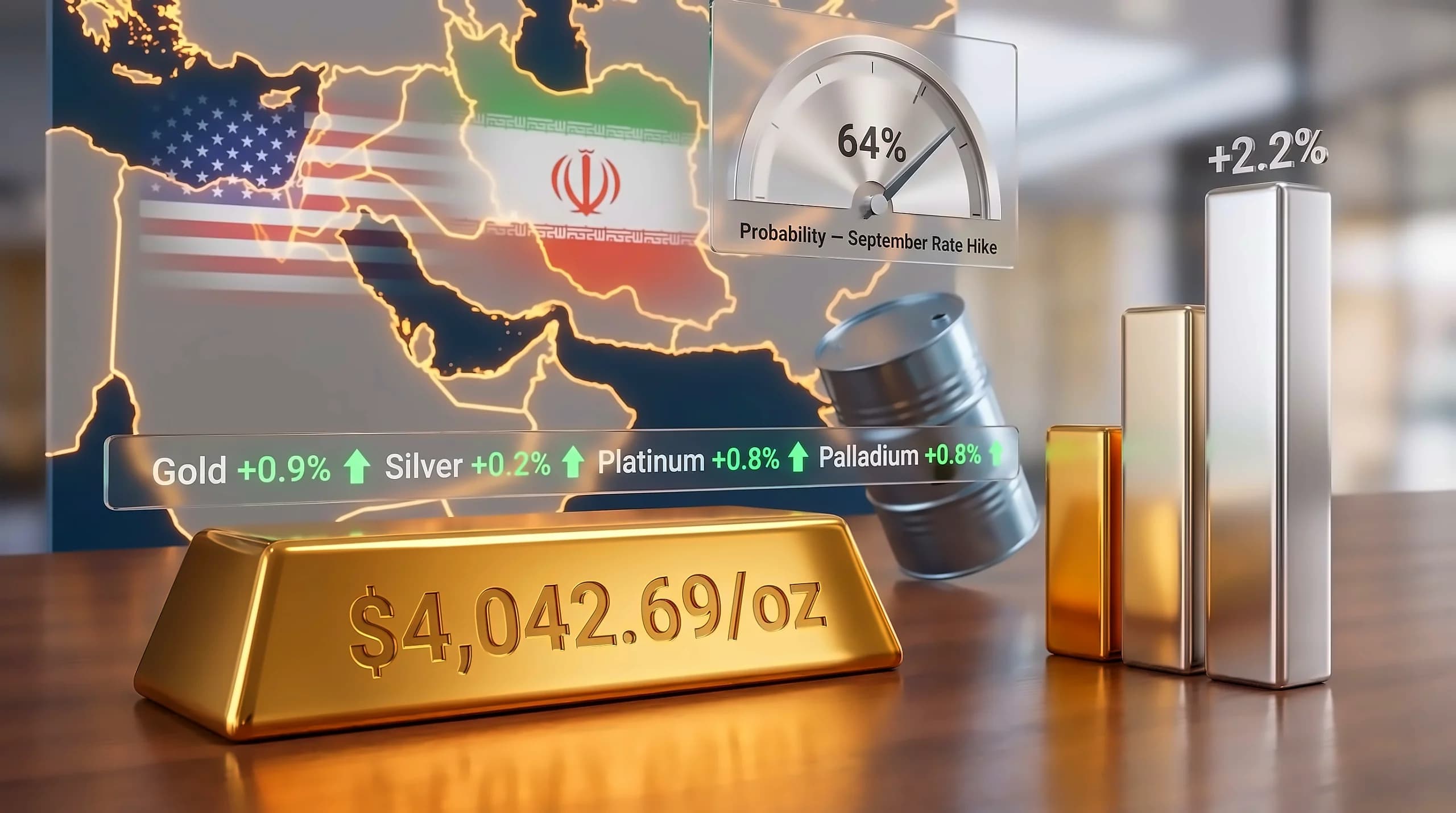
Gold prices fell more than 2% on Friday, retreating from the previous session's two-week high as Middle East conflict drove up energy prices and fueled inflation concerns. According to The Economic Times, Brent crude surged 7% on Thursday, breaking through $100 a barrel for the first time since May in one of the steepest rises since the war has started, stoking inflation concerns and strengthening the case for higher interest rates. Spot gold was down 0.4% to $4,030.09 per ounce by 0333 GMT, having hit its highest level since July 7 on Wednesday. U.S. gold futures for August delivery were 0.4% lower at $4,033.20, as investors assessed rising geopolitical tensions in West Asia while awaiting next week's US Federal Reserve policy meeting. Bullion was on track for a small weekly gain of 0.4%, showing some resilience despite the daily decline. The U.S. dollar gained 0.3%, making greenback-priced bullion expensive for buyers overseas, while yields on the 10-year U.S. Treasury note rose to their highest levels since January 2025. Jim Wyckoff, a market analyst at American Gold Exchange, noted that higher crude oil prices are pushing up bond yields on the notions that central banks will not be able to lower their interest rates because of problematic inflation, and rising bond yields are the enemy of gold and silver market bulls because gold and silver carry no yield.
The US and Iran have intensified attacks on each other as the present conflict entered its fifth month, with military operations reaching new levels of intensity. As reported by Reuters, the widening conflict led four tankers loaded with Saudi crude for Asia to reverse course in the Red Sea on Wednesday after threats from Yemen's Iran-aligned Houthis, who control the coast on the southern route out. This development comes as Iran's Interior Minister Eskandar Momeni visited mediator Pakistan and asked Islamabad to continue its efforts in ongoing mediation efforts. The military coalition led by Saudi Arabia said it had taken steps to protect vessels sailing the Red Sea, prompting the Houthi rebels to vow to impose a maritime blockade. However, President Donald Trump promised on Thursday "major military punishment" for Iran and its Houthi allies, after the Yemeni fighters struck two Saudi oil tankers in the Red Sea, raising fears that disruption to global oil supplies could spread beyond the Strait of Hormuz.
Oil prices extended their rally following escalating Middle East tensions, with both benchmarks reaching multi-week highs. According to Reuters, Brent crude prices hit $100 a barrel for the first time since late May after Yemen's Houthis said they struck two Saudi oil tankers, raising fears that disruption to global oil supplies could spread beyond the Strait of Hormuz. Three oil tankers loaded with Saudi crude for China and India reversed course in the Red Sea on Tuesday after threats from Yemen's Iran-aligned Houthis, as a widening Middle East conflict disrupted shipping through two of the world's most critical energy chokepoints. The military coalition led by Saudi Arabia said it had taken steps to protect vessels sailing the Red Sea, prompting the Houthi rebels to vow to impose a maritime blockade. Brent crude was trading above the $96-per-barrel mark, gaining more than 2%, while WTI crude stood at $88.28 per barrel. Elevated oil prices have been weighing on gold prices as they raise expectations of higher-for-longer interest rates, which tends to diminish the appeal of non-yielding gold.
The Federal Reserve is widely expected to leave interest rates unchanged at next week's policy meeting, but economists' median forecasts suggest the central bank will maintain a restrictive stance throughout 2026. According to The Economic Times, the U.S. Federal Reserve is widely expected to keep rates unchanged next week, although traders are pricing in about an 81% chance of a hike in September, according to the CME FedWatch Tool, up from previous estimates. The European Central Bank kept interest rates unchanged as expected on Thursday but held the door open to another increase in September. Investors now await the U.S. Federal Reserve's interest rate decision and Chair Kevin Warsh's comments following the central bank's two-day policy meeting next week. Traders are pricing in about an 83% chance of a Fed rate hike in September, up from 68% on Wednesday, as reported by Reuters. The marketplace expects no change in interest rates (next week), maybe a hawkish lean on the rhetoric. But if the Fed would happen to lean surprisingly dovish or surprisingly hawkish the markets would react, Wyckoff said. High interest rates tend to diminish the appeal of non-yielding bullion, as the precious metal does not offer any interest income, making it relatively less attractive when borrowing costs remain elevated.
According to The Economic Times, gold edged lower on Friday after falling 2% in the last session, as Brent crude's move back above $100 a barrel stoked inflation concerns and strengthened the case for higher interest rates. Bullion was on track for a small weekly gain of 0.6%. Among other metals, spot silver was down 0.7% at $57.29 per ounce, but was headed for a weekly gain of 2.5%, showing some resilience despite the daily decline. Platinum fell 1.3% to $1,579.49 and palladium dropped 1.5% to $1,237.50, both on track for a weekly drop. For now, bullion prices are likely to remain sensitive to geopolitical developments, movements in the US dollar and Treasury yields, and signals from central banks, particularly the Federal Reserve. A firmer dollar and higher bond yields generally weigh on gold because the precious metal does not offer any interest income, making it relatively less attractive when borrowing costs remain elevated. The Gold/Silver ratio eased to around 69.2, indicating silver's relative strength over gold, while the U.S. Dollar Index remained firm near the 101 level. Analysts warn that if gold falls below the crucial $4,000 support level (around ₹1,41,000), prices could slide further towards $3,900 (around ₹1,38,000).