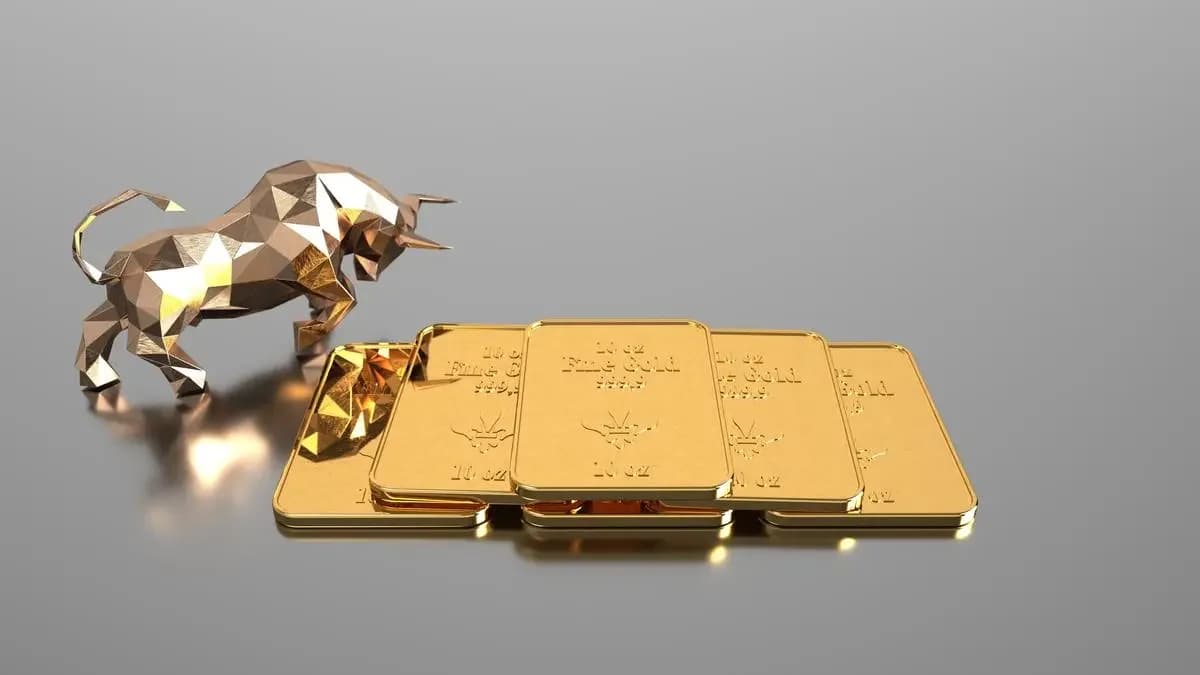
Gold prices tumbled over 1.42% on Tuesday, extending their losing streak to four consecutive weeks as Middle East concerns gave way to expectations of U.S. interest rate hikes to combat inflation. COMEX Gold was trading at $3,981.50 per ounce, down $57.40 from the previous close of $4,032.50, after touching an intraday low of $3,955.40. According to CNBC TV18, gold has now extended its losing streak to four consecutive weeks and remains nearly 30% below its January 2026 record high of $5,597 an ounce. Spot silver fell 1.38% to $57.375 per ounce after hitting a low of $57.035 an ounce during the session, with all precious metals headed for monthly losses. Prithviraj Kothari, Managing Director of RiddiSiddhi Bullions and President of the India Bullion and Jewellers Association, noted that key support for gold is currently seen in the $3,950–$4,000 an ounce range, while silver has weakened significantly, shedding nearly 10% on COMEX in recent sessions.
The US dollar spot index (DYX) strengthened 0.19% to its 52-week or 1-year high level of 101.57 during Wednesday's trading session, compared to 101.38 at the previous currency market close, according to Investing.com data. The dollar was witnessing heightened demand due to a massive selloff in tech stocks on Wall Street, which in turn boosted the currency price. Data showed that in the last three months, the US dollar has gained 2.2% and around 3.8% in the last six months, weighing down gold and silver prices in the market. The dollar index made a 13-month peak at 101.8 overnight and started the Asia session steady around 101.6, while the dollar has broken the $1.14 level against the euro this week and hit its strongest in 13 months at $1.1325 overnight, before steadying in Asia at around $1.1353. An inverse relation between the commodity and the currency price further impacts the demand for the commodities, resulting in volatile prices set by the demand and risk equation.
The primary driver behind gold's decline is rising expectations of Federal Reserve interest rate hikes this year to combat inflation fueled by the Iran war. Traders expect three Fed rate hikes this year and are currently pricing in about a 63% chance of a September increase, according to the CME FedWatch Tool, as reported by The Economic Times. CME Group's FedWatch estimates suggest there is a 36.3% chance of the US Federal Reserve increasing its key interest rates to the range of 3.75-4.00% in the July policy meeting, while there is a 63.7% chance that the central bank holds its key interest rate at the current level of 3.50-3.75% in the upcoming policy meeting in July 2026. The Fed has kept its key benchmark interest rates on hold this year as concerns loom over US inflation due to the impact of the Iran conflict, while the central bank aims to balance its dual mandate of controlling prices while boosting job growth. Since the start of May, 2-year U.S. Treasury yields, which track short-term rates expectations, are up 27 basis points to 4.15% against a 7 bp fall in Europe's benchmark German 2-year yields to 2.56%. A surprisingly hawkish-sounding debut from Kevin Warsh as Federal Reserve chair last week has traders pricing a U.S. hike as soon as October, with the Iran war and jump in oil prices reversing market expectations for U.S. rate cuts this year.
Iranian and U.S. negotiating teams were due to meet in Doha this week, but Iran said on Monday no meeting had been scheduled as weekend missile fire from both sides tested the interim ceasefire to end the four-month-old war. As reported by The Economic Times, Iran said on Monday no meeting had been scheduled as weekend missile fire from both sides tested the interim ceasefire to end the four-month-old war. Despite a brief missile exchange, Tehran and Washington agreed to halt recent hostilities in the Gulf and renew talks regarding their dispute over the Strait of Hormuz, as reported by Axios on Sunday. Oil prices rose on Monday following days of tit-for-tat strikes by the United States and Iran in the Middle East that underscored the fragility of their interim peace deal and again slowed energy shipping in the Strait of Hormuz. After the commodity market selloff at the end of January 2026, post-Fed Governor Kevin Warsh's appointment update, gold and silver prices remained highly volatile due to geopolitical developments. At the end of February, when the US attacked Iran, investors instead of buying due to heightened uncertainty, started selling the precious metals on the backdrop of a rising US dollar rate to fill in their liquidity needs to fund imports amid a supply chain disruption and higher costs.
Investors are now awaiting the June ADP employment and nonfarm payroll data, both due this week, to further gauge the Fed's stance on rate hikes, according to The Economic Times. The U.S. Supreme Court refused on Monday to let Donald Trump fire Federal Reserve Governor Lisa Cook as it stood firm to preserve the central bank's cherished independence against an unprecedented challenge by the Republican president. Guinea aims to become a regional gold refining hub, its mines minister said, joining a broader push by West African producers to process bullion locally rather than exporting it to the Middle East and beyond. Gold speculators raised net long positions by 91 contracts to 113,010 in the week ended June 23. According to Matt Simpson, a senior analyst at StoneX, gold is currently in a bearish momentum trade amid a strong US dollar environment. As reported by The Hindu BusinessLine, bullion-backed exchange-traded funds could face renewed outflows if expectations rise for rate hikes. ING analysts cut their gold forecasts, now expecting prices to average $4,300 an ounce in the third quarter of 2026 and $4,600 in the fourth quarter, compared with their previous projections of $4,850 and $5,000, respectively. Rising crude oil prices above $70 per barrel have also added to inflation worries, limiting support for precious metals, according to Prithviraj Kothari, Managing Director of RiddiSiddhi Bullions and President of the India Bullion and Jewellers Association.