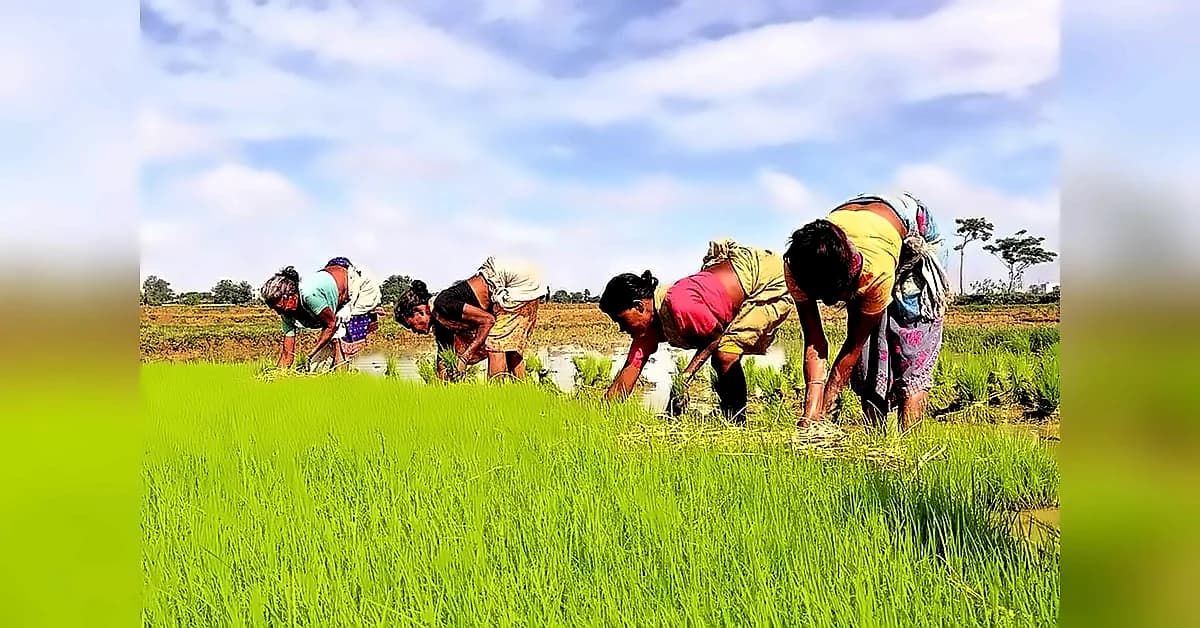
An active southwest monsoon is expected to accelerate kharif sowing after a weak June, helping narrow the rainfall deficit and support crop prospects. The area under kharif crops had lagged sharply behind last year's level until the end of June, down nearly 22% as the monsoon remained largely absent across large parts of West and Central India. According to Business Standard, most weathermen believe the current active phase of the southwest monsoon, driven by favourable weather conditions over the Bay of Bengal, is likely to continue until mid-July. Mahesh Palawat, vice president of Meteorology and Climate Change at Skymet Weather Services, told Business Standard that the first fortnight of July looks significantly better than June in terms of monsoon performance. The monsoon trough, currently stretching across Maharashtra, Gujarat and Madhya Pradesh, is expected to shift towards North India over the next few days, bringing widespread rainfall to the region.
India's economy remained resilient in the initial months of FY27, with the finance ministry's latest monthly economic review for June 2026 revealing that the economy is becoming progressively less vulnerable to fluctuations in monsoon rainfall despite current challenges. According to the department of economic affairs (DEA), structural changes in the economy, wider irrigation coverage, improvements in farming practices and government efforts to build climate resilience have reduced the sensitivity of both agricultural output and overall economic growth to rainfall variability. The review noted that high-frequency indicators such as e-way bill generation, PMI readings, electricity consumption and automobile sales continued to signal strength in domestic demand following the robust growth performance in 2025-26. Despite these improvements, the ministry emphasized that the economy continues to exhibit resilience, though moderation in select high-frequency indicators suggests some easing in momentum.
The review noted significant declines in sowing acreage across major crops during June. Pulses saw a 30% decline, while oilseeds experienced a 53% drop. Rice cultivation decreased by 25%, foodgrains by 21%, and cereals by 18%. These declines were attributed to the monsoon deficit and weak progress of the south west monsoon, as reported by the finance ministry. However, the expected active monsoon phase is likely to help wipe out much of the seasonal deficiency, though whether it disappears entirely remains to be seen as July itself is expected to receive below-normal rainfall. A healthy kharif harvest, particularly of oilseeds and pulses, is crucial to keeping food inflation in check, while good rainfall would also help revive the falling sentiment in rural India.
The finance ministry has called for reorienting agricultural pricing policies to incentivise the cultivation of climate-resilient crops and disincentivise water intensive ones. According to the ministry, India needs to build water buffers in the coming years, with water potentially at the top of the list. The review cites a recent CareEdge analysis showing that the marginal impact of rainfall deviations on both agricultural Gross Value Added (GVA) and overall GVA has moderated significantly over the past five decades, reflecting the economy's structural transformation. The report advocates prioritising water conservation, including recycling and effective utilisation of allocations under the Jal Jeevan Mission, arguing that these measures will help India better withstand future climate-related disruptions. The ministry pitched for a national policy on buffer stocks for a range of critical raw materials and inputs, highlighting it as a lesson from the war.
Despite agricultural challenges, the review highlighted that combined wheat and rice stocks exceed 4.4 times the prescribed buffer norm. The government points to favourable conditions that could help cushion the impact of a weak monsoon on agriculture, with reservoir storage levels, although 26.8% lower than a year ago, were still 5.7% above normal as of June 25, providing a comfortable irrigation buffer. Fertiliser availability also remains adequate, with stocks nearly three times the estimated requirement for June 2026, supporting agricultural activity during the ongoing kharif season. On the external front, the report said strong exports, resilient foreign direct investment inflows and comfortable foreign exchange reserves continue to lend support. It added that softening crude prices due to easing West Asia tensions and progress in US-Iran negotiations have eased external and inflationary pressures. The ministry emphasized that foreign investors have also started returning to India's sovereign debt market, with India in June offering capital gains and withholding tax relief to foreign portfolio investors on their government securities holdings, besides expanding the pool of investable sovereign papers.