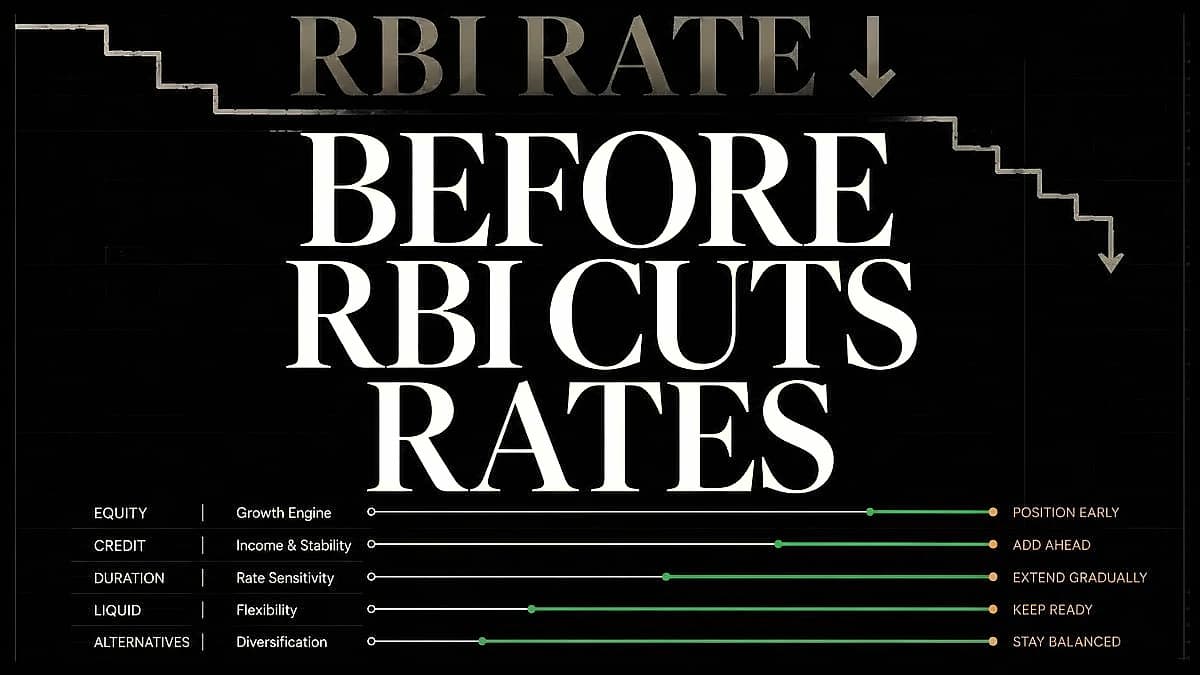
The Reserve Bank of India's decision to hold the repo rate at 5.25% for the third straight meeting signals strategic prudence as the central bank awaits more data, particularly on inflation, before considering monetary tightening. According to Elara Capital, the RBI is likely waiting for the concessional hedging window (till September 30, 2026) to end before considering a rate hike because the subsidy on FCNR(B) deposits and related forex measures is a targeted, temporary tool to attract dollar inflows without the broader economic costs of monetary tightening. The decision to hold rates was unanimous, with the MPC continuing with the neutral stance. The central bank's statement revealed mounting external pressures, with higher oil prices threatening to widen the current-account deficit and foreign portfolio investors withdrawing almost $14 billion this fiscal year, overwhelmingly from equities. The RBI's response was revealing, announcing a comprehensive package designed to attract foreign capital, support external financing and strengthen the balance of payments, moving beyond traditional interest rate tools to ensure external financing remains available even if global conditions deteriorate further.
The six-member monetary policy committee (MPC) cut its FY27 real GDP forecast to 6.6% from 6.9% projected at the April meeting, citing adverse implications of extended supply chain disruptions and elevated energy prices. As per RBI Governor Sanjay Malhotra, "The adverse implications of the extended disruption in supply chains and elevated energy prices are reflected in the moderation of growth and increase in inflation projections from the April policy." The central bank now expects CPI inflation to reach 5.1% in FY27, up from 4.6% earlier, with core inflation projection at 4.7% in FY27, up from 4.4% in April. International crude oil prices jumped to over $100 a barrel after the war in West Asia started in late February, though they have softened somewhat now, even if not to the pre-war levels. The inflation projection for the October-December period has been revised to 5.9% from 5.2%, approaching the upper tolerance limit of 6%. These projections were based on the assumption of an average crude oil price of $95 per barrel, compared with $85 per barrel in April. Although the impact of cost pressures is becoming visible, going ahead, the rise in prices of energy and other inputs coupled disruptions is likely to weigh on economic activity, as noted by the governor. Adding to concerns, the India Meteorological Department (IMD) has projected monsoon at 90% of the long period average (LPA), with food being the biggest component of the consumer inflation measurement basket.
Market experts anticipate that bond yields are likely to remain range-bound in the near term, albeit with a discernible upward bias as inflation risks build. As per Abakkus Mutual Fund, the pause combined with a cautious undertone suggests that yields are likely to remain range-bound in the near term, albeit with a discernible upward bias as inflation risks build. The RBI's decision to hold the repo rate at 5.25% reflects an evolving balance between growth and inflation risks, with earlier moderating inflation creating space for potential policy support, but sharp escalations in crude oil prices driven by geopolitical developments have significantly altered the inflation outlook. Elevated energy prices not only directly impact fuel costs but also cascade through transportation, manufacturing, and household consumption, raising the likelihood of broader and more persistent price pressures across the economy. While headline inflation remains below the RBI's target band, the central bank has acknowledged rising upside risks driven by global commodity price volatility and supply side constraints, with the potential for second-round effects filtering into core inflation. Debt markets reacted positively, with yields at the shorter end of the curve declining by 10–20 basis points, reflecting reduced near-term rate hike expectations, according to Business Standard. Bond yields eased after the announcements, with the 10-year benchmark government bond yield ending at 6.97% on Friday compared to 6.99% on Thursday, as reported by Mint. Rajeev Pawar, treasury head at Ujjivan Small Finance Bank, expects the 10-year yield to see a further fall of 5 basis points, while VRC Reddy of Karur Vysya Bank noted that the 10-year benchmark yield is likely to find support around 6.9% and could move towards 7.1% as markets reassess the policy outlook.
Markets responded mixed to the RBI's decision, with equities ending weak while the rupee emerged as the session's standout performer, strengthening 85 paise to close at 84.94 against the dollar - a one-month high that outperformed most Asian peers. According to The Hindu BusinessLine, the BSE Sensex settled at 74,243.34, down 116.67 points or 0.16%, after touching an intraday high of 74,717.57 before profit-booking dragged it to a low of 73,988.75. The Nifty 50 closed at 23,366.70, shedding 49.85 points or 0.21%, with the Nifty losing 0.77% for the week and the Sensex shedding 525 points. For the session, 4,150 stocks were advancing against 2,263 declines, with 215 stocks hitting 52-week highs and 48 touching 52-week lows. The positive currency response was aided by a softer greenback and declining crude prices, with USD/INR slipping below the 85 mark among the session's more significant moves. A decisive break past 84.70 could open the path toward 84.10 in the near term, according to analysts. Sectorally, Media, Realty, Healthcare, FMCG, and Banking closed in the green, while Metals, IT, and Oil & Gas underperformed, as reported by The Hindu BusinessLine. Since the US-Iran war began on 28 February, the rupee has weakened 3.7%, according to Bloomberg data, closing at 94.94 against the dollar on Thursday, as reported by Mint. Market reaction has been largely positive post policy announcement, with equity indices remaining flat or marginally higher, bond yields down and rupee pulling back, according to Mint.

The RBI expanded the Fully Accessible Route (FAR) to include all new 15-year, 30-year and 40-year government security issuances, giving foreign investors wider access to longer-tenor Indian government bonds. As reported by Reuters, bonds under this category are part of three global indexes, making them more attractive to international investors. The central bank also removed investment concentration limits for foreign portfolio investors under the general route, reducing one layer of restriction for foreign investors and making Indian fixed-income assets easier to access. According to The Hindu BusinessLine, the policy also included a set of capital account measures aimed at attracting foreign flows, including the introduction of a PSU ECB swap window and extended FCNR(B) hedging support. RBI Governor Sanjay Malhotra stated that the measures are expected to bring healthy flows from ECBs and various other announced measures, with experts expecting inflows of $35-45 billion as a result of the comprehensive package. The government also made sovereign green bonds eligible under the FAR framework, with the government and RBI also easing rules governing foreign investment in Indian equities. Individual Persons Resident Outside India (PROIs) will now be allowed to invest in listed Indian equities through the Portfolio Investment Scheme (PIS), a facility previously available only to Non-Resident Indians (NRIs) and Overseas Citizens of India (OCIs). The government has increased the investment cap for an individual PROI under the scheme to 10% of a company's paid-up capital from the existing 5%, while the aggregate limit for all such investors has been raised to 24% from 10%. Rajesh H. Gandhi of Deloitte India noted that the tax exemption could raise FPI returns on Indian government bonds by 15-20%, making India more attractive to foreign investors and strengthening the case for global bond index participation. The tax exemption should ease pressure on the rupee over the medium to longer term, as reported by Mint. At around the same time, the government announced that investments by FPIs in government securities will be exempt from capital gains tax and withholding tax (TDS), with the RBI fully subsidizing the forward cover cost for authorised dealers mobilizing FCNR(B) deposits.
The six-member monetary policy committee (MPC) kept the repo rate unchanged at 5.25%, citing geopolitical risks, supply-chain disruptions and weather-related uncertainties. As noted by Indranil Pan, chief economist at Yes Bank, "This policy was more about addressing the paucity of foreign flows into the Indian economy and addressing the external sector problems, rather than addressing the growth-inflation dynamics." The central bank has come under pressure in recent months after the rupee's sharp slide against the US dollar, fuelling speculation that policymakers could consider a rate hike to support the currency. The MPC felt it would be prudent to wait for greater clarity to emerge, with Malhotra stating "The MPC will continue to remain data-dependent and closely monitor developments, including supply-side pressures getting embedded in the general price level and inflation expectations." The committee downgraded the growth outlook, while raising the inflation projections. The surge in energy prices and persistent trade policy uncertainties continue to pose upside risks to India's current account deficit in 2026-27, according to Malhotra. Consumer price inflation stood at 3.48% in April 2026, well below the RBI's 4% target, with raising interest rates would neither resolve disruptions in the Strait of Hormuz nor prevent foreign portfolio investors from selling Indian equities. While India's growth is buoyant, we should grow at the maximum potential rate, as noted by Mint. Former RBI Deputy Governor R Gandhi noted that the revised inflation forecast of 5.1% is well within the corridor of the MPC mandate, stating "That is why I do not expect any immediate disturbance in terms of expecting a rate hike or anything." He emphasized that the Governor has announced that the risks are on the upside for inflation, cautioning that "if further data affirm that there is going to be a disturbance, then there could be a change in the policy rate." Economists at Barclays noted that the governor's address repeatedly highlighted the uncertain global environment, adding that "The MPC's pause today was guided by the need to wait for greater clarity to emerge on growth and inflation risks." They expect the RBI to be on hold in 2026 and deliver a 50-basis-point hike in CY2027. Soumya Kanti Ghosh, group chief economic adviser at State Bank of India, believes the RBI will continue to look through inflation prints before taking a considered call on a potential rate hike, with SBI expecting a pause in the next policy meeting scheduled for 3-5 August. Taking into account the current situation, the measures announced by the RBI and the government and the overall tone of the policy review, it is clear that we are headed towards policy rate hikes going forward, with the question being when would the rate hike cycle start? The review on 5 August 2026 would likely be a status quo event. It is likely to start in the October 2026 policy review.