The Reserve Bank of India maintained the repo rate at 5.25 per cent in its latest monetary policy decision, as reported by market sources. According to Vineet Agarwal, Co-founder of Jiraaf, the central bank's decision to keep the repo rate unchanged with a neutral stance is prudent given that FY27 inflation is projected at 5.0%, with Q3 inflation expected at 5.9%. The benchmark 10-year G-Sec yield is currently around 6.75%, already on the higher side relative to the policy rate and about 29 bps higher than a year ago. Agarwal's base case suggests a prolonged pause with a mild downward bias over the medium term if inflation moderates, though oil prices, food inflation and global yields could keep bond yields elevated in the near term.
For debt fund investors, the RBI's rate hold at 5.25% creates specific opportunities and challenges in the current yield environment. As reported by market sources, investors should focus on yield-to-maturity (YTM) and modified duration as key metrics for portfolio optimization. The current rate environment presents opportunities for investors seeking to optimize their fixed-income exposure, with debt instruments positioned to benefit from potential rate cuts that could improve yield prospects for bond holders. ICICI Bank raised $750 million through five-year dollar bonds at 105 basis points over US Treasuries, highlighting how bank funding markets remain active even as yields move. This strong institutional demand signals continued access to overseas funding channels and influences domestic debt expectations, making bank debt a potential defensive element in portfolios while offering selective credit opportunities.
For investors with a ₹1 crore portfolio over a 3-year horizon, the recommended strategy involves maintaining ₹25 lakh in G-Secs or SDLs, ₹40 lakh in AAA corporate bonds, ₹20 lakh in selectively chosen AA or other credit opportunities, and ₹15 lakh in T-bills or money-market instruments. As reported by Agarwal, the portfolio should be laddered across roughly 1-year, 2-year and 3-year maturities rather than concentrating the entire amount at one maturity. For a moderate-risk investor, a reasonable starting point could be 25% to 30% in government securities, 35% to 40% in AAA corporate bonds, 15% to 20% in selectively chosen credit opportunities, and 15% to 20% in money-market instruments. This approach allows investors to lock in current rates while retaining flexibility if inflation or oil pushes yields higher, with AAA corporate bonds offering spreads of approximately 50 to 140 bps over the government benchmark.
For investors, tax efficiency can materially change the return an investor actually earns, as highlighted by Agarwal's analysis. A 7.5% taxable interest return becomes only about 5.25% before cess for an investor in the 30% tax bracket. FD interest and bond coupon income are generally taxed at the investor's applicable slab rate, while listed bonds and government securities held for more than 12 months can qualify as long-term assets with the general LTCG rate at 12.5%. Debt mutual funds and certain debt instruments can have different treatment, making it crucial for investors to compare post-tax yield, liquidity and credit risk rather than simply choosing the product with the highest advertised interest rate. The emphasis remains on disciplined rebalancing and avoiding undue concentration in any single issuer or duration bucket, especially during a rising-yield phase.
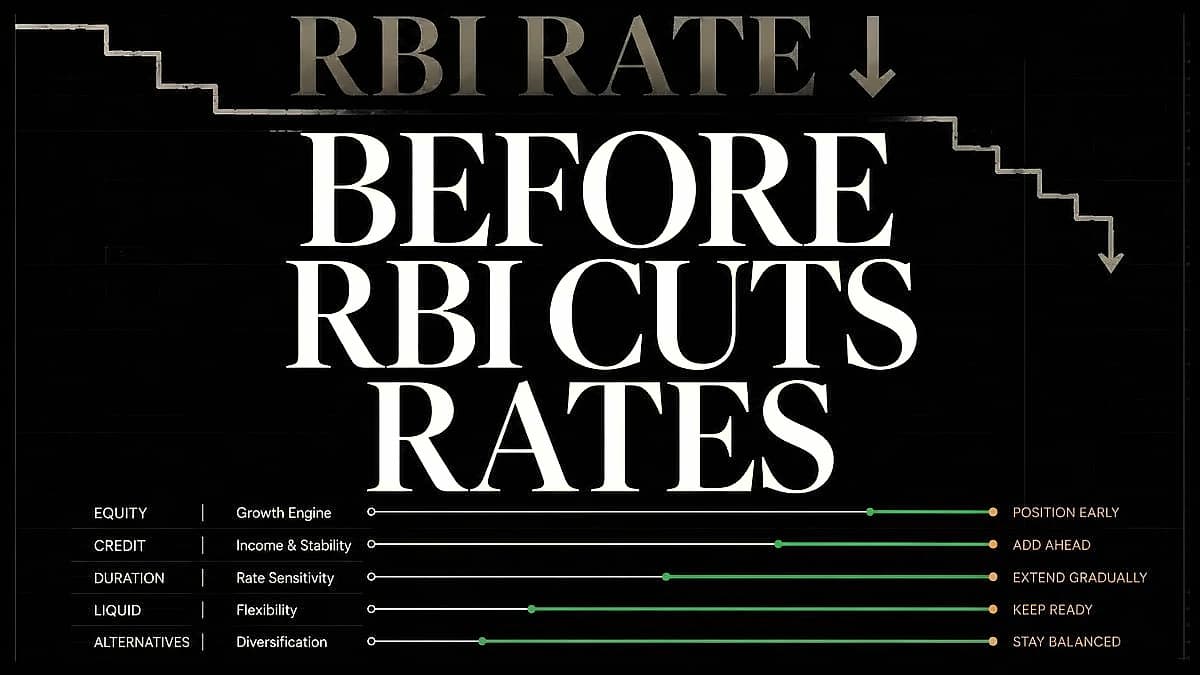
The recommended five-step approach includes clear triggers for investors to act on when rate cut expectations materialize. As reported by market sources, this framework provides a systematic method for adjusting debt and equity allocations based on monetary policy developments and economic indicators. According to Agarwal, bond funds offer professional management and broad diversification, which can be useful for investors who do not want to evaluate individual issuers or actively manage maturities. Direct bond ownership has advantages when investors have clearly defined two-to-five-year goals and want greater visibility over coupons, maturity dates and expected cash flows. The broad principle should be to use sovereign and AAA securities as the portfolio core, and take additional credit risk selectively rather than chasing the highest available yield, while maintaining the flexibility to move to longer duration as yields rise.