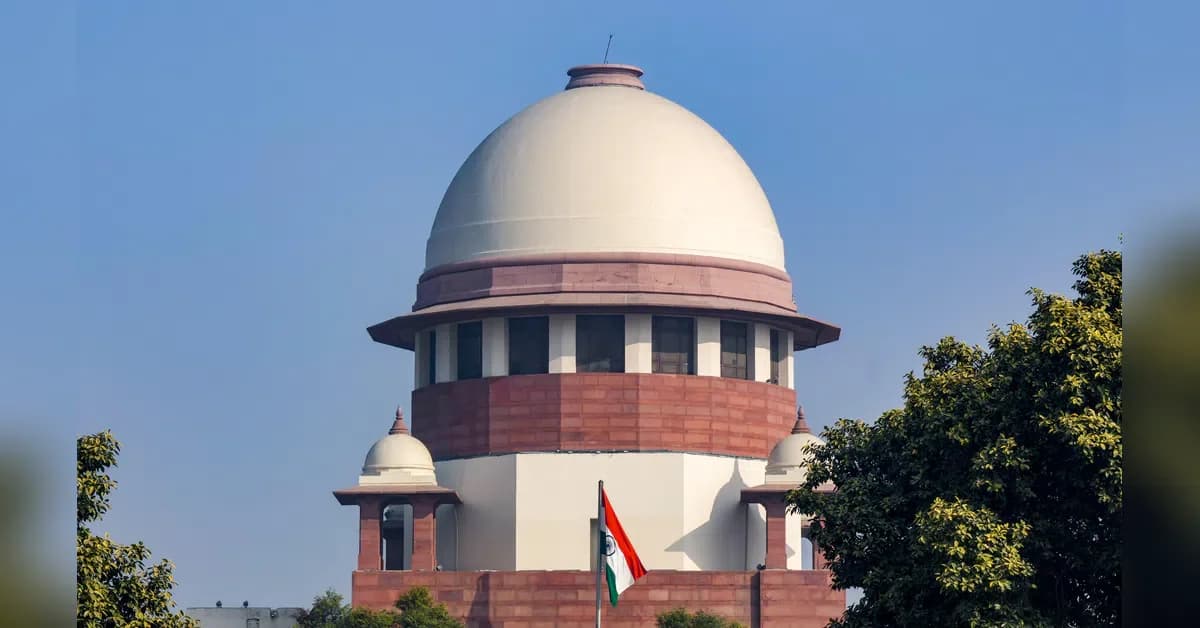
The Supreme Court delivered a landmark verdict in Ajay Vijh v. Indian Banks Association & Ors., firmly holding that banks cannot assume the role of regulators of the legal profession. According to reports from Business Standard, a bench of Justices Pamidighantam Sri Narasimha and Alok Aradhe reinforced the independence of the legal profession, stating that blacklisting lawyers amounted to an impermissible encroachment upon the statutory disciplinary jurisdiction of the Bar Councils. The court has now directed the Bar Council of India to carry out a comprehensive audit of disciplinary systems operated by it and State Bar Councils, as reported by Business Standard. The BCI has been asked to constitute a committee to objectively evaluate how it and the State Bar Councils discharge their statutory responsibility of regulating professional conduct and discipline under the Advocates Act, 1961. The BCI has been asked to consider the committee's findings and file an affidavit detailing the action proposed or taken.
The judgment clarified the scope of judicial review under Article 226 of the Constitution and held that writ petitions are maintainable against the IBA. As reported by Business Standard, the court rejected the Allahabad High Court's view that a writ petition was not maintainable because the IBA is not 'State' under Article 12. The bench emphasized that the expression 'any person or authority' has consistently received a 'wider and more liberal interpretation', making the IBA amenable to judicial review. The court directed the BCI to constitute a committee and seek an objective assessment of its duties of self-regulation of professional conduct and discipline, consider the report and file an affidavit of the action proposed/taken. According to The Hindu, the Supreme Court drew a sharp constitutional line between a bank's internal right to terminate a service contract and its lack of power to cast public aspersions on an advocate's character, stating that 'permitting banks or banking associations to bypass the disciplinary process under the Advocates Act and unilaterally portray an advocate as professionally incompetent by including his name in a Caution List is illegal, unsustainable and impermissible'. The court also ruled that RBI's fraud-prevention circulars cannot be stretched to cover mere negligence in legal opinion, reaffirming that banks have no business regulating lawyers beyond choosing whom they engage.
The dispute arose after Canara Bank removed lawyer Ajay Vijh from its panel following allegations that a legal opinion furnished by him in 2015 negligently failed to detect earlier sale transactions relating to a mortgaged property. According to Business Standard, the bank subsequently recommended his inclusion in the IBA's Caution List under the category of 'Third Party Entities Involved in Fraud', with remarks that he had provided a 'wrong legal opinion' and acted negligently, thereby exposing the bank to financial risk. The top court observed that the allegations against the advocate related only to negligence and did not involve fraud, collusion or criminal misconduct. As reported by The Hindu, the advocate challenged this inclusion, arguing that it resulted in the termination of his engagements with other banking institutions and permanently damaged his professional reputation without a fair hearing. The appellant contended that the 'Caution List' mechanism, intended for fraudulent entities, was used arbitrarily to label him as incompetent, violating his right to practice his profession. The Court drew a clear distinction between two domains - a bank is entitled to discontinue or decline empanelment of any advocate based on its assessment of performance, as this is a matter of contract, trust and internal policy, while any public or sector-wide action that effectively brands a lawyer as negligent, incompetent or untrustworthy—and thereby impacts his or her reputation and prospects across institutions—amounts to a form of professional blacklisting and crosses into the field of regulation.
The court emphasized that 'independence of the legal profession is as important as independence of the judiciary', with their independence from the executive and legislature being the foundation of the rule of law and democracy. As reported by Business Standard, the bench stated that the principle of self-regulation has historically been regarded as the defining feature of independence of the legal profession. The court directed that if banks have concerns about advocate diligence, quality and reliability of legal opinions, they should place relevant material before the competent State Bar Council to take necessary action under the Advocates Act rather than blacklisting them. According to The Hindu, the bench stated that 'matters relating to professional conduct or misconduct of advocates fall within the exclusive jurisdiction of the regulatory bodies constituted under the Act, namely the Bar Councils', and that 'the independence of the legal profession is as important as independence of the judiciary. In fact, their independence from the executive and the legislature is the foundation of the rule of law and democracy'. The court reaffirmed that 'Allowing banks or industry bodies to run parallel reputational sanctioning systems through caution lists is illegal and impermissible', establishing that this self-regulatory framework is a core element of the independence of the Bar and the justice system. The bench noted that 'the duties of the State Bar Councils and the BCI extend beyond merely processing individual complaints, having regard to the importance of maintaining public confidence in the institution of lawyers', and called for a comprehensive performance audit of disciplinary mechanisms.
The verdict addressed the broader issue of case pendency, stating there was a 'compelling need' to kindle among advocates a deeper sense of responsibility for timely disposal of cases. According to Business Standard, the court noted that mounting pendency across District Courts, High Courts, and the Supreme Court poses challenges to the justice delivery system in India. The bench emphasized that 'despite frequent references to the Bar and Bench as the 'two wheels of the chariot of justice', the Bar is seldom called upon to share responsibility for reducing delays'. The court called for a paradigm shift, stating that 'tackling pendency must become a collaborative mission of the Bench and the Bar'. As reported by The Hindu, the court identified the Bar as an 'equal institutional partner' in the justice delivery system, shifting the narrative toward shared responsibility for reducing judicial pendency. The judgment serves as a robust defense of the legal profession's autonomy, ensuring that while advocates remain accountable for their professional standards, they are protected from extra-statutory, arbitrary action by private or institutional bodies. The court has now expanded the scope of the judgment to address broader concerns over regulation of the legal profession, with the audit to examine factors such as the number of complaints filed and disposed of each year, the average time taken to decide cases, age-wise pendency, regional variations in disposal, staffing levels, procedural differences among Bar Councils, the nature of penalties imposed, transparency of proceedings, and compliance with statutory timelines.