The U.S. tech industry is experiencing another major disruption as Kimi K3 from Beijing-based startup Moonshot topped Arena's ranking of front-end coding capability, marking a significant milestone in Chinese AI development. According to Arena's co-founder and CEO Anastasios Angelopoulos, "This may be the single biggest release of the year" and represents a moment when open-source Chinese models are surpassing closed U.S. models. The Kimi K3 price is the highest yet for a Chinese AI model, but remains half as expensive as OpenAI's high-performing GPT-5.6 Sol model, as reported by Bank of America research analysts. This performance follows Zhipu's GLM-5.2 model release last month, which is already widely used by software developers globally for work comparable to top U.S. models at lower costs.
The AI cost crisis has intensified significantly since Nvidia's historic $600 billion loss on January 27, 2025, when the company lost close to $600 billion in a single trading session on fears that cheap Chinese models had rendered the entire US AI buildout obsolete. According to reports from Investing.com India, the same concerns are resurfacing now, with US inference costs growing expensive enough that firms are visibly migrating to Chinese open-weight models. The Silicon Data LLM Token Expenditure Index nearly doubled between December and May before pulling back about 20%, indicating buyers' willingness to pay is starting to peak as demand shifts toward cheaper alternatives. However, Allianz Research puts the growth gap between AI investment and AI sales at nearly 46%, wider than the 32% divergence seen during the 2001 telecom bust, highlighting the strain on hyperscaler economics.
Chinese AI models are demonstrating clear cost advantages over US alternatives. As reported by Investing.com India, Claude Fable 5 runs $2.75 per intelligence-index task against $0.37 for GLM-5.2, roughly a 7x gap. OpenRouter's April rankings show three Chinese models atop global token usage: Xiaomi's Mimo, Alibaba's Qwen, and DeepSeek, with output pricing often $0.50 to $3 per million tokens against $15 to $25 for Claude. The Chinese open weight share of global token usage jumped from about 1.2% in late 2024 to roughly 30% by late 2025, with Andreessen Horowitz estimating roughly 80% of US startups now build on Chinese base models. According to Stanford University's 2026 AI Index Report, the performance gap between the best US and Chinese models has fallen to 2.7 percentage points, compared with 17.5 to 31.6 points in May 2023, with U.S. firms attracting 23 times as much private AI investment as Chinese firms yet leading in model performance by less than 3 percentage points.
Major companies are actively switching to Chinese alternatives due to cost pressures. According to Investing.com India, Uber burned through its entire 2026 AI coding budget in four months, while Airbnb has moved customer service workloads to Qwen, Alibaba's open-weight AI model family. Pinterest has gone all in on open source and cut costs by roughly 90%, and Coinbase adopted GLM and Kimi and nearly halved its AI bill. Lindy fully switched from Claude to DeepSeek, with founder Flo Crivello announcing the move on X in June, stating the switch saved the firm millions of dollars. As reported by Axios, Microsoft is considering a fine-tuned version of DeepSeek V4, hosted on Azure, as a cheaper alternative to the OpenAI and Anthropic models that power Copilot Cowork, with Charles Lamanna citing that "the costs can go very high" for enterprise users performing hundreds of tasks each week. MiniMax, a smaller Chinese startup, ranked fourth in overall market share, trailing only Alphabet, Anthropic, and OpenAI, demonstrating the widespread adoption of Chinese alternatives.
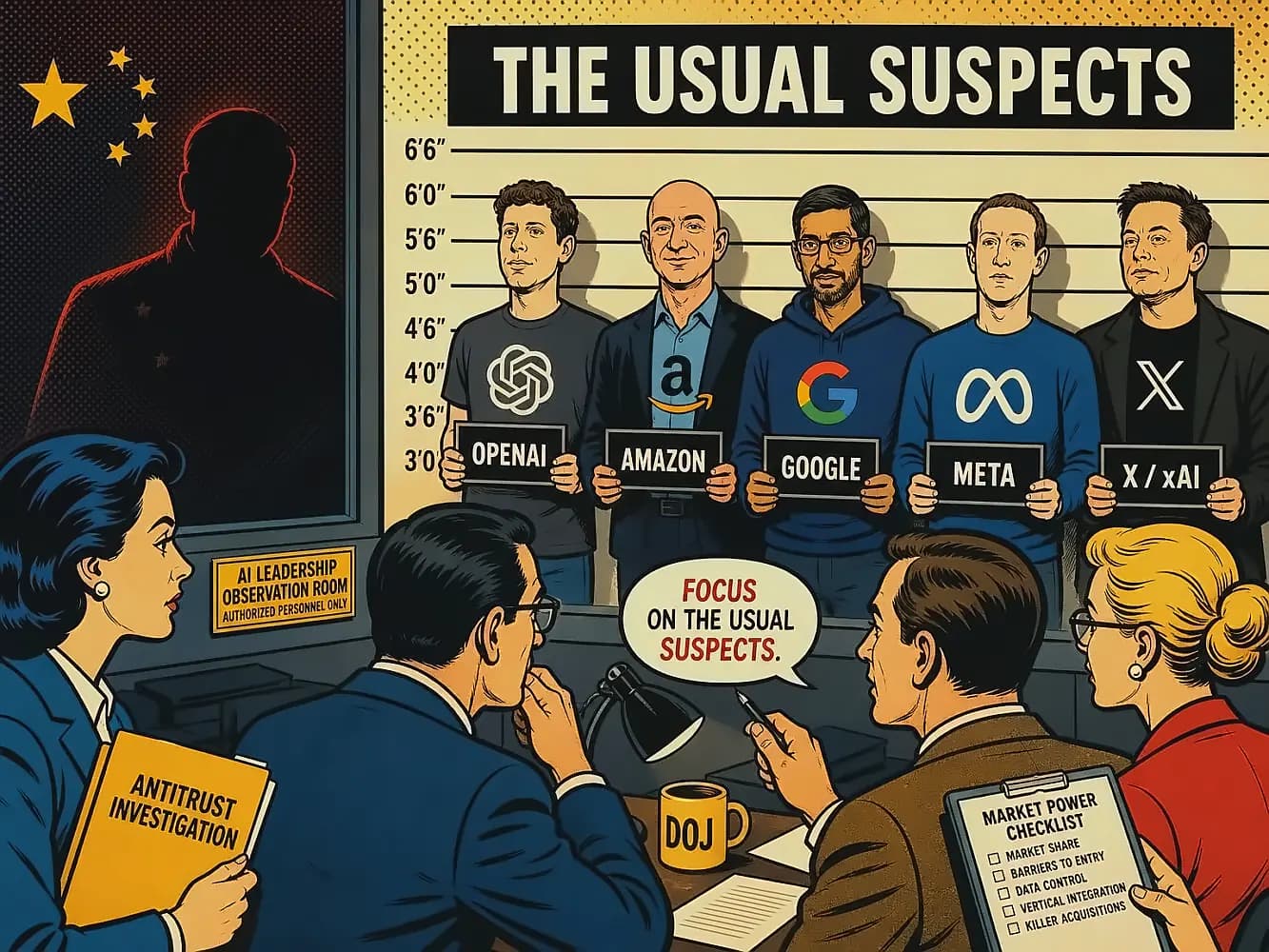
The competitive landscape is intensifying as China develops domestic hardware capabilities despite U.S. restrictions. During the World Artificial Intelligence Conference in Shanghai, Chinese President Xi Jinping emphasized that "The development of artificial intelligence should not be a solo performance by any single country but rather a symphony of global cooperation." Huawei showcased the Atlas 950 SuperPoD AI computing system, signaling China's growing domestic hardware capabilities. Moonshot co-founder Yang Zhilin earned his Ph.D. in 2019 at Carnegie Mellon University, where he made fundamental contributions to machine learning and is known for his love of Pink Floyd. The K2.5 model has been acknowledged by San Francisco-based startup Anysphere as the basis for one of its top products, with SpaceX planning to close a $60 billion deal to buy Cursor later this year. However, U.S. politicians and major AI companies including Anthropic and OpenAI have accused Chinese AI models of illicit "distillation" to extract technologies, with Anthropic accusing Moonshot, DeepSeek, and MiniMax of engaging in campaigns to "illicitly extract Claude's capabilities."