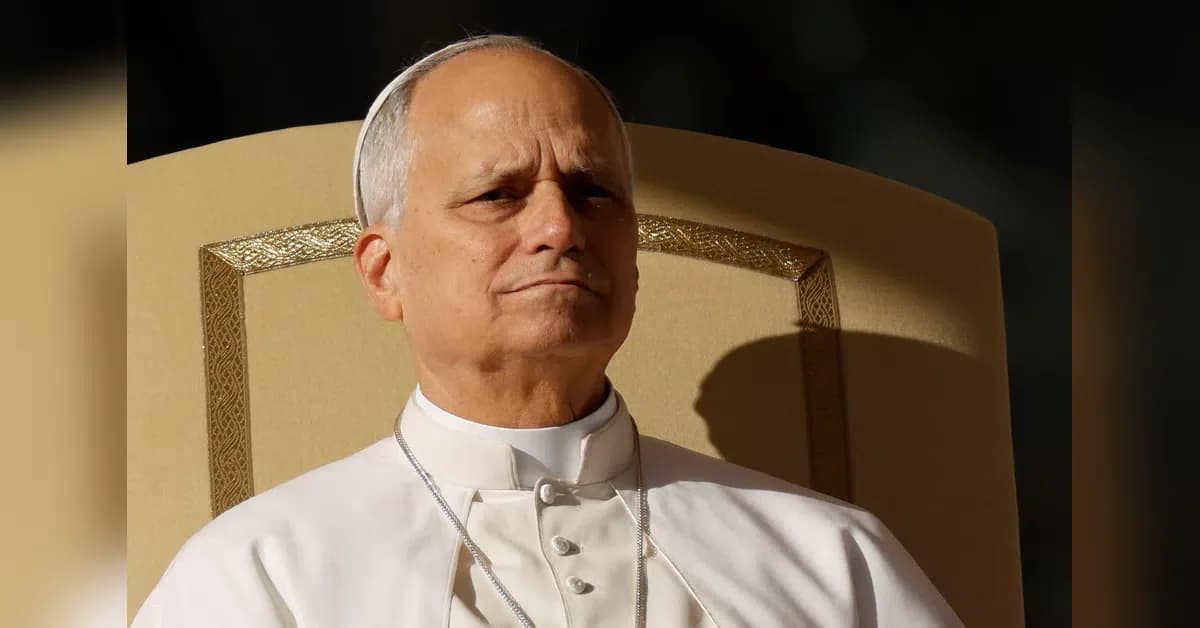
Pope Leo XIV has released his first encyclical titled 'Magnifica Humanitas' (Magnificent Humanity), calling for artificial intelligence to be 'disarmed' in a comprehensive warning about AI dangers. According to reports from BeInCrypto, the nearly 43,000-word document was released on May 25, positioning the Catholic Church at the center of the global AI governance debate. The encyclical warns that the biggest AI developers are private, often transnational entities whose resources exceed those of many governments. As reported by Morning Brew, this document represents not only the first major theological doctrine of Leo's pontificate, but also the first papal encyclical publicly presented by the pope himself. Leo signed the text on May 15, 135 years after his namesake, Pope Leo XIII, signed his own transformational document on workers' rights during the Industrial Revolution. In his letter to the world's 1.4 billion Catholics, Leo emphasizes that **'we must avoid the misconception of equating this type of
The encyclical includes direct prohibitions on machines making lethal or irreversible decisions, as reported by BeInCrypto. Pope Leo argues that concentrated power tends to evade public accountability and can generate new forms of dependency and inequality. On AI in combat, Leo is unambiguous, stating 'It is not permissible to entrust lethal or otherwise irreversible decisions to artificial systems.' The Pope also warns that AI-driven disinformation could steer democracies slowly toward totalitarianism. According to Morning Brew, Leo cautioned that AI could be the 'new Tower of Babel' and criticized AI's role in normalizing war, demanding developers build a chain of command that doesn't allow AI to use weapons without human input. The encyclical specifically calls AI use in war a 'sin, a betrayal of the just war doctrine' - a six-centuries old tradition that didn't imagine a world where human actors were not making decisions. Leo describes the field of artificial intelligence as swiftly evolving, and with real promise as a 'valuable tool.' But he emphasizes throughout the text that on a profound level, artificial intelligence is not human, however closely it comes to approximating the human mind and even its soul. These systems merely imitate certain functions of human intelligence, but do not undergo experiences, do not possess a body, do not feel joy or pain, do not mature through relationships and do not know from within what love, work, friendship or responsibility mean.
According to the encyclical, Pope Leo argues that automation is reshaping work structures in ways that do not automatically benefit workers. As reported by BeInCrypto, Leo writes that greater profits cannot justify choices that systematically eliminate jobs. The Pope calls for clear legal frameworks and independent oversight rather than voluntary ethics pledges from industry. According to Morning Brew, Leo wrote that 'the pursuit of greater profits cannot justify choices that systematically sacrifice jobs' and urged more independent oversight and AI regulation, stating 'a more moral AI is not enough if that morality is determined by a few.' The encyclical emphasizes that 'robust legal frameworks, independent oversight, informed users, and a political system that does not abdicate its responsibility are required' - a direct challenge to current regulatory approaches. Leo's message is particularly relevant as the current pope is the first American pontiff, making his encyclical a forward-looking document arriving at the precipice of what many see as a new technological age that will profoundly reshape human life.
Anthropic co-founder Christopher Olah appeared at the Vatican as a lay presenter, placing a prominent AI safety researcher alongside the Catholic Church in the global AI governance debate, according to BeInCrypto. Olah leads interpretability research focused on understanding how large language models form decisions internally, work that maps directly onto Pope Leo's demand for AI systems that are transparent and accountable to human oversight. As reported by Morning Brew, Leo delivered his declaration while standing next to Anthropic co-founder Christopher Olah, a gesture to the dialogue between Silicon Valley and the Vatican. Olah's presence was particularly significant given that Anthropic had an infamous fight with the Pentagon in February, and the White House ended up blacklisting them for government contracts. According to Christopher Hale from Letters from Leo, the Vatican sees Anthropic as 'unlike some of his competitors, someone who is willing to play ball with ethics' - someone who has been working with the Vatican for a decade on AI safety issues.
Pope Leo does not oppose AI development outright, as reported by BeInCrypto. His encyclical frames a slower, more deliberate adoption as an act of responsible care, a position that now carries the weight of the world's largest religious institution. When he was elected last May, Leo said AI posed 'challenges to human dignity, justice, and labor,' equating the technology to advancements during the Industrial Revolution. The encyclical targets the concentration of AI power in private hands, arguing that these entities often operate beyond traditional government oversight mechanisms. Leo emphasizes that 'technology should not be considered, in itself, as a force antagonistic to humanity,' but warns that without stronger safeguards, artificial intelligence could deepen inequality, weaken human agency, and shift critical decisions increasingly out of human hands. The Pope is particularly concerned about AI development being concentrated in a handful of wealthy nations, stating 'we do not have a mechanism for this. It is an unsolved problem' - a challenge the church has historically refused to let the world ignore.