Artificial intelligence is fundamentally changing how Indian IT companies approach revenue growth, with revenue expansion becoming less dependent on hiring more employees. According to Nasscom's latest report titled 'AI will reshape, not replace, IT services and BPM businesses in India', 'Growth in revenue or scope is decoupling from increase in headcount', marking a significant shift in traditional business models. The technology enables Indian IT firms to handle larger projects without increasing headcount and AI-driven automation reduces demand for traditional services while cutting project costs. As Nasscom notes, 'Where AI has primarily automated existing tasks, revenue pools are facing compression; where lower costs have unlocked new use cases or AI has generated additional enterprise requirements, the addressable opportunity is expanding'. This transformation is particularly relevant as AI-led automation has changed existing business models by cutting down the demand for specific traditional services while making earlier expensive projects more viable commercially.
A new report by JP Morgan Wealth Management reveals that artificial intelligence could put around 24 million knowledge-worker jobs at risk worldwide over the next five years. According to the analysis, this represents approximately 1.3% of the global knowledge workforce every year over the five-year period. The estimate assumes that half of enterprise spending on AI goes towards replacing jobs that would otherwise have been filled, while AI costs approximately half as much as the workers it replaces. The impact could be particularly significant in the United States, where if two-thirds of the displaced jobs were located, around 16 million workers could be affected over five years, equivalent to approximately three million annually. This would represent around 2% of US payrolls each year, more than four times the pace of manufacturing job losses during the 2000s.
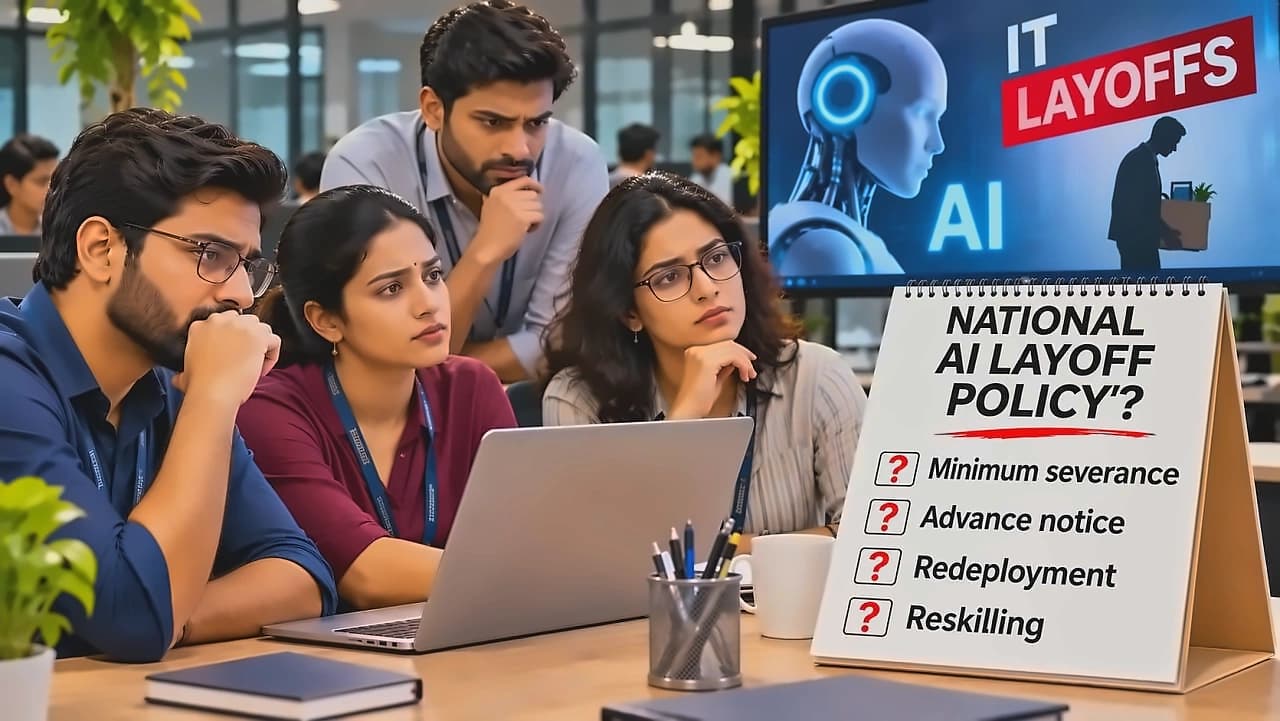
India's IT sector employees are calling for a comprehensive policy framework to address artificial intelligence-driven job losses. According to reports from The Times of India and Business Standard, the Nascent Information Technology Employees Senate (NITES) has approached government authorities with concerns about mass layoffs, forced resignations and unfair employment practices. The proposed framework would require companies to record and disclose the number of positions eliminated because of AI, employees shifted to different roles within the organisation and workers retrained for new jobs. It would also establish minimum expectations for employers to explore internal transfers before making employees redundant, offer fair compensation and help affected workers find alternative employment. Harpreet Singh Saluja, president of NITES, emphasized that companies should be able to adopt new technologies but must also account for the impact on employees' livelihoods, stating that technological progress should not come at the cost of leaving workers without adequate support.
The latest demands from NITES include mandatory disclosure of AI-related job losses, safeguards for affected employees and dialogue between the government and industry. As reported by Business Standard, NITES believes the changing employment landscape now requires a dedicated policy framework to address this emerging challenge. The organization emphasizes that IT companies need to be transparent when laying off people, particularly where such decisions are attributed to AI or automation. Employees and government authorities should know how many people are affected, why their positions are being eliminated and how many jobs are directly being replaced by technology. The forum has also requested that the government engage with Nasscom, IT companies and employee representatives, saying this would help develop a common framework that balances technological innovation and industry growth.
NITES has outlined specific requirements for companies to protect affected employees, including reasonable advance notice, fair severance compensation and payment of all outstanding statutory and contractual dues. According to Business Standard, the organization also urges companies to make efforts to upskill employees and redeploy them before eliminating positions. However, NITES warns that reskilling must be meaningful and outcome-oriented, as merely providing access to online courses or training material cannot be considered adequate support. The proposed framework would establish minimum expectations for employers to explore internal transfers before making employees redundant, offer fair compensation and help affected workers find alternative employment. AI is expected to reshape the traditional growth model of Indian IT companies, with routine tasks in application maintenance being automated, impacting entry-level roles and cutting down the scope of traditional maintenance services.
The potential impact of AI on employment is becoming increasingly relevant in India, where businesses are preparing to expand their use of the technology. According to a joint report by KPMG India and the Confederation of Indian Industry (CII), 93% of Indian business leaders plan to deploy AI agents to expand workforce capabilities, while 59% are already using them to automate workstreams or business processes. The report also found that 74% of Indian CEOs believe workforce readiness for AI will significantly influence business growth over the next three years. As AI takes over routine activities such as information retrieval, preparing first drafts and routine analysis, employees are expected to focus more on decision-making, interpreting information and evaluating AI-generated outputs. Despite traditional services facing pressures, Nasscom reports that lower software development costs are likely to help IT companies unlock a wider customer base, especially small and medium-sized businesses, with customised technology solutions becoming more affordable for companies that earlier could not justify such investments.