The Indian Space Research Organisation (ISRO) successfully accomplished three major qualification tests for the Gaganyaan crew module systems, marking another significant milestone in ensuring astronaut safety ahead of India's first human spaceflight mission. These tests represent crucial steps in validating the safety and operational capabilities of the crew module systems that will carry Indian astronauts into space. The successful completion of these tests demonstrates ISRO's progress in developing the critical systems needed for India's human space mission, bringing the country's first human spaceflight mission closer to actual human space mission. As per ISRO's announcement on July 12, these qualification tests push systems beyond their actual flight limits to ensure they can survive the most challenging conditions.
The first test focused on ensuring an upright position for the crew module after splashdown in the sea, which ISRO identified as one of the most important crew safety requirements. ISRO successfully conducted the Float Inflation Test for the Crew Module Up-righting System (CMUS), ensuring that the capsule carrying the humans back from space automatically returns to an upright position after splashing down into the sea—a vital safety feature for astronauts. The space agency developed and tested a stored cold-gas-based uprighting system, successfully conducting inflation tests for the primary inflation module where stored gas in high-pressure gas bottles was used to inflate floatation by operating control valves. The cold gas-based flotation system met all functional and performance requirements, demonstrating reliable deployment and inflation across the full range of operating conditions. As reported by ISRO, the balloons filled up within the required time and performed across the entire range of bottle pressures the system may encounter.
The second test examined the separation of the umbilical mechanism that serves as a critical electrical and hydro-pneumatic link between the crew module where astronauts live and the service module that provides power and propulsion. ISRO completed the Umbilical Separation Test for the Crew Module – Service Module Connect & Disconnect System (CS-CDS), a key mechanism that ensures electrical, fluid, and communication links between the Crew Module and Service Module during the flight. The Crew Module Service Module Connect Disconnect System (CS-CDS) is one of the major systems that facilitates all electrical communication between CM and SM as well as fluid communication for the Environment Control & Life Support System (ECLSS). The mechanism consists of two parts - CSU-1 located at the crew module side and CSU-2 at the service module side. During the crew module's Earth re-entry stage, the service module first separates from the crew module after CSU-1 disconnects, followed by CSU-2 separation just before re-entry. The test confirmed the clean separation of CSU-2 umbilical, validating the integrated system's functionality and establishing the structural stability of the Crew Module and its interfaces.
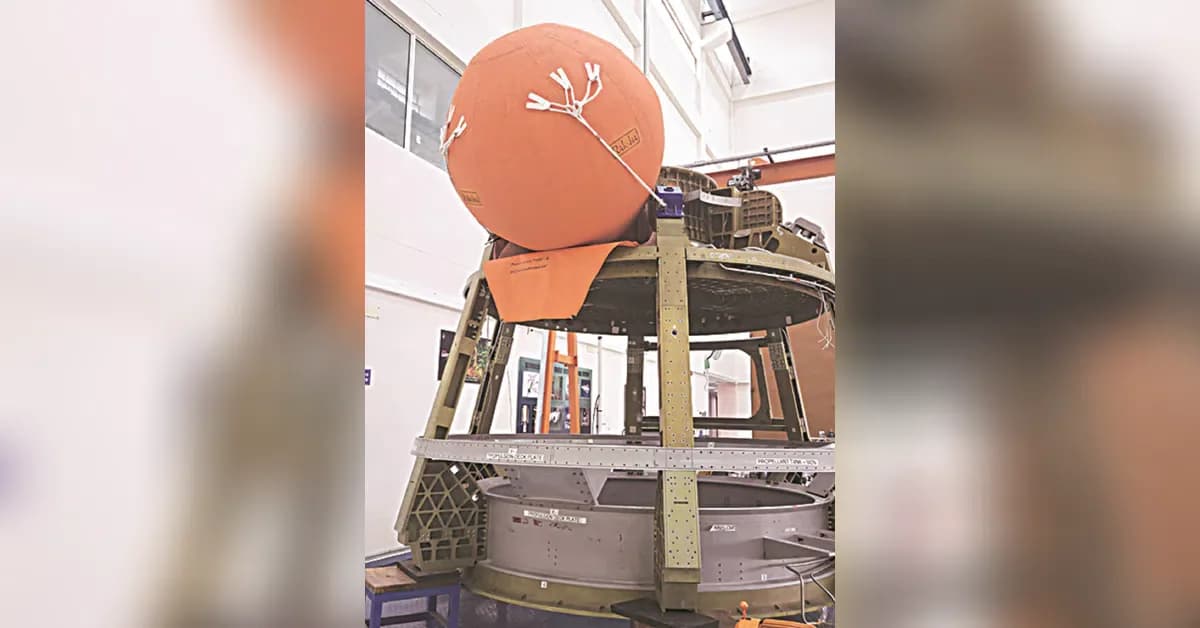
The third test validated the structural integrity of the crew module during the apex cover separation event, which is a critical safety mechanism. The apex cover protects parachutes and associated subsystems during the mission and is separated before parachutes are deployed to decelerate the crew module. ISRO successfully conducted the Crew Module Structural Qualification Test for Apex Cover Separation Loads, subjecting the Crew Module to loads nearly 1.75 times higher than those expected during flight to simulate the critical separation event. The apex cover is the lid at the top of the capsule that shields parachutes tucked underneath, and before parachutes open, the cover is flung off at a predetermined altitude using pyrotechnically actuated thrusters. To prove the structure can handle this violent departure, engineers applied approximately 1.75 times of estimated reaction loads to a simulated crew module on an instrumented test rig. All measured strain and deformations during the tests confirmed the design margins and validated the structural integrity of the crew module for the apex cover separation event in the flight, ensuring safe recovery of the crew module.