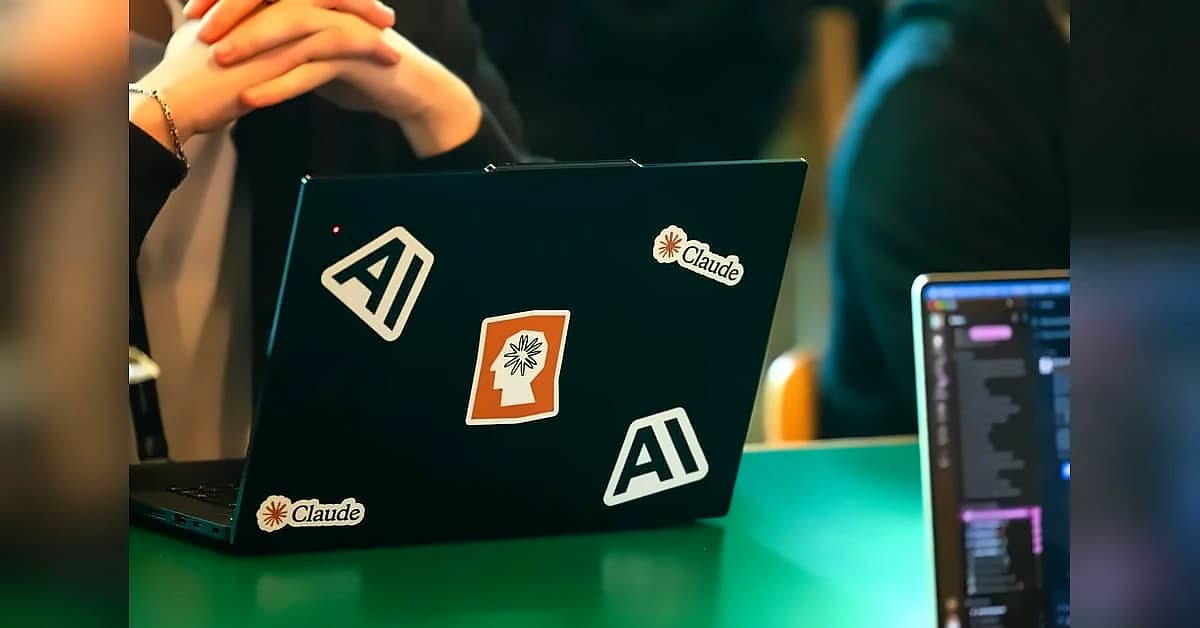
On Tuesday, Anthropic officially launched Claude Science, an AI research workbench designed specifically for scientific researchers. According to the latest reports, the workbench combines databases, coding tools, compute and research workflows in one workspace, helping scientists analyze literature, run analyses, create figures and manuscripts, and trace results back to their source code and environment. Claude Science runs on Anthropic's existing Claude models, which have undergone the company's standard responsible scaling and biosecurity evaluations. The tool is pre-configured with more than 60 scientific databases and can render scientific artifacts such as 3D protein structures, genome browser tracks and chemistry drawings. Several research organizations and companies testing the platform in beta reported significant efficiency gains, with the workbench operating as an app rather than a new AI model, allowing it to run on Anthropic's existing models while the company's most powerful Fable 5 and Mythos 5 models remain restricted under US export rules.
On Monday, Anthropic announced a significant partnership with California state government agencies to provide Claude at a 50% discount for government workers. According to the latest reports, California state workers will use Claude for a wide range of tasks, including analyzing information and drafting documents, to increase efficiency. California Governor Gavin Newsom stated that "AI should not replace the human work of government; it should help our workers move faster, solve problems more effectively, and deliver better results for Californians." The partnership extends beyond Claude Science, with California's California Department of Technology (CDT) planning to offer multiple AI productivity tools through a new shared portal. California State Chief Information Officer Chris Given explained that "CDT is partnering with departments across the state to leverage the state's purchasing power to make it easy to procure new tools, fast and for the best price." California state agencies have already been using Claude prior to this week's deal, with the state previously using Claude to facilitate surveying of Californians' views on AI and developing the AI tool Poppy for state workers.
As part of the launch, Anthropic is also launching its own pre-clinical drug programs, focused on neglected diseases, according to the company's head of life sciences Eric Kauderer-Abrams during a press briefing. "These are areas that are outside the scope of what the traditional pharma and biotech landscape might consider attractive targets, but nonetheless have real burden associated with them," Kauderer-Abrams explained. The launch is part of Anthropic's life sciences and healthcare initiative, which the IPO-bound company has been developing since October 2025. This represents a significant expansion of the company's focus beyond its core chatbot business into laboratory research applications, competing directly with OpenAI's GeneBench-Pro and other specialized AI tools.
On Tuesday, Anthropic launched Claude Science while OpenAI released GeneBench-Pro, representing a significant expansion of the AI rivalry beyond chatbots and coding into laboratory research applications. According to reports, these same-day releases reveal three distinct strategies toward the same scientific research goal. Anthropic is shipping a product for daily laboratory use with broad subscription access, while OpenAI is measuring model reliability through messy data scenarios with enterprise-gated access. Google DeepMind is leveraging owned, proprietary models like AlphaFold and AlphaGenome that other vendors can only call as tools. Anthropic announced a new AI for Science Program to stimulate adoption, supporting up to 50 projects with $30,000 in Claude Science credits each. The releases also come as Chinese models gain ground in AI research, with OpenAI's benchmark results showing that even their best model still fails most GeneBench-Pro tasks.
On Tuesday, Anthropic launched Claude Science as part of its strategic expansion into the scientific research market ahead of its anticipated initial public offering. According to reports, the company filed confidential IPO paperwork with the Securities and Exchange Commission on June 1, positioning itself for a public debut later this year. Anthropic is now competing directly with OpenAI, which filed its IPO paperwork on June 8, though the New York Times reports OpenAI could delay its public market debut until 2027. The company is expanding its AI offerings beyond its core chatbot business, with Anthropic valued at $965 billion compared to OpenAI's $852 billion post-money valuation as of March. This represents a significant shift from the early AI wars, where OpenAI initially held the lead.
Both companies face significant regulatory challenges ahead of their public debuts. Anthropic is navigating a rocky relationship with the Trump administration, with the Pentagon labeling the company a supply chain threat after refusing to allow the Department of Defense to use its AI models for mass surveillance of Americans or fully autonomous weapons. On June 12, Commerce Secretary Howard Lutnick issued an order banning Anthropic from allowing foreign nationals inside and outside the US to use the company's powerful Mythos 5 and Fable 5 AI models due to cybersecurity concerns. However, the administration has since allowed Anthropic to restore access to the models to a select group of cybersecurity and infrastructure providers. Meanwhile, OpenAI faces potential delays in its public market debut until 2027, though both companies continue expanding into multiple markets including financial services, healthcare, design, and cybersecurity to better monetize their AI capabilities. Despite California embracing Anthropic, the AI company has recently had a much frostier response at the federal level, with President Trump claiming the company was run by "Leftwing nut jobs" and ordering all federal agencies to stop using its technology in February.