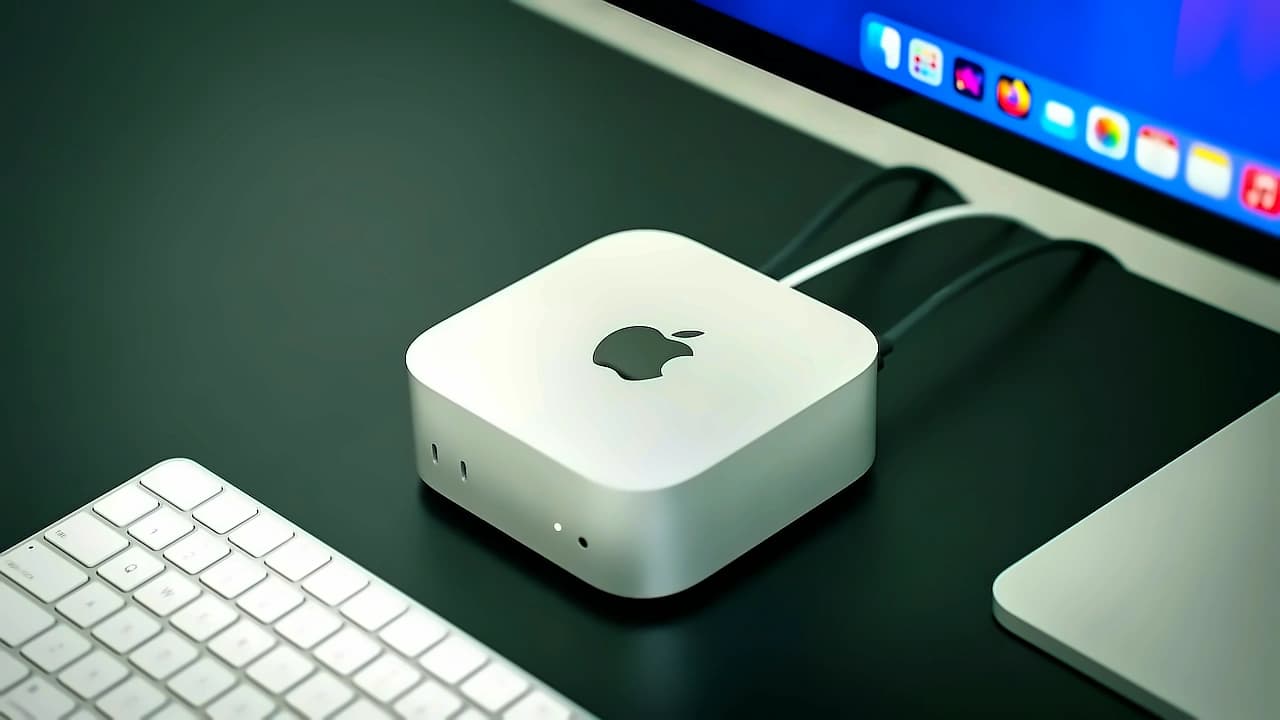
Apple has debuted two new chips for its desktop computers, furthering its efforts to draw enterprise attention to the AI capabilities of its devices. The M6 chip in Apple's new Mac mini and M5 Ultra in Mac Studio deliver advanced compute and power efficiency, according to Apple's Tuesday announcement. The M6 chip features increased unified memory bandwidth, a larger 12-core CPU complex and 12-core GPU with neural accelerators, while the M5 Ultra chip includes larger CPU and GPU cores and 50% more memory bandwidth than its predecessor, the M3 Ultra. As reported by CIO Dive, these enhancements are specifically designed to enable future AI workloads, including agents, in the enterprise. Mac revenue grew 29% year over year, reaching $10.4 billion during the third quarter of 2026, with CEO Tim Cook describing Mac as the "ultimate AI powerhouse" with capabilities including high throughput and on-device inference.
Creative teams at Disney — one of Apple's enterprise customers — are using Mac for on-device AI workflows that reduce token costs, according to Kevan Parekh, senior VP and CFO at Apple. French retail bank Credit Agricole is using on-device AI to streamline regulatory workflows, as reported by CIO Dive. "More companies are choosing Mac for on-device AI advantages, including lower costs, better performance and enhanced privacy and security," Parekh said during the call. The enhanced memory capacity of Apple's latest chips, particularly the M5 Ultra, can enable models with hundreds of billions of parameters to run on a desktop, a level of on-device inference that Nvidia and AMD haven't caught up to yet, according to Brendan Burke, research director of semiconductors at The Futurum Group. Ranjit Atwal, senior director analyst at Gartner, noted that "this is allowing agentic workloads to operate in a way they need to work."
Perplexity has launched Portable Computer, a local AI solution that promises to keep "private data local and escalating to the cloud only when a task needs it." The service runs on the Nvidia DGX Spark with Qwen 3.8 27B or PPLX 27B, a post-trained version of the Qwen model, with a 30B open model coming soon to the model picker. According to Computerworld, the orchestrator, planner, tool router, scheduler, durable task queue, and local search index all run on device, requiring Linux as the underlying OS with Windows support coming soon. The most critical enterprise benefits include data staying local and on-device work not consuming token credits, with customers only charged if explicitly told to move compute to the cloud for advanced research and reasoning. Portable Computer works with Google Drive, Gmail, Slack, and GitHub through app connectors, enabling users to keep confidential details local while escalating to the cloud for current market comps or recent precedent deals.

The on-device generative AI market is projected to reach $94.8 billion by 2035, representing a CAGR of 35.4% from 2026 to 2035, according to latest market analysis. North America dominated the market with a 36.6% share in 2026, representing approximately $2.27 billion. This substantial growth is driven by the increasing adoption of local AI processing, privacy concerns, edge computing, AI PCs, and smartphones. The market expansion reflects on-device generative AI moving from limited demonstrations toward large-scale consumer and developer deployment. Recent BCG research finds that consumer trust in AI is on track to grow by 15 percentage points by 2030, with nearly a third of consumers now using AI at some point in their purchase journey, roughly triple the rate of 18 months ago.
AI is becoming a bigger factor in device buying, with 58 per cent of laptop buyers calling upcoming AI features extremely useful for productivity, according to Amazon's latest Best in Tech Survey. On-device AI assistants emerged as the most sought-after capability at 28 per cent, followed by AI-processing chips at 25 per cent, and AI-powered content creation and editing at 23 per cent. As reported by Amazon, this interest comes as consumers become more familiar with using AI across devices, with 71 per cent of Indian smartphone users using Gen AI features multiple times a week according to a recent CyberMedia Research study. The global addressable device ecosystem is substantial, with Apple reporting its global installed base had exceeded 2.5 billion active devices in January 2026. BCG research reveals that 31% of surveyed consumers use AI at some point in their purchase journey, with 19% being AI loyalists who rely on it regularly when making purchase decisions, and 70% of these users ultimately buy the products it recommends.
Despite the growing AI interest, traditional hardware priorities remain the primary purchase drivers for laptop buyers. According to Amazon's survey, processor performance ranks as the single most important consideration for 87 per cent of buyers, followed by RAM and storage specifications. The findings show that 53 per cent of laptop buyers would choose another brand if it offered better specifications at the same price, while 48 per cent compare two to three brands before making a decision. Mobile AI performance continues to increase rapidly, with Qualcomm's current Snapdragon 8 Elite Gen 5 platform delivering on-device generative AI inference of up to 220 tokens per second. Mobile AI has already reached significant scale, with Samsung reporting Galaxy AI was available across more than 400 million devices worldwide in January 2026.