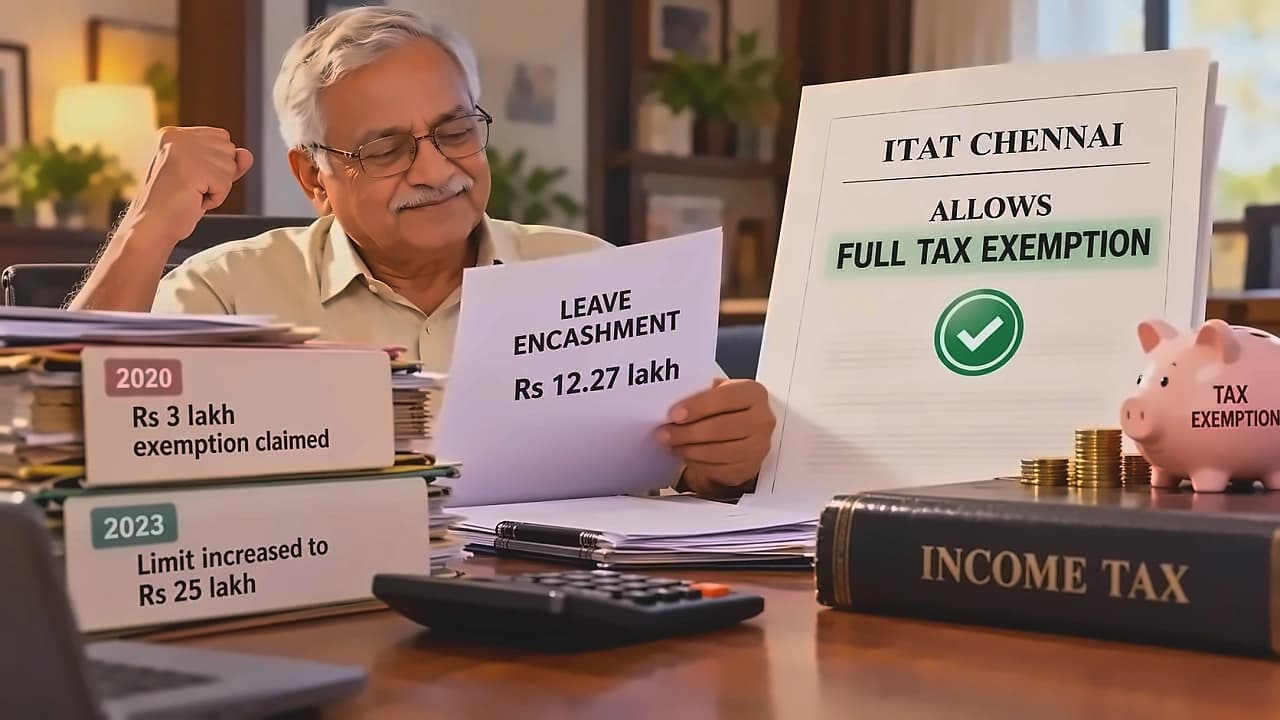
A retired State Bank of India (SBI) employee who received ₹12.27 lakh leave encashment during financial year 2019-20 has been granted full tax exemption by the Income Tax Appellate Tribunal (ITAT), Delhi. According to reports from The Times of India, the taxpayer filed his income tax return for assessment year 2020-21 on September 10, 2020, claiming ₹3 lakh exemption under Section 10(10AA)(ii) of the Income Tax Act. After claiming this exemption, he declared a total income of ₹24.36 lakh. The case involved a key question about whether higher leave-encashment exemption limits introduced in 2023 could benefit employees who retired before that change, particularly when their tax proceedings were still being pursued.
The case gained significance when the Central Board of Direct Taxes (CBDT) issued Notification No. 31/2023 dated May 24, 2023, which increased the exemption limit for non-government employees from ₹3 lakh to ₹25 lakh. As reported by The Times of India, the notification stated it would come into force from April 1, 2023, while its Explanatory Memorandum records that no person would be adversely affected by giving retrospective effect to the notification. The taxpayer subsequently sought the benefit of the higher exemption against his earlier claim, since he had received only ₹12.27 lakh leave encashment and sought exemption for the entire amount rather than the ₹3 lakh he had originally claimed.
The ITAT Delhi ruled in favour of the retired SBI employee, holding that the enhanced limit could benefit employees who had retired before April 1, 2023. According to reports from The Times of India, the Tribunal noted that the notification did not create a new exemption or introduce a new class of eligible taxpayers, but rather enhanced the monetary ceiling of an exemption already available to non-government employees under Section 10(10AA)(ii). The bench relied on its own recent decision in Ram Charan Gupta, Jaipur v. ITO dated June 27, 2023, which had rejected the Revenue's identical stand. In that case, the tribunal had pointed to the Delhi High Court's observation in Kamal Kumar Kalia v. Union of India that the grievances regarding exemption limits under Clause (ii) of Section 10(10AA) not being raised since 1998 appeared to be justified, noting that the last drawn salaries have increased manifold since the notification was last issued in 1998.
The ITAT's decision was supported by judicial consistency from various ITAT benches, as reported by The Times of India. The Delhi bench referred to earlier decisions which had similarly allowed the enhanced ₹25 lakh limit in cases involving earlier retirement years. The tribunal noted that the decisive development was that the CBDT had revised the limit of its own accord, with the revised limit now standing at ₹25 lakh. Amit Ganatra, Executive Director at Khaitan & Co, explained that ITAT viewed the enhancement as a measure intended to update and rationalise an existing provision and to mitigate hardship from the continued application of an outdated monetary limit. The bench also considered it inequitable to deny the benefit of the enhanced ceiling to employees merely because their retirement preceded the notification date.
For taxpayers, the ruling is particularly relevant to non-government employees who retired before April 1, 2023, and whose exemption for leave encashment was restricted to ₹3 lakh. According to Ganatra, the decision provides judicial support for the position that the enhanced exemption limit of ₹25 lakh may also be available in respect of such earlier years. The practical takeaway from this case is that the old ₹3 lakh ceiling is no longer the wall it once was for non-government retirees. However, he cautioned that the issue is not free from judicial divergence, as the Patna High Court in Purnendu Shekhar Sinha v. Union of India held that the classification between government and non-government employees was not discriminatory and proceeded on the basis that April 1, 2023 is the operative date for the enhanced exemption limit.