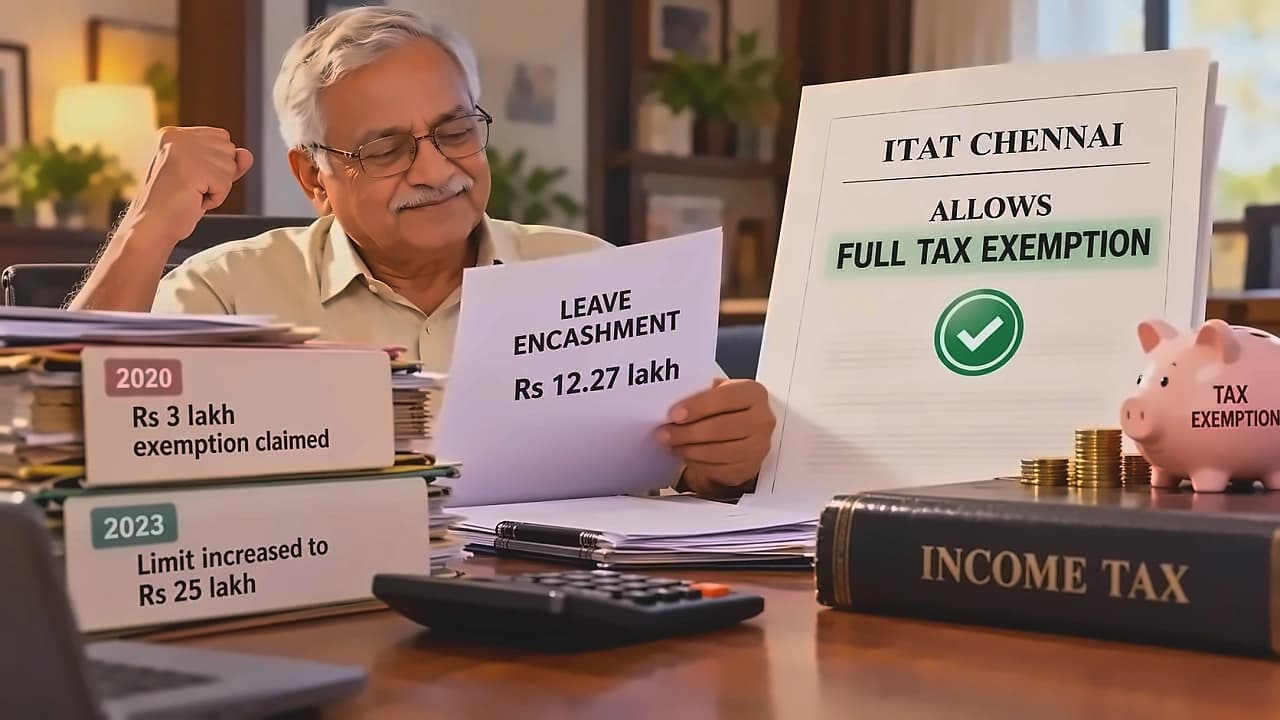
The Chennai bench of the Income Tax Appellate Tribunal (ITAT) has granted complete tax relief to a former Bharat Sanchar Nigam Limited (BSNL) employee who opted for the company's VRS-2019 Scheme. According to reports from Mint, the woman employee had initially paid tax on her ex gratia compensation after claiming only the ₹5 lakh deduction available under Section 10(10C) for Assessment Years 2020-21 and 2021-22. After discovering favorable judicial precedents, she challenged the earlier tax treatment and successfully sought full exemption. Chartered Accountant Suresh Surana explains that Smt Govindarajulu succeeded because ITAT Chennai accepted the argument that the BSNL VRS-2019 compensation was, in substance, retrenchment compensation and not merely compensation under a conventional VRS.
The Chennai ITAT noted that BSNL's VRS-2019 was part of a wider revival package for BSNL and MTNL that was approved by the Union Cabinet on 23 October 2019. As reported by Mint, the ex-gratia payments under the scheme were funded directly through budgetary support provided by the Union government. The tribunal consequently held that the scheme was not simply a conventional voluntary retirement programme but possessed the legal characteristics of a government-approved retrenchment mechanism. On this basis, the compensation qualified for complete exemption under Section 10(10B) of the Income-tax Act. A similar ruling was also made by ITAT Chandigarh in another case between Harish Kumar vs ITO, demonstrating consistent judicial interpretation across different tribunal benches.
Under Section 10(10C) of the Income-tax Act, 1961, employees of public-sector companies, other companies, statutory authorities, local authorities, cooperative societies, universities, IITs, the Central or State governments and specified institutions can claim an exemption of up to ₹5 lakh on amounts received upon voluntary retirement or separation. According to Mint, the ₹5 lakh VRS exemption can generally be claimed only once during an employee's lifetime, with any amount above the permitted exemption being normally taxable as salary income. For both government and private-sector employees, VRS compensation generally receives exemption under Section 10(10C), provided the prescribed conditions are met. However, where the payment is characterised not as voluntary retirement compensation but as retrenchment compensation, exemption may instead be available under Section 10(10B), which provides exemption in respect of retrenchment compensation received under the Industrial Disputes Act, 1947, or any other law.

Tax experts noted that the former employee succeeded because the Chennai ITAT accepted that the compensation paid under BSNL VRS-2019 was, in substance, retrenchment compensation rather than ordinary VRS compensation. As reported by Mint, they cautioned that the ruling does not mean compensation received under every VRS scheme will automatically become tax-free. The central government notified ₹5 lakh as the monetary ceiling for retrenchments occurring on or after 1 January 1997, through Notification No. 10969 dated June 25, 1999. Chartered Accountant Suresh Surana emphasizes that the ruling should not be interpreted to mean that every compensation received by employees under any such Scheme is automatically exempt from tax, highlighting the importance of case-specific analysis based on the specific circumstances of each VRS scheme.
Under the Income-tax Act, 2025, the corresponding benefit is available as a deduction under Section 19(1), Table, Sl. No. 10. According to Mint, the deduction is limited to the lowest of the compensation received, the amount calculated under Section 25F(b) of the Industrial Disputes Act, 1947, and the amount notified by the central government, which cannot be below ₹50,000. Under Section 10(10B) of the Income-tax Act 1961, the exemption is available up to the least of the following amounts: the amount of compensation calculated in accordance with Section 25F(b) of the Industrial Disputes Act, 1947, ₹5,00,000 (the amount notified by the Central Government), or the actual retrenchment compensation received. The key test for determining VRS classification is whether the employee has voluntarily opted to separate from service under a scheme formulated by the employer, with retrenchment typically involving employer-driven termination for reasons including redundancy, restructuring or reduction in workforce.