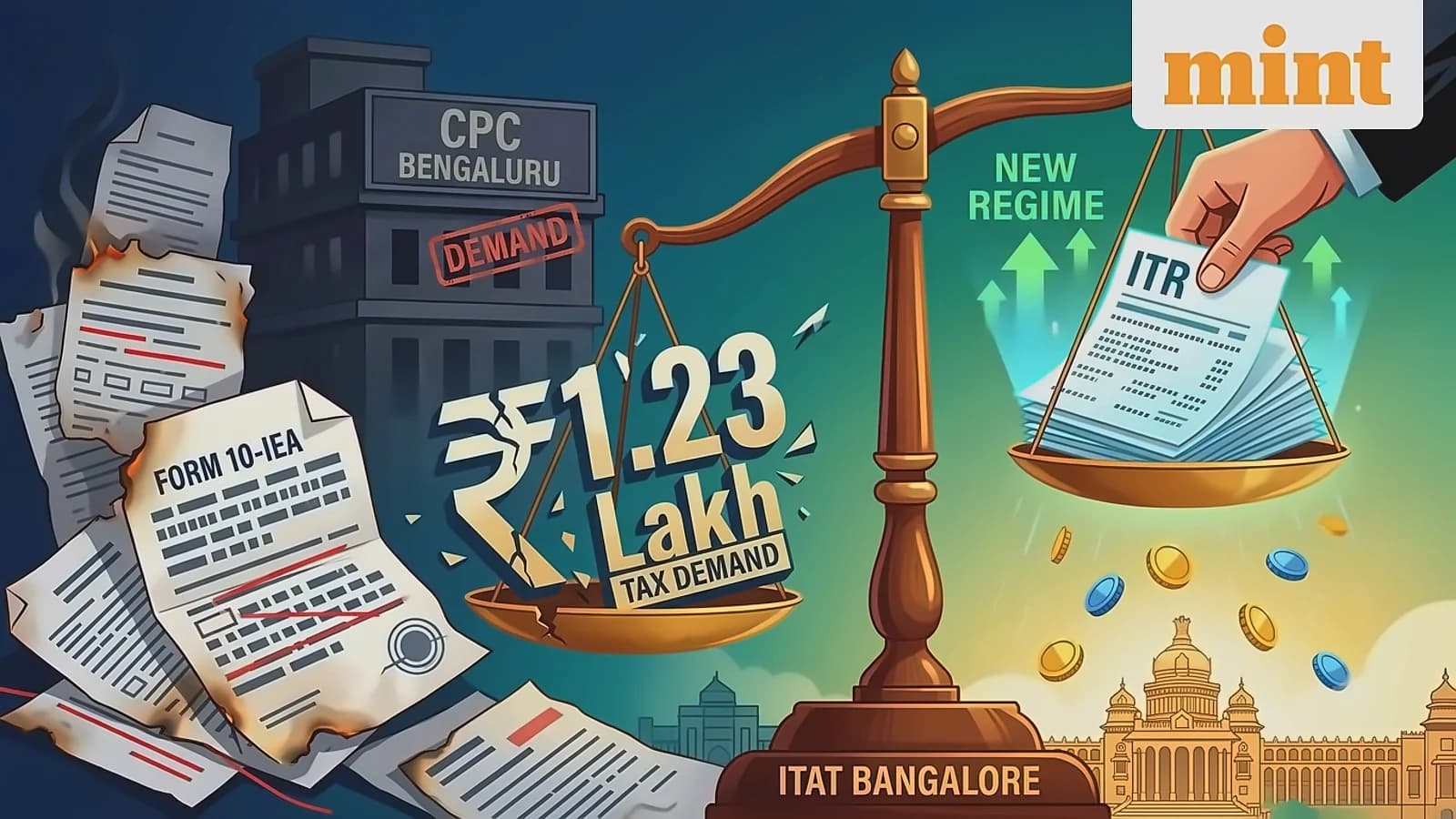
The Income Tax Appellate Tribunal (ITAT) Chandigarh has cancelled a ₹26.69 lakh tax demand after a small trader's commission income was counted twice due to an ITR form filing error. According to reports from Moneycontrol and Mint, the case involved commission earned from the sale of mobile recharges and SIM cards for assessment year 2017-18. The trader had filed ITR-4 instead of ITR-3 for business income, resulting in a procedural discrepancy that led to the tax department treating commission receipts as fresh income. Chartered Accountant Divya Bhanushali explains that the key issue was the tax department treated the gross figure as additional income instead of checking whether it had already been accounted for in the business income declared in the return.
During processing under Section 143(1) of the Income Tax Act, 1961, the Centralised Processing Centre (CPC) relied entirely on Form 26AS, which showed gross commission receipts of ₹26,69,319 as reported by telecom operators after calculating and deducting tax under Section 194H. As reported by Moneycontrol and Mint, the taxpayer maintained that these receipts were already included in his declared business income details, resulting in the same income being taxed twice. The taxpayer's Section 154 rectification application was also rejected, followed by dismissal of his appeal before the Commissioner of Income Tax (Appeals). The appellate authority noted that ITR-3 should have been filed and that the taxpayer had not produced a revised return establishing his claim before the CIT(A). However, there was no specific finding that the ₹26.69 lakh appearing in Form 26AS represented income earned in addition to the business income that had already been declared by the taxpayer.

The ITAT Chandigarh held that filing the wrong or incorrect ITR form could not, by itself, establish that the income was undisclosed. According to Mint, the Tribunal emphasized that this distinguishes the case from fresh deductions restricted by the Supreme Court's Goetze (India) Ltd. v. CIT ruling. The Bench correctly separated a procedural error from the substantive question of whether income had actually been disclosed. The taxpayer had produced the corrected return and supporting documents demonstrating that commission receipts were clearly embedded in original income declared. The Tribunal deleted the entire ₹26,69,319 addition after reviewing the facts of the case, setting aside the CIT(A)'s order. As reported by Mint, the ruling reinforces an important tax principle: a procedural mistake in filing the appropriate return form cannot, by itself, justify taxing income twice when the taxpayer can establish that the receipts were already included in the income originally offered to tax.
As reported by Moneycontrol and Mint, this ruling presents several important lessons for taxpayers regarding improved tax compliance. Chartered Accountant Divya Bhanushali emphasizes that taxpayers cannot use incorrect ITR forms or treat tax returns hurriedly, and highlights the significance of carefully checking and reconciling Form 26AS/AIS receipts with income reported in returns. The decision establishes that procedural mistakes should not automatically turn already-taxed income into taxable income again, provided documentary evidence supports the truth. The ruling is fact-specific and not a nationwide binding precedent, with the fundamental lesson being that filing errors should not automatically result in additional tax liability. Taxpayers should maintain a reconciliation between gross receipts appearing in Form 26AS/AIS and the income actually offered to tax, and respond promptly to Section 143(1) adjustments rather than assuming they are automatically correct.